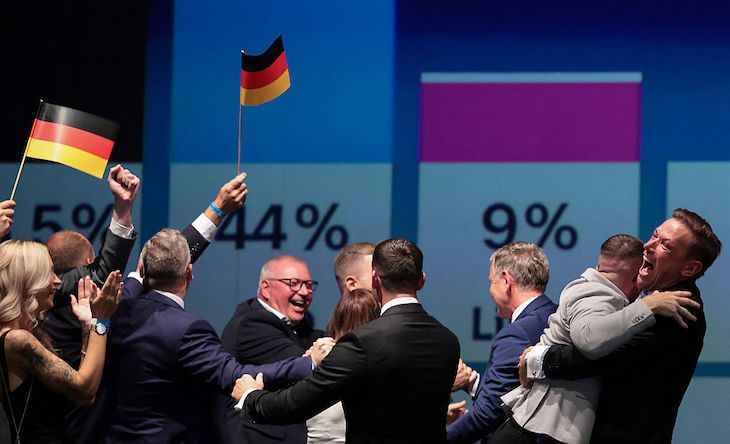
The Alternative for Germany (AfD) is on the verge of leading a state government for the first time in history. According to the preliminary results announced on Monday morning, the AfD achieved 43.8 percent in the state election of Saxony-Anhalt, more than doubling their voter share compared to the previous election in the state in 2021.
The AfD achieved 43.8 percent in the state election of Saxony-Anhalt, more than doubling their voter share
Meanwhile, the Christian Democratic Union (CDU), the party of chancellor Friedrich Merz, lost 20 percent and fell to 17.2. The election result from Sunday is not only damaging to the CDU, but to all historically established parties in Germany. They might not be able to prevent the AfD from governing for the first time.
In recent years, the CDU and other parties were usually able to form state governments in some fashion amid the growing success of the AfD, particularly in Germany‘s east. But in Saxony-Anhalt, a state in the former GDR territory with a large rural population, the AfD and it’s frontrunner Ulrich Siegmund created such a hype in the lead-up to the election, that no one was able to stop them.
The AfD won the most votes of all parties in every age group. It had its lowest number among the over-70-year-olds, with 31 percent, but scored 53 percent among 35-to 44-year-olds and 45-to 59-year-olds respectively. Voter turnout was at a record high of 77.8 percent.
Siegmund ran a smart campaign where he presented himself as a man of the people. He was often seen riding an old Simson moped which has been popular in eastern Germany since GDR times.
Siegmund didn’t necessarily say how his party would specifically solve the problems Saxony-Anhalt faces in terms of infrastructure, industrial transformation and education. Instead, he ran on a tough immigration crackdown which remains the one policy area where the AfD can attract a growing number of votes.
In doing so, Siegmund was able to evoke the emotions of the electorate. Meanwhile, the established parties attempted to explain why no one should support the AfD, pointing out the party’s murky ties.
It didn’t make a difference, not least because AfD voters in the east of Germany view the party as being positioned in the center of the political landscape, regardless of any connections to right-wing extremists.
As for the coming weeks, Siegmund has the clear intention of forming a government in Magdeburg, the state capital of Saxony-Anhalt. His party missed an outright majority, winning 39 of 83 seats and needs to find a coalition partner. Sahra Wagenknecht’s BSW barely made the five-percent threshold but could end up hoisting the AfD into office. BSW’s lead candidate Claudia Wittig repeatedly stated during campaigning that her party would be open to coalition talks.
The BSW was formed when Wagenknecht split from the Left (Die Linke) but has transformed itself ever since. The party continues to run on left-ish economic policies but is socially conservative. And it is the one party that seemingly has no issue speaking to the AfD, even as the other parties hold on to the now famous “fire wall” (Brandmauer) which forbids any partnerships with the AfD.
While Siegmund is fully convinced he can lead the government in Magdeburg, AfD groups in other federal states aren’t necessarily jubilant about the idea that the AfD could finally take governmental responsibility. The fear is that the party doesn’t have enough experts to run an administration successfully. The AfD is still growing as an organization in the slipstream of a handful of charismatic leadership figures.
It is increasingly likely that the party will win another state election in two weeks, as it is currently leading the polls in Mecklenburg-Western Pomerania, with a comfortable gap over the second-placed Social Democrats (SPD).
Whether Siegmund will end up leading the government and bring the AfD into power for the first time or not, Sunday’s election was historic and has shaken the foundations of German politics.






Comments