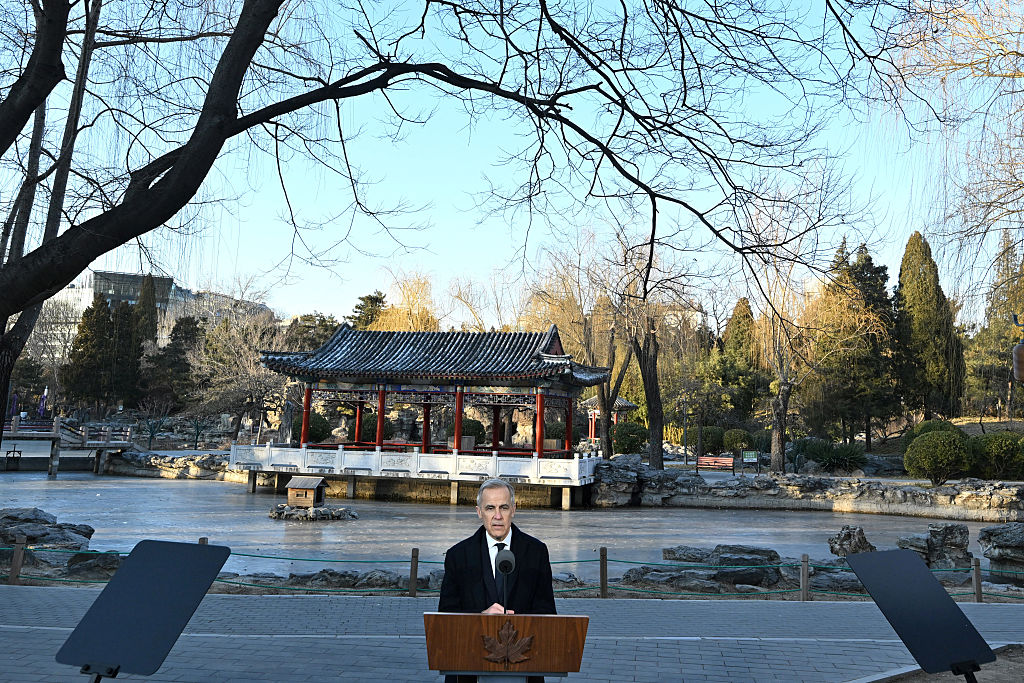


As Can Force One moved toward Chinese airspace, the delegation’s electronic devices were powered down and secured in signal-blocking bags. Burner phones were passed out: the only machines the public servants, staff and journalists would be allowed to use for the duration of their stay. The Canadian Prime Minister’s security team was taking no risks.
But Mark Carney himself was on his way to do something many back home would consider very risky indeed: signing agreements with Chinese President Xi Jinping on trade, global governance, energy, media access and law enforcement. The country Carney had called, only one year ago, Canada’s “biggest security threat,” was about to accomplish a magical transformation from frog to prince, from interfering foreign power to “strategic partner” in the “new world order.”
Faced with fears of a recession, stagnant GDP and a struggling jobs market, Carney is trying to address the impacts of America’s trade war with Canada by pursuing a policy of diversification. And while Canadian industry leaders and geopolitical experts support diversifying with trading partners such as India, Japan and South Korea, it is widely feared that a rapprochement with China puts Canada in a position of vulnerability.
If Canada starts relying on China accepting its canola, the CCP will be able to twist Canada’s arm
It was all smiles, balloons and cotton candy in Beijing, where Liberals enthused about Carney’s deal to accept 49,000 Chinese electric vehicles into Canada in exchange for China lifting tariffs on canola. But one journalist covering the trip was brave enough to point out to Liberal cabinet member Mélanie Joly that he was using a burner phone “because China spies on journalists and businessmen.” If that’s how things are, he asked, was China really the right kind of partner for Canadian industry?
“Listen,” Joly said. “We’ve been clear-eyed. We are eyes wide open. We know this. But there have been investments by Canadian companies for years here.”
On the same trip, a memorandum of understanding between the Royal Canadian Mounted Police and China’s Ministry of Public Security was signed, agreeing to cooperate on corruption and transnational crimes such as drug trafficking. But the Ministry of Public Security has for years sought to control and intimidate members of the Chinese diaspora in Canada. Only last year, it offered a million-dollar bounty for the arrest of a Canadian federal candidate, Joe Tay, harassing him until, afraid to leave his house, he abandoned his campaign. Given this abuse, cooperation that would grant Chinese police access to information about Canadian residents should be completely ruled out. But is it? Nobody knows; the text of the memorandum has been kept secret. Shouldn’t Canadians be told, considering what’s at stake?
Collaboration with another country’s law enforcement presumes a certain amount of common ground on law, ethics and human rights. This does not exist with China. Law enforcement in China exists not to protect public safety, but to protect the stability of the regime. Such cooperation would also presume the Chinese government wishes to put a stop to transnational crime such as fentanyl trafficking. Garry Clement, who has spent five decades in law enforcement, intelligence and financial crime investigation, testified before the Canadian parliament that, far from wanting to end the fentanyl crisis, the Chinese government was, in his opinion, at its root. He went so far as to call the People’s Republic of China the largest transnational organized crime group he has ever seen.
Clement says cooperation with the PRC is never apolitical. Michael Kovrig, one of the “Two Michaels” taken hostage by China at the time of the Huawei crisis in 2018, and incarcerated for more than 1,000 days, agrees. Kovrig was, at the time of his arrest, a Canadian diplomat in China, working for the International Crisis Group. His arrest violated multiple international agreements signed by the Chinese government.
Kovrig, who was released in 2021 after Canada finally allowed detained Huawei chief financial officer Meng Wanzhou to return to China, is concerned about Carney’s deal with Beijing. He believes China intends to use Canada as a dumping ground for its excess production, which could spell the end of Canada’s manufacturing sector. Canada cannot compete with Chinese manufacturers because Canadian companies have to pay their workers more, aren’t heavily subsidized by government and are required to adhere to quality standards Chinese companies are not. Also, China isn’t interested in buying more costly products manufactured in Canada.
A country without manufacturing power lacks the ability to defend itself, to make and repair infrastructure and to be self-reliant at times of crisis. A country that cannot produce its own food is at the mercy of the nations who supply it. The canola deal that Carney has struck with China will certainly make it easier for farmers to sell their crops – but if Canada begins to rely on China accepting their canola, the CCP will be able to twist Canada’s arm into decisions and attitudes favorable to China. Will Canada dare to condemn China if it decides to attack Taiwan? Will Canada be pressured into silence if China commits human rights abuses?
If there were to be conditions under which trade with China were possible, they would include a government in a position of strength, capable of wielding China’s desire for status and influence as a bargaining chip, a government able to protect Canada from foreign interference. Most of all, they would include a government with the moral courage to counter the inhumanity of communism with the principles of justice, freedom and charity affirmed in Canada’s Christian heritage and its roots in European civilization.
Carney claims to be a devout Catholic, but his government is about to pass Bill C-9, legislation that seeks to criminalize passages of the Bible – the word of God – as hate speech. What is more fundamental to western civilization than the Bible? And what could signal weakness more clearly to enemies of western civilization than censoring its foundational text?
At Davos in January, Carney told the middle powers that “if you are not at the table, you are on the menu.” Perhaps Carney should listen to himself. A Canada ashamed of its identity, negotiating with a communist one-party authoritarian state from a position of moral weakness, without enforceable safeguards, may find itself in the soup.





Comments