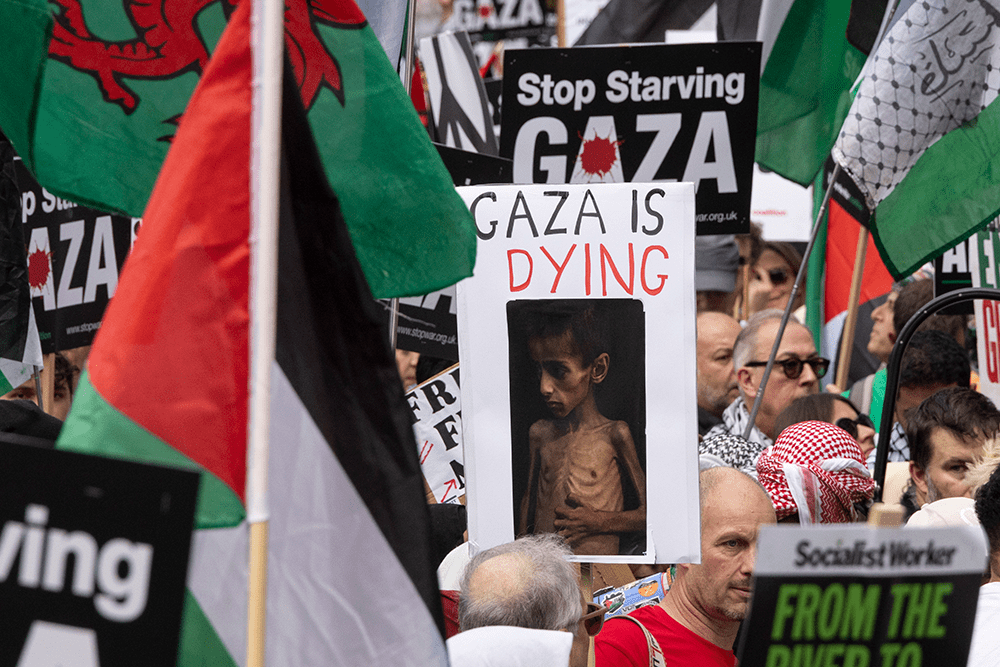
As Tony Blair contested a third election in 2005, the Labour government’s popularity was in tatters. The divisions in the country were running deep, following a United States-led war in the Middle East. The general election, held alongside the locals, saw the emergence of new radical political parties. They seized an opportunity to break the two-party consensus by opposing foreign wars and weaponising an increasingly politicised Muslim vote.
Not much is written today about Respect, but it had some success fighting on an anti-Iraq war platform. George Galloway, the party’s leader, won in Bethnal Green and Bow. Although Respect’s staying power proved limited, what is emerging for next month’s local elections might prove more durable. This time, the left-wing, anti-Labour alliance is built around the Green party and various independent candidates who are cutting deals, forming pacts and encouraging tactical voting, united by the issue of Palestine.
The dominance of this issue has implications for our country’s democracy and broader security. When I was the government’s independent adviser on extremism, those in Whitehall and the security services would warn me that the politics of places such as Pakistan, India and Palestine would shape our operating environment for years to come – not just electorally, but also with the potential to provoke intercommunal violence or terrorism.
The messaging from Muslim influencers is the same: if your priority is Palestine, Labour isn’t for you
The Gorton and Denton by-election was a sign of what to expect with this witch’s brew of pro-Palestinian and Green politics. In the past, Labour had the Muslim vote sewn up but in an article for the website Islam21c, Haitham al-Haddad, an influential and hardline Salafi cleric, encouraged Muslims to vote Green. Labour, he said, had burned through Muslim support over how it ‘armed and enabled the genocide of the people of Gaza’. Haddad acknowledged that ‘we [the Muslim community] may not always feel comfortable with some of the social values’ of the Greens. He concluded, however, that ‘these issues can be overlooked in pursuit of more urgent matters’.
Elsewhere, the messaging from Muslim influencers is the same: if your priority is Palestine, Labour isn’t for you. Take Muhammad Jalal, who hosts a podcast on Muslim issues. Vote for ‘a good quality independent’, he told his followers. Failing that, go Green. ‘They are on point on Gaza, the Iran war [and] Islamophobia,’ he wrote.
There is little doubt that the issue of Gaza will benefit the Greens next month, but it has also presented a fresh opportunity for independents to get elected. In Birmingham, where 69 wards will be holding elections, the Independent Candidate Alliance (ICA) – which describes itself as a ‘grassroots political movement committed to reforming Birmingham’s neglected inner-city areas’ – has cut a deal with Galloway’s Workers Party of Britain (WPB). They have agreed not to stand against each other in order to maximise their prospects for damaging Labour.
The ICA is led by Shakeel Afsar, a property developer, and Akhmed Yakoob, a solicitor fighting money-laundering charges. That they were integral to the campaign to prevent Maccabi Tel Aviv playing Aston Villa last year and have been questioned by the police for their attendance at a protest where an Israeli flag was burned gives an insight into their politics.
Afsar first came to a position of prominence in 2019 as a key figure in protests against the teaching of LGBT-inclusive relationships education at Anderton Park Primary School in Birmingham. He then came second in the 2024 general election in Hall Green.

Yakoob, too, has political ambitions. He ran unsuccessfully for West Midlands Mayor in 2024, where Gaza was integral to his campaign. (A photograph from that period is appropriate for our doomer times: an abandoned, dilapidated factory in the background; a Yakoob billboard reading ‘Lend Gaza Your Vote’ in the foreground.) In the general election he then took 33 per cent of the vote in Shabana Mahmood’s Birmingham Ladywood constituency, finishing second. The ICA’s dislike of Labour is clear. ‘They have done nothing for us, they have used us,’ Afsar told local media. He claims Labour has always been able to take the Muslim vote for granted, relying on clan networks to deliver bloc votes. He wants to break that model.
The ICA/WPB alliance has attracted many candidates dedicated to Palestinian activism. One is Nosheen Khalid, who took to TikTok after the government recognised Palestinian statehood to declare ‘recognition without action is complicity’ and called for an arms embargo and sanctions against Israel. Another candidate is Shahid Butt, who spent the 1990s travelling to different jihadist conflict zones and was one of the Yemen Eight jailed in Yemen for terror offences in 1999. He reportedly also once acted as muscle for Abu Hamza when he ran Finsbury Park mosque. Giving an impression of the alliance’s hardline approach, Afsar told Iranian television: ‘I want us to fund the Palestinians. I want us to give them weapons, guns, grenades, missiles, and allow them to liberate themselves against their occupiers.’
A new campaign group, meanwhile, has been formed to make sure there is no let-up. Vote Palestine wants prospective councillors to focus their attention on holding Israel accountable for ‘genocide’ and encourage voters ‘to not support those who enable or excuse the genocide and ethnic cleansing of Palestinians’. By late February, more than 1,200 councillors had backed this pledge.
Vote Palestine cares less about which party wins and more about whether candidates toe the line. It proudly proclaimed the cross-party support it received, including from some Conservatives, and seems to be attempting to replicate the role played by the Muslim Vote in the 2024 general election, which sought to ensure voters supported only candidates who wanted a ceasefire in Gaza and sanctions imposed on Israel.
This was a tactic that helped ensure Labour bigwigs such as Jonathan Ashworth did not get elected in Leicester South and that Wes Streeting only just squeaked home in Ilford North. Among the Muslim Vote’s supporters was the Muslim Association of Britain (MAB), widely understood to be one of the Muslim Brotherhood’s key affiliates in the UK (which MAB denies).
Muslim Vote has endorsed Vote Palestine’s pledge. So, too, has the Palestine Solidarity Campaign, the UK’s largest pro-Palestinian activist network. There is also support from the Palestinian Forum in Britain, formerly chaired by Zaher Birawi, who was recently sanctioned by the US Treasury for his ties to Hamas (an allegation he denies).
Vote Palestine is backed, unsurprisingly, by Jeremy Corbyn, who implored his followers on X to ‘make Palestine non-negotiable this election’. Corbyn has been turning up in areas where his presence might be helpful. In Gorton and Denton, for instance, he encouraged tactical voting for the Greens; in Newham, he backed the Newham Independents party, the head of which has attended multiple pro-Palestinian protests.
Corbyn is the leader of Your Party, yet his focus is not solely on that venture’s success but on racking up wins on issues that matter to him and fellow progressives. As with Vote Palestine, he does not seem to mind which renegade political party benefits.
All of which supports the hypothesis that in sections of the country, a party is just a vehicle, abandoned when no longer useful. Fajila Patel, for example, who is standing as an independent in Blackburn, ran as a Conservative in 2022. In this she’s following in the footsteps of her councillor husband, Altaf (known as Tiger), who was elected as a Conservative in 2021 but is now also an independent. They were never, it’s fair to say, traditional Tories. Fajila wears a niqab and in 2024 Tiger tried to get Craig Murray, former ambassador turned Salisbury poisoning conspiracy theorist, elected to parliament. Fajila previously would have worn a blue rosette to signal her political allegiance. Now she campaigns with one that is green, red and black: the colours of Palestine. Once the party has been ditched, only the cause remains.
In sections of the country, a party is just a vehicle, abandoned when no longer useful
A breakdown of traditional party dominance will be celebrated by some but there are bad consequences for our politics. Take your pick of historical precedents for why open sectarianism is not desirable, but Northern Ireland is the one closest to home. Unfortunately, base sectarianism can also be good politics: independents who campaigned mainly about Gaza in the last general election were sometimes rewarded with a seat in parliament or a close second-place.
What’s more, a sectarian form of politics may bring with it an anti-democratic mindset. One source with intimate knowledge of a city represented by an independent MP tells me that at the last general election, in some locations one individual would gather all the family members’ voting slips and fill them out on their behalf. On other occasions, there were multiple people in polling booths. ‘It wasn’t one person, one booth, and it definitely wasn’t private voting,’ the source says.
The experience from Gorton and Denton, where the independent electoral observers Democracy Volunteers said they witnessed 32 instances at 15 polling stations of more than one voter in a booth at any one time, suggests this isn’t a one-off. (Greater Manchester Police investigated this ‘family voting’ and found ‘no evidence of any intent to influence or refrain any person from voting’.)
I hope I’m wrong to worry about the growth of an anti-democratic and extreme form of politics. But the disorder in Leicester in 2022, in which there were violent clashes between Hindus and Muslims, and the nature of the Gaza-infused terror threat after 7 October suggests I might be right. Consecutive governments gambled that stridently promoting British values was the answer and that integration would follow naturally. Increasingly, though, that seems naive.



Comments