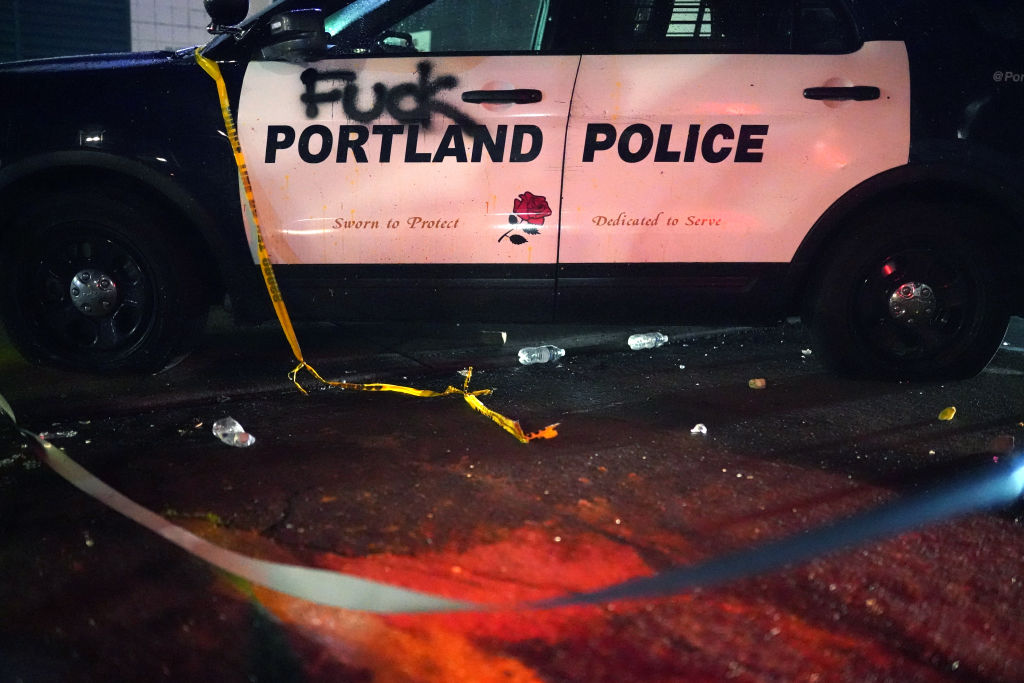
Portland’s downtown area, though not without a certain residual hippy charm, increasingly resembles the Dunkirk of May 1940. Standing on top of the city’s Moda Tower at night is to survey the aftermath of a battle, with legions of homeless residents hunched together around braziers or lying on cots displayed in rows on the sidewalk.
It appears as if the police in Portland can’t be bothered to enforce the few remaining laws involving public drug use or fouling the streets.
But the truth is there simply aren’t enough cops to enforce the laws after the city council became one of the first Democratic strongholds to defund the police in the wake of the George Floyd riots in 2020. Now the results of that ideological experiment are in.
Portland’s much shrunken police bureau currently has a total of 328 patrol officers working across three precincts. Surprisingly few for a city of that size, you may think.
But hold on: of those 328, at any given time an unspecified number are either off duty, on leave, out injured or sick, in court, attending mandatory training sessions, or enjoying their guaranteed one hour of “personal wellness” per shift.
By the city’s own estimation, greater Portland has about 59 patrol officers on call at any moment, which means there’s roughly one active policeman on hand per every 35,000 residents.
Or to put it another way: according to the number crunchers at the National Safety Council, you’re about twice as likely to die from radiation sickness or extreme temperature exposure as you are to randomly encounter a beat police officer on the streets of America’s so-called Rose City.
As a consequence, today people are being assaulted, raped, robbed, injured and killed in Portland in significant part because the law enforcement officers who have been denounced as the genocidal oppressors of those they’re sworn to serve simply aren’t available in enough force to stop the violence.
Take the scene the other Saturday evening in the city’s Tom McCall Park, a 40-acre downtown oasis that runs alongside the banks of the Willamette River. At around 7pm, 911 dispatchers received a call reporting that a long-haired, naked man had been seen loping through the area, which might be thought unusual even by the prevailing standards of a summer weekend in Portland. No one responded.
Roughly quarter of an hour later, another 911 caller reported that the suspect had seized a 7-year-old girl who was out walking with her mother, and tried to run off with her. A passer-by used pepper spray on the would-be kidnapper, at which point he took to the adjacent river, where police in tandem with a hastily convened team of social workers eventually arrived to extract him some forty minutes later.
The Pacific Northwest is often hailed as a sort of social laboratory whose fads and trends ultimately seep out to pervade other parts of the country
It later turned out that the few available police units in the area at the time of the attempted abduction had been tied up on a particularly troublesome domestic violence call elsewhere in town. “We just don’t have the appropriate number of officers to handle the amount of demand for police services,” the Portland PD’s deputy chief Brian Hughes was left to admit.
Back in the heady days of June 2020, Portland’s city council pushed through a budget slashing an annual $15 million from the city’s police bureau. The idea was to reboot attitudes to public safety. “Our community is working hard to change the way we respond to many 911 calls,” the council announced with some pride, before extolling the virtues of a Crisis Assistance Helping Out on the Street (CAHOOTS) program, designed to “dispatch teams of paramedics and trained mental health professionals” to a public emergency. Which, of course, can be, and was, soundbited to “Making our streets safer.”
That’s the thinking, anyway. No one at Portland Mayor Keith Wilson’s office immediately replied when I enquired whether the attempted abduction of a small child by a nude, wild-eyed maniac might have been a situation calling for a more traditional law enforcement response, or for that matter if operatives of the CAHOOTS program should have been scrambled to the scene with greater alacrity.
Six years after the George Floyd riots, most weekends see a display of public passion on the streets of Portland, with a generous quotient of flag-burning – I’ve more than once had to check my screen to confirm that this was Oregon, and not Tehran – in response to the latest perceived shortcoming on the part of some authority figure. It seems a shame none of this outrage is similarly directed towards a matter such as the attempted kidnapping in broad daylight of a child in a downtown park, or to the numerous other instances of assault, rape, and homicide where Portland’s much reduced police force has been unable to intervene in a timely fashion.
The Pacific Northwest is often hailed as a sort of social laboratory whose fads and trends ultimately seep out to pervade other parts of the country. If so, America should beware. Up in Rose City, we’re seeing a society that entertains itself with anti-authority sloganeering and disregards real problems because it lacks the will to tackle them.





Comments