

Two years ago, there was a revolution in Bangladesh. An uprising of students toppled the regime of Sheikh Hasina. Her supporters fled the country; more Bangladeshis sought asylum in Britain in 2024 than any previous year on record. Now, we are getting some good old unintended consequences.
Last week in Chadwell Heath in east London, there were street brawls between Hasina’s people and backers of the revolutionaries who deposed her. Fifty of them whacked each other with traffic cones and tree branches outside a wedding venue. Three people were admitted to hospital.
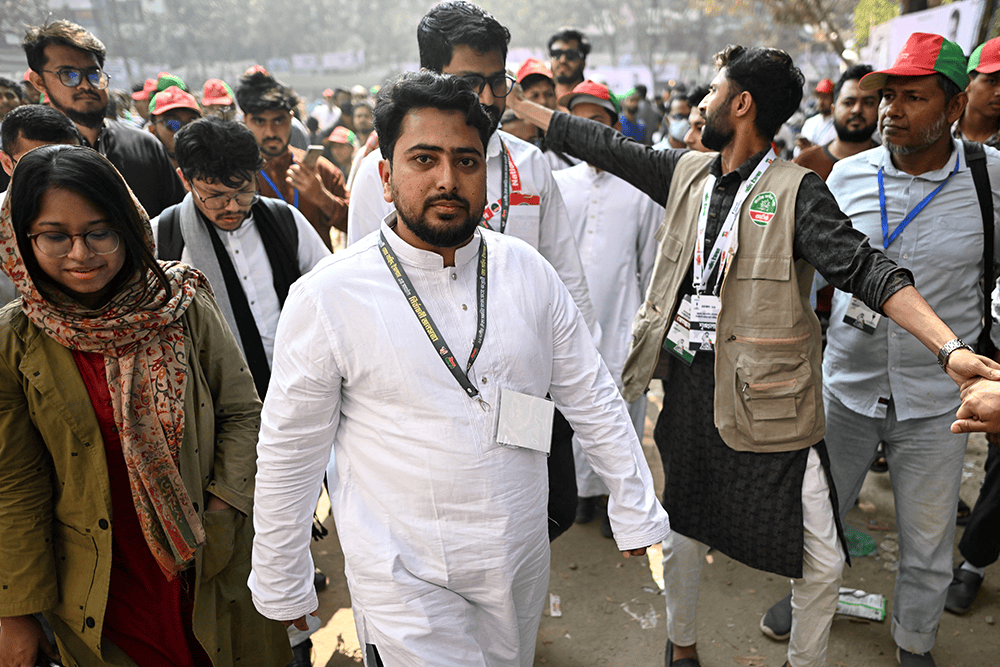
The immediate cause of last week’s trouble was a trip to Britain by Nahid Islam, the leader of the protests which got rid of Sheikh Hasina. He is now an MP in Bangladesh’s parliament. Islam arrived in the UK for a week-long tour on 13 November. During his stay he had to sleep in a safe house in Tower Hamlets. ‘No one knew where Nahid was staying,’ Alauddin Mohammad, one of Islam’s allies who accompanied him to Britain, tells me. Many young, educated Bangladeshis here endorsed the ousting of Hasina. But Islam was concerned about the activities of Hasina loyalists here who still champion her party, the Awami League.

The chief agitator against Islam’s visit was a man called Sushanta Das Gupta. He claims to be a ‘human rights activist’, but he’s close to the leadership of the Awami League’s UK branch. On 14 November, Islam visited Cambridge University at the invitation of the Bangla Society, and that morning, Gupta uploaded an AI-generated poster on Facebook telling his followers – he has more than one million of them – to congregate outside St John’s College and lob eggs at Islam. In the event, Islam remained unegged. But there were scuffles – just enough for Cambridge police to waste a bit of time restoring order.
Two days later Islam travelled to Chadwell Heath. He chose to go there because, well, lots of Bangladeshi people live nearby. Britain has the largest Bangladeshi diaspora in the western world, and half live in London, mainly in the eastern boroughs.
Islam was meeting his supporters at the Mayfair Venue, an indoor spot typically reserved for weddings and amateur boxing nights. Gupta put a video on Facebook telling his followers to meet him outside the Tube station that evening and be ready to ‘resist’ Islam the ‘terrorist’. A black baseball bat leant against the wall behind him.
The Awami League says the new government – which Islam backs – has killed its party’s members. The new government reminds them that Hasina killed around 1,500 of their people during the last croaks of her regime.
Hasina is currently in hiding in India, and despite being sentenced to death in absentia by a Bangladeshi court, she and her closest allies are promising to return to Bangladesh on 16 December. She has instructed a British KC, Steven Powles, to request a passport from the country’s high commission in New Delhi. Some of the exiles in Britain are helping to plot her return. Anwaruzzaman Chowdhury, the former mayor of the Bangladeshi city of Sylhet, who is living in London and is currently joint general secretary of the UK Awami League (and is close to the Labour MP Tulip Siddiq, Hasina’s niece), recently said that 40 planes of Hasina’s followers would storm Dhaka’s airport in the coming weeks. Ten, apparently, would take off from the UK alone.
Many young, educated Bangladeshis in Britain endorsed the ousting of Hasina, but others are her loyalists
Britain has now become the central theatre in Bangladesh’s politics. Ten planes is probably pushing it, but many in the Awami League high command have been spotted in London since the revolution, in addition to Chowdhury. In April last year, four former ministers were pictured attending the wedding of the son of Syed Shazidur Rahman Faruk, the general secretary of the UK Awami League, at the InterContinental hotel at the O2 arena. (How Faruk’s ‘general secretary’ differs from Chowdhury’s ‘joint general secretary’, I do not know.) Three of those ex-ministers were fugitives who have been charged with crimes in Bangladesh. In June last year, two former Awami League MPs who had reportedly claimed asylum in Britain were also pictured in London, this time at a protest, and three months later, two different former Hasina ministers were pictured at a funeral in the capital. Hasina herself tried to claim asylum in London but was rejected. She must have been the only one.
Ahead of Hasina’s attempted return to Bangladesh, the Awami League’s London leadership has been frantically meeting with British politicians to plead that they have been unfairly treated. ‘Last week I saw Oliver Ryan [Burnley MP, Labour], and before that, Lewis Atkinson [Sunderland Central MP, Labour],’ Faruk tells me.
There are photos of Faruk and other UK Awami League leaders meeting Ryan and Mary Creagh, the Labour MP for Coventry East, last week, along with Abu Sayeed Al Mahmood Swapon, Hasina’s former chief whip, who has been charged with corruption in Bangladesh. ‘Every week we are seeing British MPs and Lords and ministers,’ Faruk says. ‘Next week I will see Richard Burgon, the Leeds MP.’

In a way, it’s funny. Bangladesh’s current Prime Minister, Tarique Rahman, who is forcing this current crop of former Awami League politicians to live in exile in London, was himself an exile in the city between 2008 and 2025, before he returned and won this year’s election. Our capital has become a sin bin for Bangladesh’s exiled politicians. During the brawls outside the Mayfair Venue, Sushanta Das Gupta spent most of his time squatting and growling and karate–chopping the air. ‘I WILL FUCK YOU UP BRO!!’ one of his little pals shouted at a huge security guard who pushed him.
But it’s more awful than amusing. Inside a building on a British high street, a foreign visitor told his backers that they’d soon see their political opponent in the gallows. They went outside and were ambushed by a gang of their rivals, loyalists to an old dictator.






Comments