
Two young Canadian pilots were killed in a tragic accident on 22 March. What should have been an occasion for sober reflection, compassion and prayer, has regrettably turned into an undignified dispute about bilingualism.
Captain Antoine Forest, 30, and First Officer Mackenzie Gunther, 24, died when a fire engine crossed the runway in front of them as they landed at LaGuardia Airport in New York City. The nose of the plane took the brunt of the impact and both pilots were killed. Grateful passengers credited the two young men with saving the lives of everyone else on board by doing their utmost to slow the plane down in the last instants before the collision. The occupants of the fire engine were injured but survived.
PM Carney said Rousseau’s language choice displayed a lack of compassion, which seemed a bit extreme – surely Rousseau is more likely to speak from the heart in a language he comprehends?
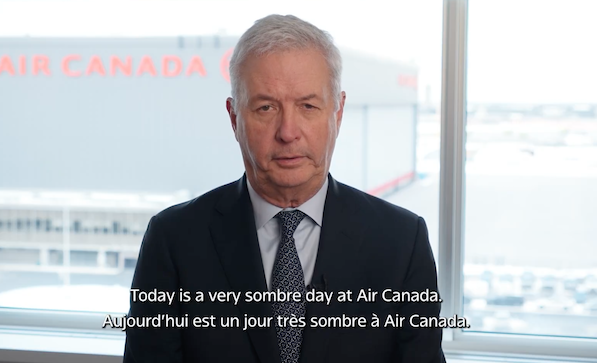
In the aftermath of the crash, Air Canada CEO Michael Rousseau released a video message with an update for those affected and condolences for the families and colleagues of the deceased. The video was captioned in both English and French, but Rousseau, who, despite his last name, has been in hot water before for his lack of proficiency in French, spoke only two French words throughout – ‘bonjour’ and ‘merci.’
Centre-left politicians raised an outcry. Prime Minister Carney said Rousseau’s language choice displayed a lack of compassion, which seemed a bit extreme – surely Rousseau is more likely to speak from the heart in a language he comprehends? The premier of Quebec said Rousseau should resign. The leader of the Bloc-Quebecois said his use of English was disrespectful of the deceased Antoine Forest’s francophone background.
This naturally sounds strange to anyone outside of Canada (and a few inside Canada as well). It is necessary to understand that Air Canada, because it was once a Crown corporation, is subject to the Official Languages Act and therefore required to provide all communications in both French and English. One can sympathise with Rousseau’s wish to deliver such an urgent and sensitive message in a language he understands, while thinking he would have been wise to provide against a backlash.

But it is hard to see how three and a half minutes of English with French subtitles can justify what happened next. Rousseau was summoned to appear before the Official Languages Committee in Ottawa to explain his behaviour, then hauled up before the board of Air Canada. As the nation looked on in disbelief, he was then forced to resign – with the last word going to Carney, who pronounced the end of Rousseau’s career ‘appropriate’.
The world was outraged, including Elon Musk, who doesn’t tweet about Canada very often, but when he does, makes it count. During the 2022 Freedom Convoy, while Mark Carney was drafting op-eds about freezing protestors’ bank accounts, Musk tweeted out ‘Je m’aple syrup’, a creatively bilingual statement appreciated by Francos and Anglos alike.
Musk commented on Air Canada CEO Michael Rousseau’s resignation, saying ‘That’s crazy’. He added, ‘Moreover, it is not reciprocal at all. There are many one-sided laws in Canada that mandate French at the expense of English. Extremely hypocritical and unfair!’
Musk has a point. But a legalistic mindset on this question doesn’t get to the heart of the matter. The coexistence of French and English cultures in Canada is one of the nation’s great cultural riches. But those with an axe to grind find that cultivating resentment on both sides creates opportunity for change.
Charles de Gaulle knew it and needled the sore point with his infamous Vive le Quebec libre! in 1967. A quick scan of Quebec politicians reveals that those keenest to stoke linguistic insecurities – for example, outgoing premier François Legault and his minister Jean-François Roberge, both of whom called for the Air Canada CEO’s resignation – also believe that the essence of Quebec is secularism, an ideology imported in the 1960s. Quebecers don’t even notice their real history and culture being pulled out from under their feet, while language police issue fines to bakeries for posting English TikToks and measure the French lettering on barbershop signs to make sure it’s bigger than the English.
Outside of Quebec, Alberta has long complained about equalisation payments, where taxes collected from richer provinces are redistributed to poorer provinces like Quebec to ‘equalise’ funding of social programmes. And many English speakers across Canada find it unfair that access to top jobs in government and some industries is barred to those who do not speak French.
But resentment is like drinking poison and hoping the other person dies. Perhaps, as the world criticises Canada for focusing on bilingualism when it should be focusing on the victims of a tragedy, it is time for each province to think more profoundly about the historical reasons for Canada’s greatness. Linguistic nagging and blame games won’t revive a dying culture. But art and symbolism that puts people in touch with the historical sources of Canadian strength and virtue, can.
United, Canada’s provinces hold a power against the federal government they never could alone. Divided, they can be leveraged against each other to hold Canadians in servitude to petty laws and pettier bureaucrats.




Comments