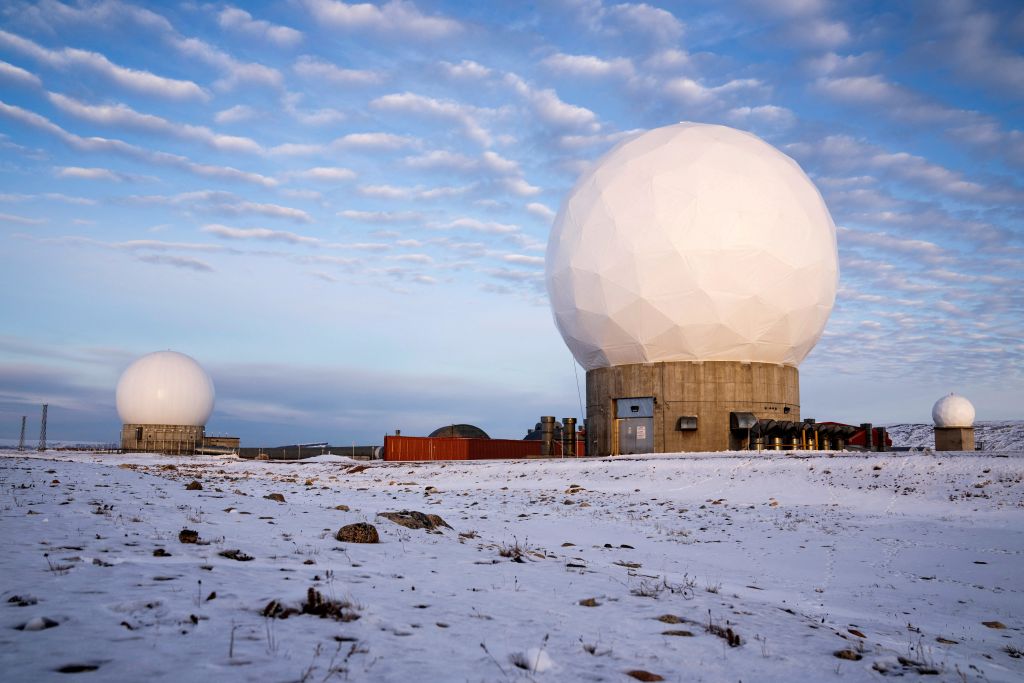
Donald Trump’s desire for Greenland is not just about access to oil, minerals and control of the new strategic and commercial corridors opening in the region. It’s also about data. Specifically, the most important data in the world.
For decades, Pituffik Space Base – formerly Thule – in Greenland has been central to US space defense and Arctic strategy. It’s the US military’s only base above the Arctic Circle and their most northerly deep-water port and airstrip. It’s home to the 12th Space Warning Squadron. Its massive AN/FPS-132 radar has 240 degrees of coverage surveying the Arctic Ocean and Russia’s northern coast, especially the Kola peninsula where it has concentrated its strategic nuclear weapons.
The high north is on the approach route for Russia’s ballistic missiles as they head for the US mainland. When a Russian rocket blasts off, especially if unannounced, Pituffik reacts to data from the Air Force’s Space Based Infrared System, which detects the rocket’s heat signature from its engines during take-off.
It then reconfigures the radar to track it, sending real-time reports to the US Combined Space Operations Center at Vandenburg Air Force Base in California, as well as the Missile Warning Center in Colorado Springs. Every day, Pituffik also tracks hundreds of satellites: Russian, and the increasingly sophisticated orbital manoeuvres of the Chinese.
Donald Trump recently posted on social media that Greenland is “vital for the Golden Dome we are building” – referring to his enormous defense project against space weapons and ballistic weapons.
Pituffik will be at the front line of the Dome and duly upgraded in the next few years. It will provide an outer shield and important extra time and data for ground and space-based interceptors.
In March last year, Vice President J.D. Vance, who two months before hosted the Danish and Greenlandic foreign ministers in Washington, visited Pituffik. Soon after his trip, the commander of the station, Colonel Susannah Meyers, was fired, reportedly for distancing herself from Vance’s criticisms of Denmark’s handling of Greenland’s security.
Pituffik is the world’s most important space base
The base is run by the US, but the Danish flag flies over it. Visitors can see it is functional but run down. At the same time, China and Russia are currently refurbishing old oilfields and infrastructure, radars and sensors in the region. Pituffik used to be assigned to US European Command but was last year reassigned to US Northern Command, an indication that the island is seen as a growing part of homeland defense.
And Pituffik is not the only high-latitude space base that is vital to the US, and indeed the West. Svalbard is a Norwegian island chain 600 miles north of Norway’s most northernmost city Tromsø. It is the world’s most important space base, providing ground services to more satellites than any other facility on Earth. If you control space, you control the Earth, and this time Russia is already there. The US believes that nobody will fight them if they move on Greenland. Europe has said it will be the end of NATO. This is just what Russia wants, and it’s got its eyes on Svalbard.
Polar ground stations are the only places where satellites in certain vital orbits can downlink their data and receive commands on every lap of the Earth. They are important to gather data for science and weather forecasting, and internet traffic generally relies on the satellite infrastructure in Svalbard.
The Svalbard Treaty of 1920 between Norway and Russia gives sovereignty to Norway, but gives Russia rights to settlements there. The treaty bans military fortifications and activities on Svalbard, but satellite data of almost any kind can have dual use: for example, the weather over Ukraine and its internet traffic have military significance. While Svalbard doesn’t work directly with military satellites, other ground stations in northern Norway do, connecting with satellites that do military communications and missile warning.
In its early years such data had to be shipped out on magnetic tape, but since the early 2000s the island has been linked to mainland Norway with an undersea data cable that, along with a second cable, sends valuable data to the continent and provides the internet to the island.
In January 2022, one of the cables was cut. For 11 days the island ran on just one communications line. Some investigators suggest it was accidental, possibly due to a dragging anchor from a fishing boat, but inevitably suspicion turned on Russia. A Russian trawler passed over the cable’s path more than 20 times in the days before the cut. Svalbard has workarounds for such a situation, but it still resulted in delays of several hours which can affect weather predictions. Just last month, Finnish authorities accused Russian ships of severing a cable in the Baltic Sea.
Norway’s sovereignty over the archipelago allows people from other national signatories to live and work as full residents without visas. There are hundreds of Russian citizens among its population of 3,000.
In 2023, some Russian residents staged a military-style parade in two Svalbard settlements. Men in Army green flew in a Mi-8 helicopter after a “navy parade” in the waters off Svalbard the previous year. In 2023, a group led by a prominent Russian bishop erected a 20ft Orthodox cross, with a ribbon supporting the war in Ukraine. The subtle undermining of the treaty is underway. Russian officials have questioned Norway’s sovereignty over the island prompting the Norwegian government to increase its presence on the archipelago.
As it is in Greenland, so it is in the European Arctic. The US Space Force’s Space Development Agency is constructing a satellite ground station on the island of Andøya, alongside an existing Norwegian military installation, to communicate with and control a constellation of satellites carrying out missile tracking and weapons targeting. The US and Norway recently launched Arctic Satellite Broadband Mission to maintain contact with military facilities in the High North.
The scenario concerning analysts is what would happen if Russia made a move on Svalbard, citing a possible Trump military move on Greenland as justification to protect its own national assets. Moscow can clearly portray America’s activities as looking for provocation, while positioning itself as the defender of the Svalbard Treaty. It’s unlikely that Russia would occupy the main settlement, but it could start expanding its loss-making mining colony at Barentsburg and smuggling in equipment.
Russia would also be able to jam and spoof the satellites Svalbard maintains links with, and in so doing disrupt global communications. Given Russia’s stalemate in Ukraine, a move against Svalbard makes much more sense than moving against the Baltic States.
An invasion is not seen as militarily possible, and even without a NATO response the combined Scandinavian forces are impressive. But in many ways Svalbard is a modern-day Thermopylae – a vulnerable pinch point for information. It’s also been called NATO’s Achilles’ Heel.





Comments