Growing up on the border of Pennsylvania and Ohio, I am well acquainted with a good country fair – that uniquely rural convergence of rodeo games, fried food, barnyard smells and arts and crafts. Washington DC too is now relishing the American-ness of state fairs by hosting the Great American State Fair in the weeks leading up to the semi-quincentennial. And the Smithsonian American Art Museum has prepared a temporary exhibition celebrating a quintessential American artist who first debuted her works at state fairs in rural New York.
That gallery is Grandma Moses: A Good Day’s Work, a collection of 88 paintings which will be in DC until July 12, and then heads on tour. It highlights an artist who undeniably shaped our image of the American past – but who never achieved the critical acclaim her commercial success may have anticipated.

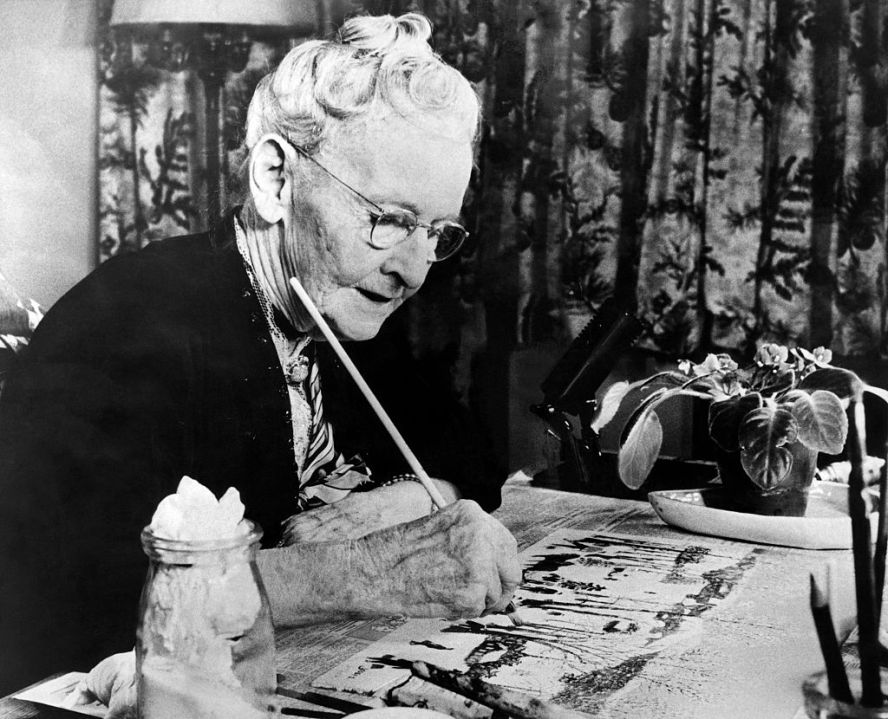
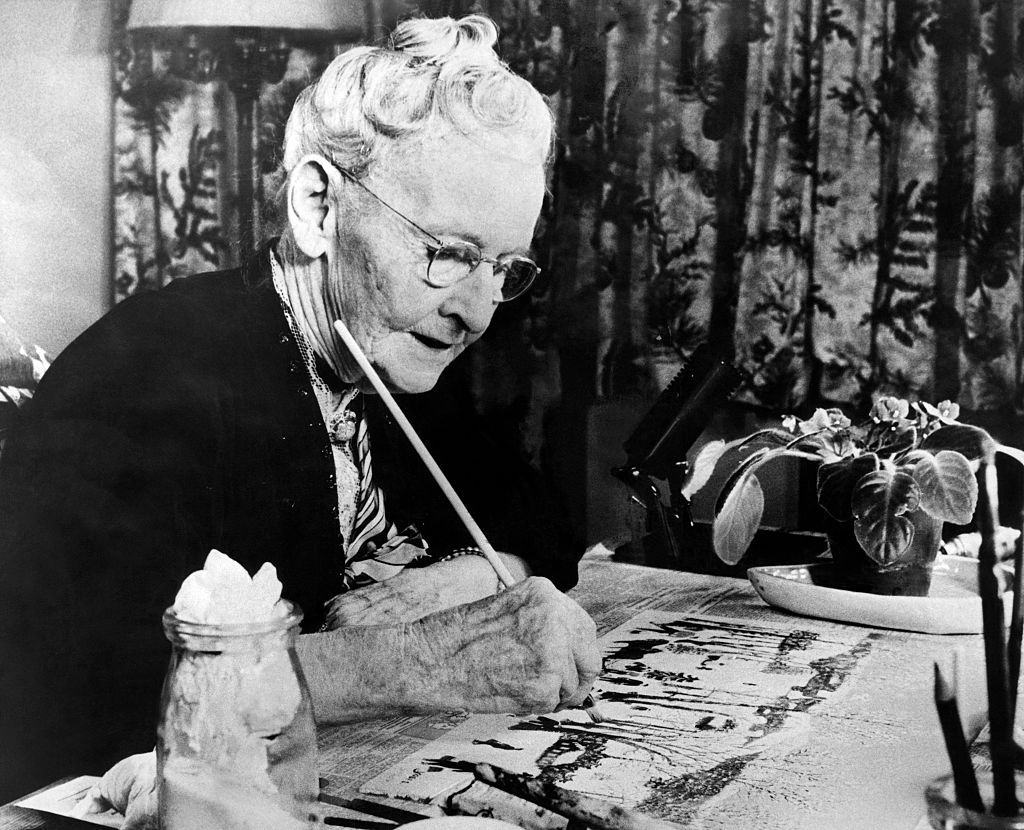
Grandma Moses was an outlier from the outset. She only began painting seriously when she was 78, as the farm work that had shaped her life became more difficult. “If I didn’t start painting, I would have raised chickens,” she joked in her autobiography. She approached painting with a formulaic machinery – how else could she have churned out more than 1,500 paintings in 23 years, right up to her death at 101?
Grandma Moses’s paintings are instantly recognizable because they approach landscapes with a unique disregard for convention. Moses treated a scene like a quilt, with each patch of the canvas holding something different and interesting to her artist’s eye. Each landscape overflows with activity and disregards traditional expectations for perspective. Some paintings (like 1955’s “Halloween”) show interiors and exteriors simultaneously, as if the buildings are dollhouses with the back removed so we can see the inner workings of the farming communities.
That is one of the most lovable elements of Grandma Moses’s works – every corner captures a moment in time; moments that were intimately familiar to a farmer like Grandma Moses, and moments that she deftly communicates to us, even 60 years later, as the way of life she knew has become increasingly bucolic.
At the same time, you can’t focus too much on the humble domesticity of Grandma Moses. She also achieved commercial success during her lifetime that was nearly unrivaled.
Initial attempts to introduce her paintings at local fairs didn’t meet with much success (“I won a prize for my fruit and jam,” she reminisced, “but no pictures”) until she caught the attention of art collector Louis Caldor, who initiated her first solo exhibition.
From there, it was nothing but momentum. Her paintings were on cards, aprons and dishes. Her face was on TIME and Life and Saturday Evening Post. Her 100th birthday in 1960 was announced by New York Governor Nelson Rockefeller to be “Grandma Moses Day.”
By 1949, she was in the eyes of those in the country’s highest office. President Truman presented the painter with an “Achievement in Art” award. President Eisenhower and Vice President Nixon sent notes on her hundredth birthday. When she died, President Kennedy announced that “all Americans mourn her loss.”
It isn’t a coincidence that her commercial success was accompanied by political endorsements. Grandma Moses’s works were deployed across Europe during the Cold War to serve as depictions of American values. One Foreign Service officer described the gallery as promoting “the core of our national character which we are endeavoring to articulate in opposition to the efforts of the communists.” Grandma Moses’s vision of rural American life was the perfect diplomat to persuade a watching world that America was still rooted in good old tradition and community, rather than morphing into a greedy crony of capitalism.
She was widowed for thirty-four years, and five of her children didn’t survive past infancy
The irony is perhaps obvious – despite her rural background and themes, Grandma Moses was a success because of the commercialization of her art only possible in a place like capitalist midcentury America. It is therefore easy to read the artist as an over-glorified propagandist.
But Grandma Moses: A Good Day’s Work challenges this reading of Moses. The gallery begins with less popular works from throughout her career that center around natural disasters – fires and storms ravaging countrysides. These include several of Moses’ earliest paintings (including 1939’s “The Burning of Troy”), and one of her largest (1947’s “A Fire in the Woods”).
These tragic, desolate landscapes serve to remind us that Grandma Moses didn’t live in a snow globe. In her hundred years, she was witness to some of America’s most tumultuous moments – from the Civil War to Vietnam, from Frederick Douglass to Martin Luther King, Jr. Her personal life was also staccatoed with tragedy – she was widowed for 34 years, and five of her children didn’t survive past infancy.
With that in mind, her declaration that “I don’t believe in painting ugliness” and would rather her body of work be “always something pleasing and cheerful” no longer reads as ignorant naivete feeding a false narrative of America’s past. Instead, it is a demonstration of hope built on a rural centenarian’s lifetime of hard work and perseverance.
“I look back on my life like a good day’s work,” she wrote in her autobiography. “It was done and I feel satisfied with it.” And I walked away from this exhibition of her works with a better appreciation for the small details of life all around me. The joy that effuses from this gallery shouldn’t feed longing for some idyllic past, but serve as a reminder of the enduring value of living in a community that strives together to overcome adversity.




Comments