This is a book that many of us might like to have on our coffee tables – beautifully produced, not too heavy and full of pictures of pretty ladies, many of them with no clothes on. Its purpose is to show not only how artists have viewed the female body from the Renaissance to the present but also to explain how this body has been used to express both emotion and the attitudes of the day.
Take Hiran Powers’s 1845 marble sculpture of a naked woman in chains, entitled ‘The Greek Slave’. This appeared after Britain had abolished slavery but before the American Civil War had put an end to it in the US. Thanks in part to the statue’s symbolism, beauty and perhaps also to its slight but titillating hint of bondage and thus of female subjection, it touched many nerves. It also accurately reflected the spirit of the age, becoming the most discussed and reproduced work of art at the time.

The first of the 80 artworks shown in these brilliantly coloured pages – red, green, yellow and pink – is everyone’s favourite: Botticelli’s exquisite 1486 ‘Birth of Venus’. The goddess, modestly swathed in her Rapunzel-like hair, her pearly skin enhanced by the alabaster powder applied by the painter, sails serenely to shore to teach us humans some much needed lessons about love.
Almost 400 years later, Alexandre Cabanel’s ‘Birth of Venus’ shows the continuing popularity of the subject. This time the goddess lies supine upon her shell, arms outflung behind her head and surrounded by clouds of adoring cupids. Perhaps the most sensuous version of the goddess of love is Titian’s ‘Venus of Urbino’, gazing at us in languorous invitation. Apropos, Dempsey notes that the ideal woman of the 16th century had no body hair (with numerous books and pamphlets giving tips on how to remove it).
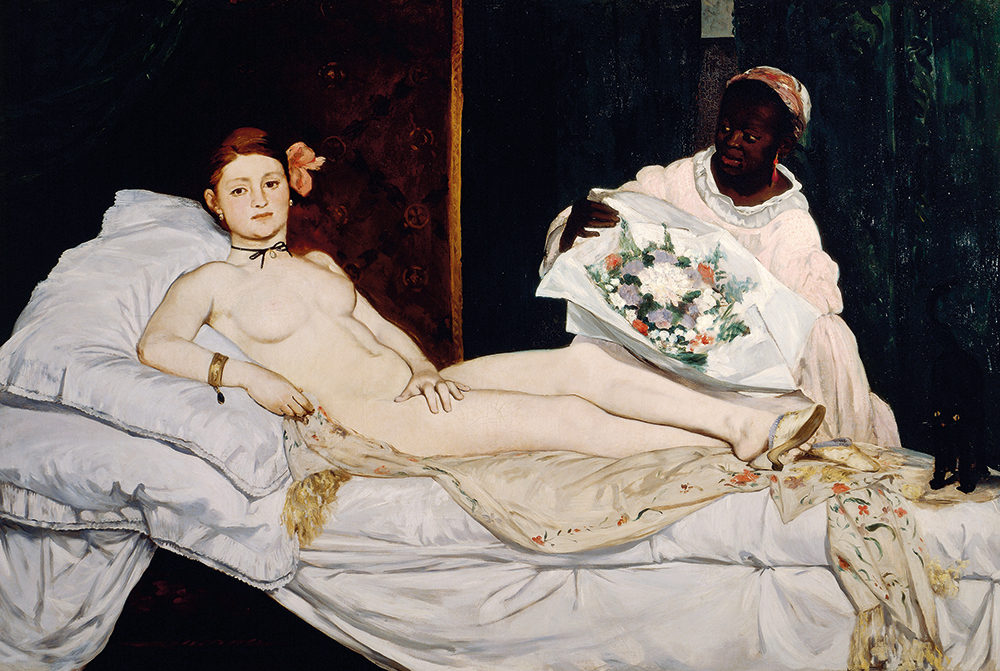
In art, the female body could without offence be naked if it was a representation of classical mythology, such as Rubens’s fleshy ‘Three Graces’; or the ‘Rokeby Venus’, Velazquez’s only surviving nude, seen from the back; or depicting mainly anonymous females in a situation where nudity was natural, such as Ingres’s 1814 ‘La Grande Odalisque’ – not her fault she is in a harem. Manet’s ‘Olympia’, however, caused a scandal when it was first exhibited in 1865 and it is not hard to see why. Unlike the nudity of Venus, sterilised by the fact that she is an allegorical figure, or Ingres’s passive odalisque, Olympia is a fille de joie clearly at the top of her game and ready to take on all comers. As well as the boldness of her gaze, there was the fact that in 19th-century Paris ‘Olympia’ was a common synonym for a prostitute.
Twenty year later, another painting of a woman, this time fully clothed – John Singer Sargent’s ‘Madame X’ – again caused outrage, for the rather ludicrous reason that one of the jewelled shoulder straps of her sumptuous black evening gown was slipping off her shoulder. This hint of undressing, coupled with Virginie Gautreau’s lack of discretion over her love affairs, was enough. Later, Sargent painted the strap back on her shoulder, as it can be seen today in New York’s Metropolitan Museum of Art.
Before the age of the printing press, let alone the mass reproduction of the past century, a portrait was often the only way for its sitter to express his or her wealth, sophistication, status, beauty and innocence, or lack of it. The bejewelled images of Elizabeth I exude royal power; Thomas Gainsborough’s portrait of Georgiana, Duchess of Devonshire (cut down from its original full length to torso only to fit over a mantelpiece), shows the youthful duchess with a cloud of hair, a wary expression and a huge black hat. As a leader of fashion, she found her hairstyles and hats being slavishly copied.
When the art nouveau movement swept Europe in the late 1880s, two of its exponents could not have approached the female body more differently. In Gustav Klimt’s portrait of Adele Bloch-Bauer, the wife of a rich industrialist and the only person he painted twice, she is surrounded by glittering gold tesserae (Klimt had been heavily influenced by the Ravenna mosaics while he was painting her), giving her a justified aura of sophistication and immense wealth. Turn the page and there is the female body in its rawest form: Egon Schiele’s explicit ‘Nude in Black Stockings’ – scrawny and vulnerable, yet pulsating with energy.
As Dempsey points out, our world is flooded with images; we can see art when and where we want. But a few centuries ago paintings were only available to the rich who commissioned them or to church congregations, and thus the effect was both more telling and more powerful.
Just as Dickens’s writing helped bring the terrible social conditions of the poor to attention, so George Watts used his art to show, as Dempsey puts it, ‘the plight of the urban poor and the unfair treatment of Victorian women’. His 1848 painting ‘Found Drowned’ (‘found’ was the word used to avoid the stigma of suicide, which was illegal and would prevent a Christian burial) depicts a pale, thin young woman whom the viewer infers has thrown herself into a river because she found herself alone, starving and pregnant. Here the female body is a comment on the hypocrisy of Victorian society.
To illustrate the past century, photographs are included, many of faces rather than bodies, such as that of the woman that became known as the ‘Face of the Depression’ and Andy Warhol’s head-only print of Marilyn Monroe. Here I have to say that I found the omission of Lucian Freud inexplicable. Nor was I overly keen on the whiff of political correctness – black is always spelt with a capital B and one artist is given the pronouns they/them/theirs. But hey-ho, the pictures are great.



Comments