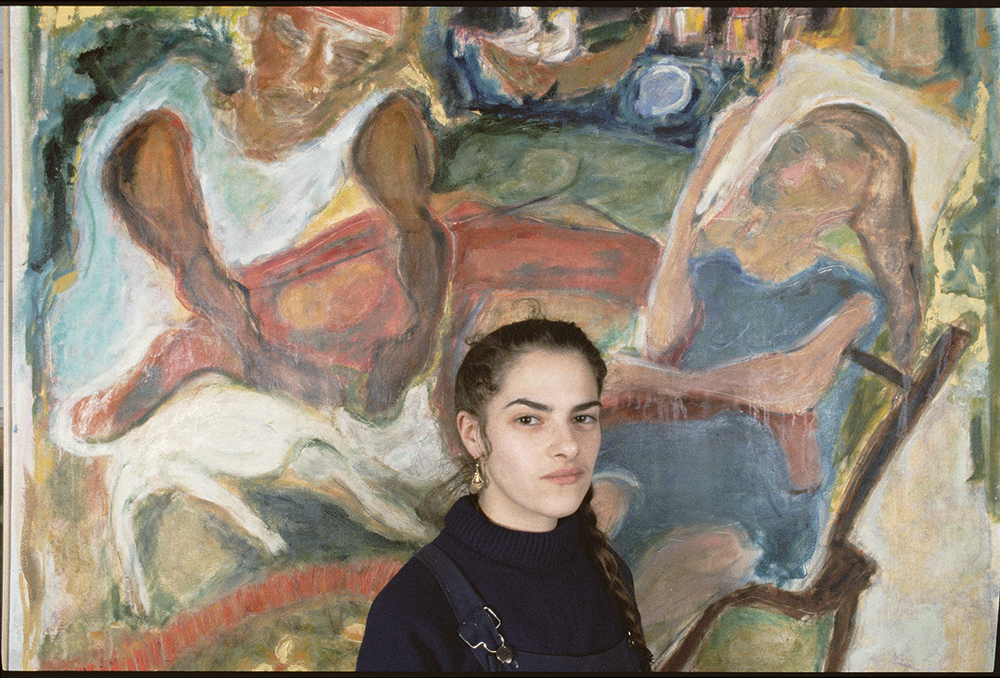
On the eve of a major retrospective at Tate Modern comes this portrait of Tracey Emin as a painter, told largely in her own words. It traces a remarkable trajectory, from gobby Margate teenager to one of the UK’s most respected and celebrated artists, and a Dame of the British Empire. At its heart is a series of conversations with Martin Gayford, a critic with a deep engagement with the nature of painting and insights gleaned from close friendships with 20th-century giants, Lucian Freud and David Hockney among them.
It is a book full of heart – frank and confessional – and presents Emin at the zenith of her powers, having survived near-fatal cancer and found new purpose and conviction. She’s back home in Margate, she’s teaching, ‘reinvesting my knowledge back into art’, and she’s ‘painting like a banshee’, as she puts it.
Gayford claims Emin as a Romantic, one for whom art is a kind of salvation
It is an account full of surprises, too. One senses that Emin’s celebrity obscured the real artist behind the headlines and the seriousness of her aims. Yes, she wasted a lot of time goofing around – she would be the first to admit to that – but behind the enfant terrible with questionable domestic habits (cf. ‘My Bed’) and all the public mayhem was a focused and driven student, passionate about the art of Edvard Munch, Egon Schiele and the German Expressionists, and eager to learn everything she could from them. Though often linked together, she was never a YBA; she studied at Maidstone and the Royal College of Art, not Goldsmiths; she was not part of Damien Hirst’s defining exhibition Freeze in 1988.
Instead, she was learning to draw, the very core of her practice and the starting point for many of her most painterly paintings. She drew Margate and friends and cats and birds and nudes; she learned to make monoprints, woodcuts, etchings and lithographs: ‘I chose printmaking because I loved the alchemy of it. I loved the machinery, the old-fashionedness of it, the smell of the ink.’ Expressionism was her model, and allowed her full expressivity at a time when painting meant little to her: she had not yet discovered its possibilities.
This discovery was made on her first trip to the Tate at the age of 22. She chanced upon a mid-period Mark Rothko, sat down and wept. She had never heard of Rothko, but the emotional depth-charge opened her eyes to the vast potential of painting as a medium in all its mystery and grandeur. It was to be a rocky road, however, peppered with stops and starts – years of break-ups, breakdowns, pregnancies, abortions, celebrity, notoriety, more celebrity – before she found her stride as a painter in the early 2000s, using thin veils of acrylics that trail like blood or tears down the canvas, adding extra jeopardy to the emotional psycho-drama portrayed.

The Venice Biennale of 2007 was a watershed. Emin was the UK’s chosen artist for the British Pavilion, a challenge she found immensely daunting. It was her first venture into paintings of scale, and she never underestimated the task: painting then was ‘something I was scared of. It would intimidate me. Now it doesn’t… I just go in there, and the painting doesn’t know what’s going to happen to it. And it’s tchooow! Battle it out!’ Another turning point was her mother’s death in 2016. After that, she embraced pure spontaneity, ‘like a seance’:
I want a painting to tell me something I didn’t know before, not something I already knew. My mind goes on a kind of journey. It isn’t technical. It’s not an exercise. It’s just me, moving through the canvas and moving through the ideas.
Emin’s voice is refreshingly direct, both serious and humorous, and in addressing various themes close to her heart – the sea, the sunset, even the importance of beds – we come to a better understanding of her hard-won success and her position in the painterly canon. Gayford claims her as a Romantic, one steeped in the townscape (and seascape) of her childhood, one for whom dreams and the psyche are a vivid source of inspiration and for whom art is a kind of salvation. ‘I Need Art Like I Need God’ was the title of one show. It is hardly surprising that Margate’s Dreamland Cinema, such a feature of her youth, should still glow in her mental landscape, inspiring her neon strips, and now restored to Margate with her help: ‘I Never Stopped Loving You’ beams out from one of the town’s most prominent facades.
This concise, elegant and beautifully illustrated study, with Gayford’s skilful and always apposite narrative, is as thought-provoking as it is readable, and I closed it with a greatly enriched understanding of the mysterious process by which life is transmuted into art.



Comments