
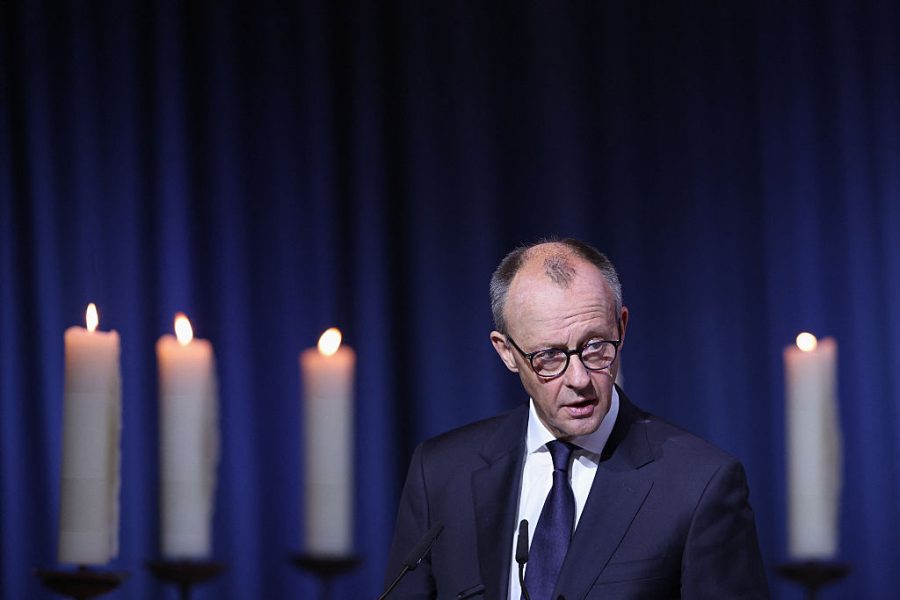
What a radically changing year 2025 has been: a year in which Germany’s new chancellor, Friedrich Merz, found himself fighting not merely the parliamentary opposition, the Russian threat and the brittle promise of European unity, but also his weakest and most self-confident adversary of all – his own coalition partner, the Social Democrats (SPD).
After years of aborted ascents, Friedrich Merz has finally reached the summit. For more than seven months now, he has sat in the Kanzleramt in Berlin he once seemed destined never to occupy. His ascent, however, was ungainly. Two rounds of voting were required to crown him chancellor. A monumental volte-face on the reform of the constitutional debt brake shattered his reputation for reliability before the paint on the office door had even dried. And all the while, his party, the Christian Democratic Union (CDU), can feel the AfD’s breath growing warmer, closer, more confident.
Still, to conclude that Merz has failed would be premature. There have been unmistakable hits amid the stumbles. The arrival of Alexander Dobrindt at the Interior Ministry marked a rhetorical, if not yet substantive, shift on migration. Abroad, Merz has projected something Germany had conspicuously lacked under his predecessor Olaf Scholz: presence. Where Scholz faded into communiqués and caveats, Merz shows up, speaks plainly and, crucially, is noticed. When the New York Times recently crowned him ‘the strongest remaining leader among Europe’s great powers’, it was not flattery but relief.
Merz still has time. But time in politics evaporates faster than credibility
At home, however, the knives are out – and they are aimed, predictably, at Merz’s mouth. Too blunt, too spontaneous, insufficiently ‘chancellor-like’: the familiar German media chorus. The ‘cityscape’ remark – when, in October, he linked urban problems with illegal migration – is wheeled out as exhibit A, as though the Republic might collapse under the weight of an unpolished sentence. This is a misdiagnosis bordering on wilful blindness. Merz’s impulsiveness is not a bug but a feature. It belongs to him as cinnamon belongs to a Christmas star: sometimes excessive, rarely fatal. Indeed, after years of Olaf Scholz’s linguistic shrink-wrapping – sentences sealed against any conceivable offence – and Angela Merkel’s syntactical labyrinths designed to obscure intent, Merz’s lack of teflon can feel almost invigorating.
No, Merz’s real problems lie elsewhere. And they are far less cosmetic. The chancellor governs as though Germany were an annexe of the Foreign Office. His gaze is fixed on summits, alliances and historical verdicts, while the domestic landscape blurs beneath his feet. Nothing illustrated this more starkly than his recent confusion over the pension level – a basic concept, mishandled at precisely the moment pensions became the coalition’s most explosive fault line. Merz clearly dreams of a place in the history books as the chancellor who finally made the ‘Zeitenwende’ real, who stiffened Europe’s spine against Russia and restored Germany as Washington’s equal rather than its anxious dependent.
The danger is obvious. For most Germans, geopolitics is abstract; the heating bill is not. A foreign policy legacy does not pay the rent. Governments that lose touch with the social and economic texture of everyday life do not merely stumble – they hemorrhage trust. After the pension debacle, public satisfaction with the coalition collapsed to barely 20 per cent. The old truth still holds: foreign policy may flatter statesmen, but domestic policy decides elections.
Then there is Europe – the arena in which Merz should, by rights, feel most at home. As leader of the EU’s largest net contributor, he possesses leverage few can match. Yet when it came to the European Green Deal and its most dogmatic offspring, the de facto ban on combustion engines, that leverage went largely unused. The policy was driven by Ursula von der Leyen, a former CDU minister no less. If ever there was a moment for a CDU chancellor to intervene decisively, this was it.
Instead, Merz appealed – and was ignored. Manfred Weber’s breathless declaration that ‘the combustion engine ban is history’ turned out to be political fiction. What followed was a fudge: a so-called compromise that satisfies no one, confuses industry and leaves regional candidates in Germany’s automotive heartlands politically naked. Power in Brussels is not asserted through optimistic tweets. It is asserted through confrontation and sometimes through vetoes. On this score, Merz has yet to demonstrate that he is willing to use the weight Germany pays for.
Most perilous of all, however, is the slow, quiet transformation of the CDU itself. If the party is to survive as a force rather than a memory, Merz must arrest its drift into social democracy. The SPD, drunk on moral self-assurance, treats the coalition’s ‘firewall’ against the AfD as both shield and sword – its insurance policy against ever having to compromise. The Union, meanwhile, risks becoming the junior partner in all but name.
Again and again, it is the SPD that prevails where the CDU promised change: the pension guarantee line, the cosmetic reform of the Bürgergeld benefit, the stubbornly high tax and contribution burden. The rhetoric is conservative; the outcomes are not. A CDU that administers social-democratic policy cannot expect conservative voters to remain loyal indefinitely.
Merz still has time. But time in politics evaporates faster than credibility. Without domestic ballast, without the will to throw his weight around in Brussels, and without a CDU confident enough to negotiate rather than acquiesce, his chancellorship will rest on a single, fragile pillar: foreign policy acclaim.
Germany’s chancellor may yet be remembered as a statesman abroad. The question is whether, in this radically changing year, Merz can also survive at home – against an emboldened opposition, an impatient electorate, and a coalition partner that smiles politely while tightening the noose. And so we return to where we began: a year of upheaval, a chancellor besieged on all sides, discovering that the hardest battles are rarely the ones fought beyond the border.

Comments