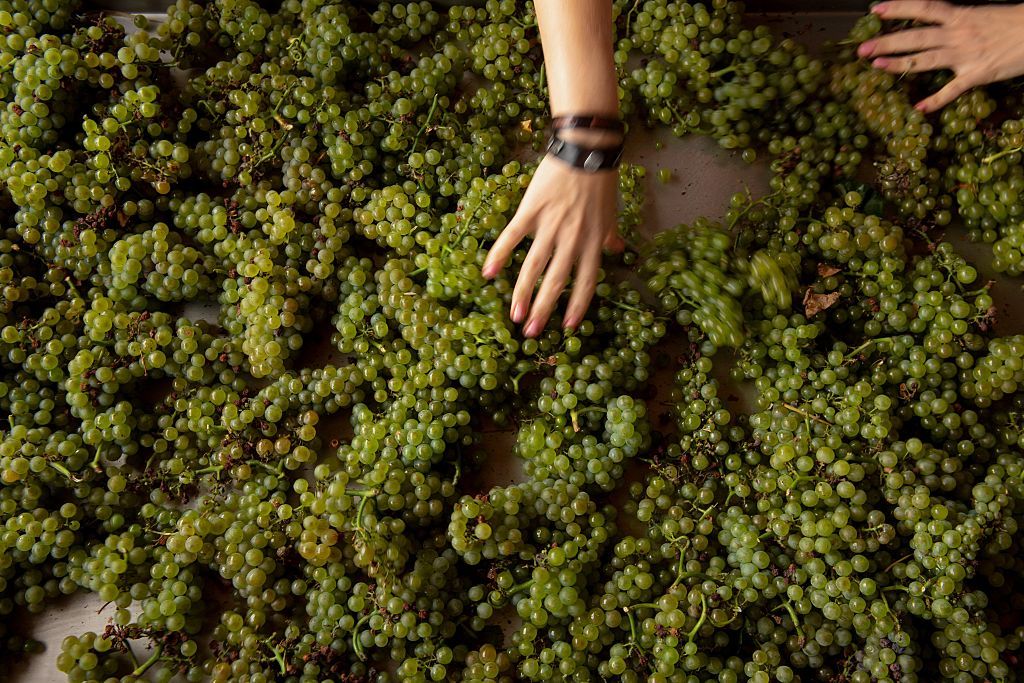



In the last installment of these cheery chronicles, I had occasion to mention aligoté, the second most widely planted white grape in Burgundy. I say “second most,” but it is a distant second. Only about 6 percent of Bourgogne is planted with that ancient grape, a crossing of pinot noir and gouais blanc, a nearly extinct varietal known as the “Casanova of Grapes” because it is a parent of scores of grape varieties.
Until fairly recently, aligoté was second in another sense as well. It seldom ripened fully by harvest time and the resulting wine, though taut and full of mineral notes, tended to be a bit astringent. It’s usual fate was as the muscle behind the cocktail kir, the elegance being supplied by crème de cassis. Two things changed that: nature and nurture.
Nature played its part by warming up the Côte Chalonnaise, where aligoté chiefly thrives (it is also planted as far north as Chablis and in parts of Côte de Beaune, Côte de Nuits, and the Mâconnais). Higher temperatures meant longer growing seasons, which made the grapes happy.
But if nature was important in the evolution of aligoté, nurture was decisive. Perhaps the most important figure in the care and feeding of aligoté was the wine legend Aubert de Villaine. Now 87, Villaine was co-director of Domaine de la Romanée-Conti from 1974 to 2021 (when he stepped back to an advisory role). It was de Villaine who descried the nascent potential of aligoté in the Côte Chalonnaise. He bought an estate in the village of Bouzeron, just south of the Côte de Beaune, and labored to have Bouzeron elevated to AOC status. That happened in 1998. Les Aligoteurs, an organization devoted to aligoté, now includes some 50 domaines covering 60 hectares.

Bouzeron is the only AOC devoted exclusively to aligoté doré, the “golden,” lower-yielding clone as distinct from the more common aligoté vert. As one commentator noted, aligoté “may be said to have fallen in love with this piece of ground, lying at an altitude between 270 and 350 meters. The upper portion consists of white marls derived from Oxfordian limestone (the first stage of the Jurassic system).”
Among the many elegies to the best examples of aligoté doré from Bouzeron is this fetching evocation: “The nose evokes acacia, white flowers and hazel-bordered country lanes. Flinty mineral notes and lemon complete a classic bouquet, to which may sometimes be added a discreet touch of honey or warm croissant.” It’s true, too, though for most of us it won’t substitute for breakfast.
Here are a few excellent aligotés you may wish to research. I shall pass over the 2023 aligoté from Domaine Roulot that I mentioned last time. It’s delectable. You will like it. It costs about $70.
You will also want to make a date with Jérôme Galeyrand, everywhere described as “one of Burgundy’s rising stars.” Based in the Côte de Nuits, he also produces some splendid aligotés from Bouzeron. I recently had two from 2022 – a tip-top year – the Les Clous and Le Cran. Both are about $65. Everything from that commendation cited above can be said about these wines, except perhaps for the bit about the toasty croissant.
You will also wish to sample the 2023 Les Clous Bouzeron from Les Champs de Thémis, a lovely aligoté by Xavier Moissenet. The literature tells us that it comes from a sunny, east-facing plot and that the vines are about 40 years old. It’s a classic example of the new generation of aligoté with excellent minerality, robust acidity and a complex palate of citrus, white flower and almond notes. A refreshing summer wine that is hearty enough to accompany a seafood or shellfish dinner, but pleasingly discreet enough to be a solo afternoon potation.
Finally, let’s take a trip to the fons et origo of aligoté doré, the celebrated Domaine de Villaine, which is now run by Aubert’s nephew Pierre de Benoist. Benoist wanted to be an astronaut, then a helicopter pilot, then a chief of police in Paris. “It was a job where you can meet beautiful and dramatic behavior from humans at the same time,” he told an interviewer. In the event, he went into the family biz and carried on and enhanced the beautiful and dramatic work of his uncle.
I recently had the 2024 Domaine de Villaine aligoté. It was complex, still a little tight, but full of enticing promise. It was $50 and worth it. The famous importer Kermit Lynch, who handles the wine, has long been a fan. His relation to what is easily the most famous winery in Bouzeron has not always been easy, however. In recent newsletter, he reprints a confession from 1984 under the rubric “One Of My Worst Faux Pas in France.” “When I first visited Aubert de Villaine in 1974,” Lynch recalled, “I liked his aligoté and told him it was just what I needed because I had recently discovered a good crème de cassis.” Uh oh. “Aubert’s expression turned as sour as a bad aligoté. It would be unfortunate, he informed me kindly through gritted teeth, to obscure the quality of his aligoté by pouring crème de cassis into it.” The newsletter also wisely advises that this aligoté “should be kept as far away from your crème de cassis as possible.” Noted.






Comments