There are many ways for an established act or artist to call it a day. Some implode mid-tour in a fireball of drugs, ego and flying guitars. Others drift quietly out of sight unannounced. Some take their cue from those annoying people at parties who bid everyone a fulsome farewell and then just keep coming back. Most, as we know, don’t manage to say goodbye at all.
As ardent scholars of pop history, Sarah Cracknell, Pete Wiggs and Bob Stanley are more aware than most of all the pitfalls and indignities involved. They have duly planned Saint Etienne’s exit from the scene with obvious care and attention. Like those annoyingly reasonable couples who throw divorce parties, the trio have pitched their retirement as a celebration. This is conscious dethroupling, indie-pop style.
First, in 2025 Saint Etienne released a very decent studio swan song, International. A year later, they are coming to the end of a civilised jaunt around the UK and Ireland to bid their fans a personal adieu. Everyone seems to still get on. As far as I’m aware, no one has been in rehab or desperately needs the dough. There has been no great falling off in creative quality, and all three remain busy with other creative projects. Good for them. More bands should take their leave with such decorum. The only conceivable downside, and it’s one that extends slightly to the music itself, is the lack of drama.
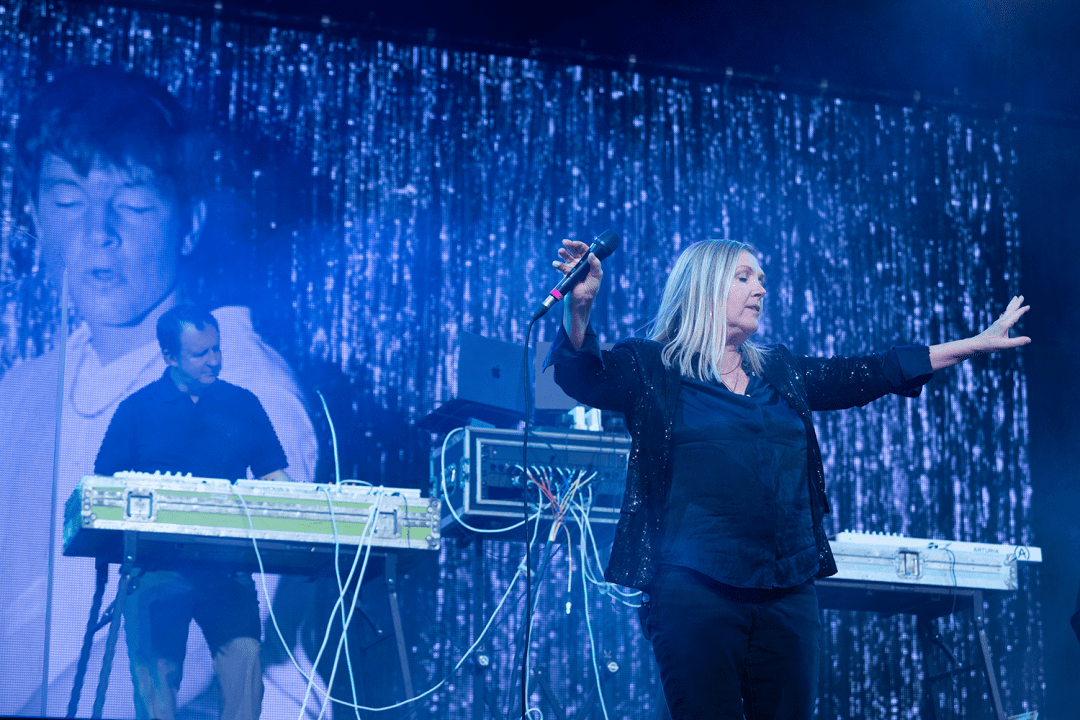
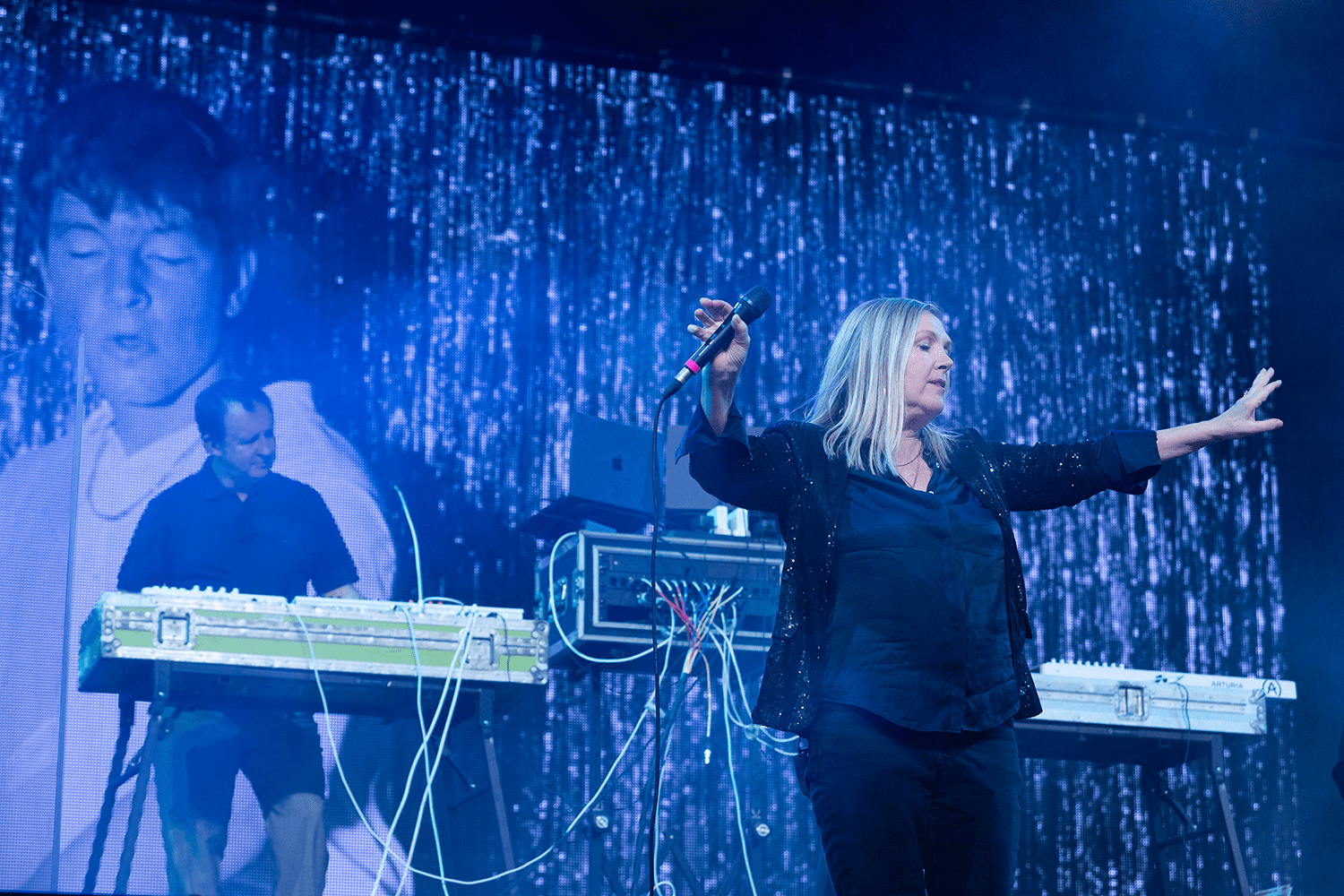
I first saw Saint Etienne in Glasgow sometime in the early 1990s. Back then Cracknell was the unthreatening pin-up on the kitchen wall of many a shared student flat; your friend’s glamorous but approachable big sister with a 1960s sense of style. Thirty-odd years later, and still not averse to a feather boa, she remained the focal point. There was nothing starry about Wiggs or Stanley. Flanking Cracknell behind their keyboards, they resembled two lecturers doing a Kraftwerk tribute, joined by Debsey Wykes on backing vocals, Joe Bennett on guitars and Laurence Colbert on drums.
Having never fully joined the ranks of true believers, I came in one last attempt to be persuaded. I left still feeling that their obsession with capturing the humdrum minutiae of English (not British) life, with its moments of quiet ecstasy, desperation and unexpected beauty, is often overly on the nose; likewise, the Richard Whiteley samples, David Essex collaborations and too knowing cultural references.
The lasting impression, however, was a positive one. Though Saint Etienne came of age during the Britpop era, they were the antithesis of its brash, bullish egocentrism. They wanted us to like their music, of course, but they wanted us to like the entire idea of music even more, piling their songs high with homages to northern soul, 1960s pop, disco, house, folk and electronica. Their mantra has always seemed to be: ‘Listen to this! Isn’t it great?’
In Glasgow, that spirit of generosity was very present. They revisited many of their finest moments in a set smartly constructed as a narrative of sorts, opening with the sugary pop rush of ‘Tonight’. Acknowledging that music fandom is a great leveller, Cracknell sang of the anticipation of going to see a favourite band: ‘Maybe they’ll open with an album track? Or a top five hit… this could be my life.’
More bands should take their leave with such decorum
‘You’re In A Bad Way’ still sounded like the Supremes by way of Finsbury Park. And while ‘Who Do You Think You Are?’ has dated better than the cheesy ‘He’s On The Phone’, their ingenious pop deconstruction of Neil Young’s ‘Only Love Can Break Your Heart’ never sounded better.
If the band’s ethos could be summed up by a single song, it is ‘Mario’s Cafe’, a quintessential evocation of a ‘rainy cafe, Kentish Town, Tuesday,’ where ‘everyone’s dreaming of all they’ve got to live for’. Cracknell’s airy vocal rode over a languorous beat, the sound of violins was interspersed with samples from Billy Liar and That’ll Be The Day, and a deeply romanticised ideal of London life was conjured up before us.
‘Nothing Can Stop Us’ still sounded like bottled sunshine, with its choppy guitar riff and those sampled flutes, but Saint Etienne chose a more ambiguous closer in ‘The Last Time’, accompanied by a visual montage spanning the band’s history. It’s a song about the years passing and connections that once meant something being tested by time. ‘I’m really glad we made the trip,’ Cracknell sang, ‘because only three survived.’
This trio have more than survived. Saint Etienne are departing in much the same way as they existed: with a classy, idiosyncratic and understated flourish.




Comments