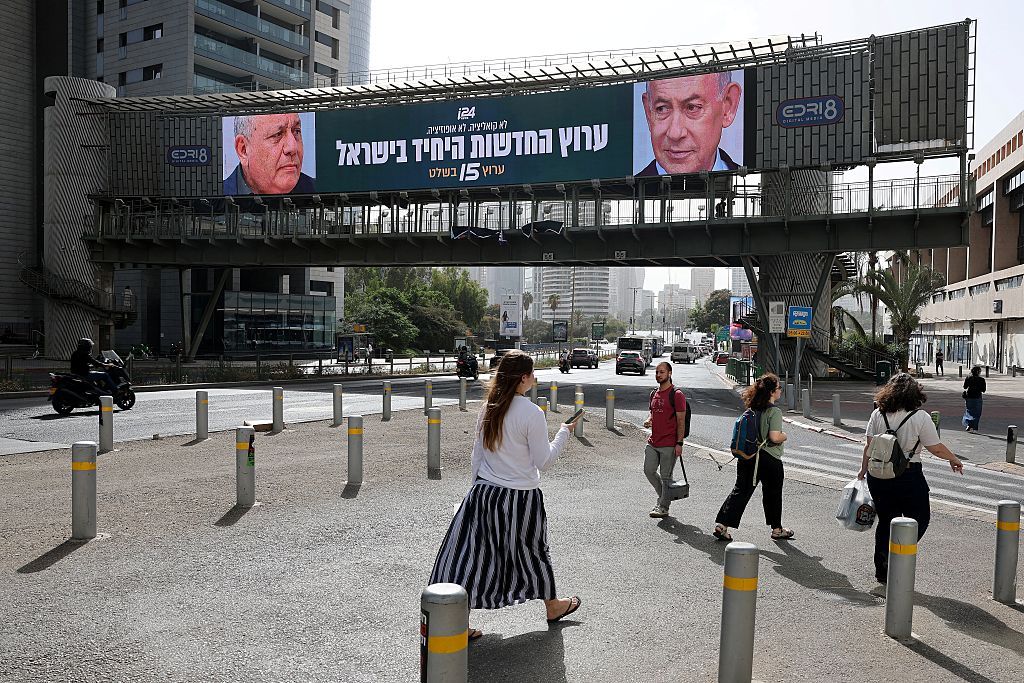
Last night’s election in Israel, with the highest voter turnout since 1999, was widely seen as one of the most consequential in the country’s history. The last four years in Israel have at times resembled a bizarre thriller penned by a perpetually drunk screenwriter – featuring mass unrest over an attempted judicial overhaul, the deadliest massacre of Jews since the Holocaust, and a prolonged, multi-front war that never seems to end. With that in mind, many Israelis were hoping for a decisive change of course, with the battered ship of state steered towards calmer waters.
Eisenkot’s triumphant speech on Wednesday morning, with 66 per cent of the votes counted, seemed detached from reality
These elections were perhaps the most ideological and least personal in decades. For once, there was a well-disciplined ‘change bloc’ of various parties opposing prime minister Benjamin Netanyahu. But they weren’t solely anti-Bibi either. Its members had a set of tangible objectives that resonated with large sections of the public: establishing an independent state commission into the October 7 catastrophe, easing the crushing burden on reservists by ending blanket military exemptions for ultra-Orthodox men, and restoring public trust in state institutions.
Going by the preliminary results, it seems like Israeli politics has become a game of Tetris in which most of the pieces could fit together into a functioning coalition – were it not for one awkwardly shaped block called Benjamin Netanyahu. By Wednesday morning, neither side had secured a clear majority in the 120-seat Knesset. For much of the night, the two rival camps appeared neck and neck, while the Arab parties, projected to win a historic 17 to 19 seats between them, occupied a potentially pivotal position. As the night wore on, it seemed that Israel’s perpetually drunk screenwriter had decided to share a little of his liquor with the party leaders, who somehow all managed to declare victory in impassioned speeches. Everyone won Israel’s election. Everyone lost.
The opposition frontrunner, former IDF Chief of Staff Gadi Eisenkot, can claim a sort of victory, having established himself as a formidable alternative to Netanyahu and built a major political force in a relatively short space of time. He is also widely regarded as a unifying figure – a calm, trustworthy former military commander who lost his son during the war in Gaza. When it comes to confidence in the current government – the most right-wing coalition in Israel’s history – the combined strength of Eisenkot’s camp and the Arab parties suggests that a substantial majority of voters want a change of leadership.
Yet Eisenkot’s triumphant speech on Wednesday morning, with 66 per cent of the votes counted, seemed detached from reality. ‘The Israeli people have voted against Benjamin Netanyahu remaining as prime minister,’ he declared. Even if Eisenkot is right that Netanyahu has failed to secure a sufficiently strong mandate to form a stable government, the parliamentary arithmetic could still allow the prime minister to cling to power. Indeed, the fact that Netanyahu’s Likud still appeared to be the largest party in the Knesset – despite the failures of October 7; investigations into his closest confidants’ alleged murky ties to Qatar, which has provided financial support to Hamas-run Gaza; and numerous other shortcomings – says something important about Bibi’s enduring appeal.
Last night, while delivering his fiery election results speech, Netanyahu was beaming. He thanked his now significantly weakened coalition partners – the ultra-Orthodox parties and the far-right factions led by the inflammatory duo of Itamar Ben-Gvir and Bezalel Smotrich – before declaring: ‘The right-wing bloc has an absolute and decisive majority among Jewish voters… We must form a strong, national right-wing government.’ Despite this defiant statement, the maths doesn’t add up, and his natural partners won’t be sufficient to form a government.
In terms of values, however, he is not entirely wrong. Israelis have become more right-wing in recent years. Despite the toxic rhetoric, bad blood and well, Netanyahu, there are lot of similarities between mainstream Likud and several leading figures in the ‘change bloc’. Could then there be a government of national unity? That seems unlikely while Netanyahu remains in office, as it would mean ‘change bloc’ leaders betraying their central electoral promise. Netanyahu’s decades-long track record as a silver-tongued serial backstabber has pushed many right to centre-right politicians towards the ‘change bloc’.
Most of the ‘change bloc’, despite their united goal to unseat Netanyahu, have also promised not to rely on the Arab parties. The Jewish political establishment remains reluctant, since October 7, to embrace ‘non-Zionist’ Arab parties, though Arab and Druze candidates appear on most Jewish-led party lists across the political spectrum. Netanyahu understands that Eisenkot is in a deadlock. ‘We must not endanger Israel and make a government that leans on Arab anti-Zionist parties’, he warned, portraying the parties as servants of ‘Israel’s enemies’.
While the separatist Joint List, an alliance of Arab left-wing and pro-Palestinian nationalist parties, will not be part of any coalition, it has expressed interest in providing external parliamentary support to the ‘change block’. And Ra’am, a more pragmatic Islamist party, has openly said it wants to join Eisenkot’s government. Yet even with the backing of the Arab parties, the ‘change bloc’ could still fall short of a stable parliamentary majority.
The Arab parties, therefore, can claim a victory too. Driven in part by frustration over the current government’s policies and the hostile rhetoric directed at their communities, Arab Israelis mobilised in extraordinary numbers at this election. This has demonstrated that they can no longer be treated as politically irrelevant.
Meanwhile, the man who might yet help piece together Israel’s fractured political landscape sits in Washington. On election night, the Wall Street Journal reported that the United States had warned several Gulf Arab countries to prepare for a possible short but intense military campaign against Iran after the American midterm elections on 3 November.
Netanyahu opened his speech with Iran, declaring that the Islamic Republic was ‘weaker than ever’ and that Israel had a ‘historic, one-time opportunity’ to eliminate the Iranian threat alongside Donald Trump. Eisenkot, apparently mindful of the tense situation, warned Netanyahu against using Israel’s security for political gain. He also appealed to Israel’s security chiefs, reminding them that their responsibility is to the state and its citizens, rather than to the prime minister.
Behind the scenes, however, according to the Washington Post, figures within Trump’s administration have reportedly discussed the possibility of a Netanyahu–Eisenkot unity government.
Eisenkot and the Arab parties, meanwhile, will be wary of another election, in which their present levels of support might prove difficult to reproduce. Sooner or later, the political players may have to compromise. And as Israel’s politicians ponder how to fit the pieces together, its bewildered citizens could once again find themselves preparing their bomb shelters.





Comments