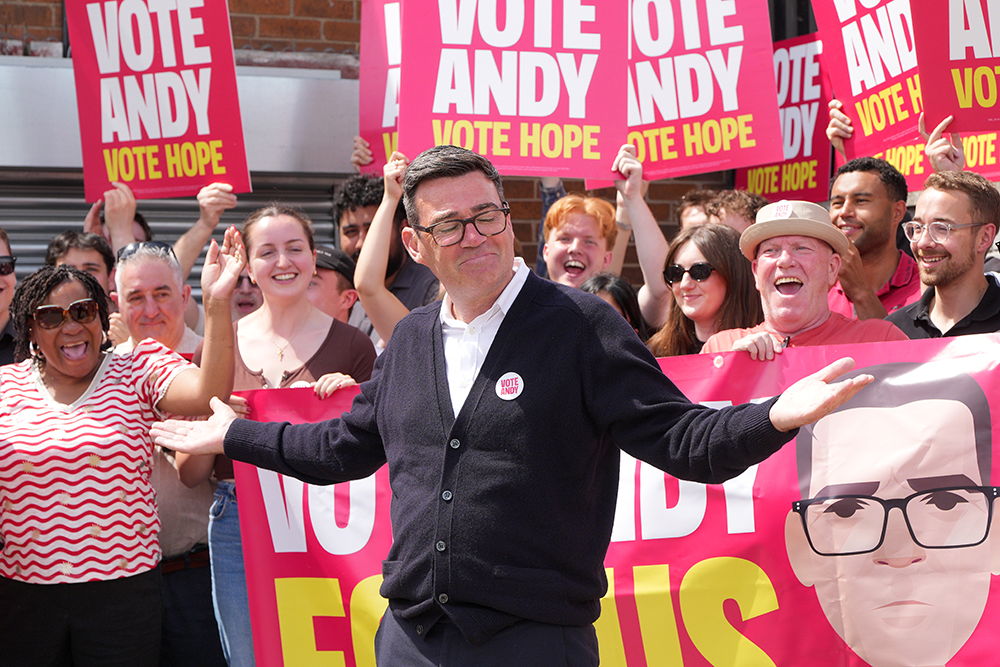
The British constitution is an admirably flexible thing, so I would not claim that Andy Burnham’s leadership campaign, and the coverage thereof, is unconstitutional, but it is certainly unseemly. Why did a BBC helicopter follow his train from Manchester to London (which arrived, of course, late) as if he were Lenin heading for the Finland Station? And why was he allowed to preempt his result with a mass selfie with about 200 of his supporting MPs in Westminster Hall? He is merely a new Member of Parliament, until he isn’t. Turning the place into his stage set is a way of intimidating possible challengers. If he is challenged, he will surely still become leader, but the point of a challenge is to force him to say what he means to do. So far, no one – not even, one suspects, Andy Burnham – knows what Andy Burnham stands for.
It is widely assumed that Mr. Burnham will have to take at least one new stance which will reassure markets and avoid his complete capture by the left. The biggest such change would be to get rid of – or rather, postpone – net zero. Funnily enough, it might also be the easiest. Most trade unions are aware of the policy’s job-destroying effects. Most of the Red Wall detest the consequent energy prices and Britain’s vulnerability, because of losing our own oil and gas, to Russia and the Middle East. A Burnham government might even get away with fracking. Such policy changes would immediately improve confidence, benefit industry and steal the clothes of the Tories and Reform. If they annoy people in places like Richmond or Brighton, that would be quite a small price to pay. Note, however, that Mrs. Burnham, Marie-France van Heel, has, according to the Plan International, on whose board she sits, a “passion for sustainability and the green economy” and is “championing the fair and accessible transition to electric vehicle ownership,” as the chief customer officer at Be.EV.
Expect a clash quite soon between Mr. Burnham and sections of the media, especially newspapers. He is one of those politicians obsessed with the wickedness of the Murdoch press and is close to Hacked Off, in whose campaign for “a free and accountable press” the second adjective most emphatically trumps the first. Hugh Grant was up in Makerfield, helping the Burnham team. Will statutory press regulation be his reward?
The late Michael Wharton’s Peter Simple column in the Daily Telegraph identified two epithets which, when conjoined, well describe a certain sort of modern public figure. They were “genial, unpopular,” and were most often applied to one of his creations, Sir Aylwin Goth-Jones, chief constable of Stretchford. There is a real place called Stretford in Greater Manchester. Wharton had spotted the fact that the genial – who love to be liked – tend to become disliked on closer acquaintance. More arguably, he associated such people with the north-west. Andy Burnham is very genial, and comes from the northwest. If he wins, he will be the first Labour leader since J.R. Clynes (1921-22) to do so.
What a week for political leadership – Sir Keir Starmer giving notice of resignation, Sir Jeffrey Donaldson found guilty on multiple counts of child sexual abuse, Peter Murrell sentenced for embezzlement. Unlike the others, poor Sir Keir did nothing criminal and so is not, in the new meaning of the phrase, a conviction politician. Speaking outside Downing Street for the last time, he expressed himself thus: “Every decision I’ve taken has been about putting the country I love first. That is why I will resign as leader of the Labour party.” This sounds like a non sequitur, even a contradiction, but perhaps it isn’t. When she resigned, Theresa May also invoked “the country I love.” What pathos is here. No doubt the feelings of both these unsuccessful leaders are genuine, but, as Edith Cavell said in a very different context: “Patriotism is not enough.”
I write this in the broiling heat. It is almost exactly 50 years since the previous hottest June day. I remember. I was passing through London on the way back from an Oxfordshire barge holiday which had been hampered by the lack of water in the canals. It had been so hot at night that we slept on the roof of the barge. From the upper deck of a bus in Piccadilly, I surveyed the semi-naked, sweating crowds. Suddenly I spotted an utterly different figure in a soutane and a broad black hat. It was Monsignor Alfred Gilbey, making his way, presumably toward the Travellers Club, where he lived. I was impressed that he looked as cool and impervious to the climate as he was to the entire 20th century.
In those innocent days, the tabloid headlines said “PHEW, WOT A SCORCHA!,” illustrated by lovely Linda Lusardi disporting herself in a fountain, and no one spoke of climate change. I conceived but failed to complete a dystopian short story in which politicians had started to try to control the weather, thus souring the most harmless subject of conversation in British culture. That fantasy has now come to pass.
I have mentioned before that, in country districts, the sign “ROAD AHEAD CLOSED” is rarely true, especially at weekends and after public works stop for the day (around 4 p.m.). In the past two weeks, I have kept a record. Eight out of my ten journeys past such signs have carried me safely through to my destination. The latest sign popping up a lot (there are works everywhere at present, trying to catch up on years of neglect) says: “CATS EYES REMOVED.” It sounds as if it is a service offered, like “WATCHES REPAIRED” or “KEYS CUT.” When I was a small boy, I thought cats were indeed looking out, half-hidden in the middle of the road, and have never quite shaken off that feeling.




Comments