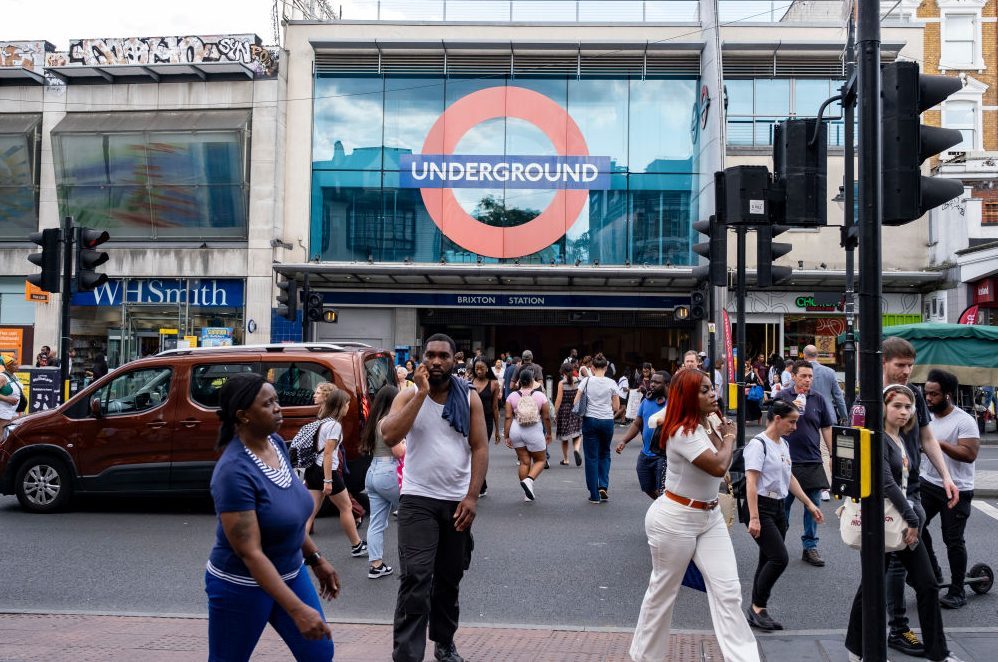
For the last few years I lived in Brixton, I’d be contacted intermittently by news editors who’d heard that a Waitrose was set to open in my ‘hood. They would ask if I could write about the gentrification of what, to their generation, was a no-go area, at best described as ‘vibrant’, or ‘edgy’.
In Brixton, degeneration lives cheek-by-jowl with gentrification
For Boomers, Brixton will always be associated with the riots of 1981, inner-city decline and drugs. It’s for this reason that the Chin Dictionary Tube Map, which toffs were having framed and hung in their downstairs loo a few years ago, renamed the Brixton stop on the Victoria Line, ‘Fascinates Granny’. Monument, if I recall correctly, was ‘Internship with Godfather Rupert’, Victoria, ‘Train for Cottesmore Prep’, etc.
Sadly for news desks — and my bank balance — cursory enquiries always put rumours of a Brixton Waitrose into the category of stories that are ‘too good to check’.
During my time in the borough, I lived in all three postcodes: SW9, SW2 and SE24, finally buying a wreck of a house with an outside loo and a derelict Anderson shelter in the latter, Herne Hill, aka ‘the posh bit of Brixton’. But only by the sort of people who’d buy mugs emblazoned with this statement in one of the many Hygge-Tygge-shops-from-Motherland you now find there.
For years, Brixton was KFC, Iceland and Western Union Money Transfer, though there was a slow creep towards gentrification, as will always happen in an area with good housing stock and quick transport links to the City. The bar where you could buy a bag of weed (after a cursory chat about cricket with the elderly Jamaican proprietor) is now an expensive tapas bar.

Red trousers were spotted in Brixton Market after it became a foodie destination, although the burglaries and anti-social behaviour never abated, worsening after lockdown. Waitrose never did open there. (The upper-middles who bought up the Victorian townhouses in the catchment areas for ‘outstanding’ primary schools enjoyed the kudos of shopping at Lidl with its excellent cheap provolone, olives and mortadella.)
But last month Brixton gained the ultimate stamp of gentrification: a branch of Gail’s. Naturally this caused the usual types to lose their minds; the area was plastered with posters depicting a Gail’s sourdough loaf attached to a bomb, accompanied by wittering about the chain’s links to ‘the genocidal state of Israel’.
It’s many years since Yael Mejia, Gail’s founder, the British-born, Israel-raised baker, was bought out by investors. Yet the chain has become a lightning rod for keffiyeh-bothering, over-privileged protestors. One of the key figures in Strapline, the group that targeted the Brixton Gail’s, rejoices in the name Marlo Swann McNair Plowden and hails from a line of Old Etonians.
His group also accuses Gail’s of the lesser crimes of ‘late-stage gentrification’ and ‘aggressive corporate expansion’. But it hasn’t pushed out an independent (of which there are plenty) and is a vast improvement on the dingy Starbucks that occupied the same spot by the Tube when I was commuting daily. According to one report in The Economist:
‘Naturally, once opened it was rammed with Brixtonians buying ham-and-cheese croissants for £5.40. Its windows provided a panorama of travellers streaming down the steps into Brixton Underground Station. Just before 4pm on Saturday October 24th it offered a view of a man pinning someone down and stabbing at him repeatedly.’
On the subject of ‘aggressive corporate expansion’, protestors may have a point. Gail’s is majority-owned by the private equity firm, Bain Capital, whose noble goal is to open another 100 branches, bringing the total to 300. Private equity, with its desire to reach saturation point, is the reason why every third shopfront on the Strand is a Pret and the pizzeria Franco Manca (which started as a tiny place in Brixton Market you had to queue for) is everywhere.
Banbury — perhaps the only scuzzy town left in the Cotswolds — now has a Gail’s. So does Billericay, repository of Towie tropes, Essex girl jokes and mock-Tudor mansions. Every new location will have been run through the company’s internal algorithm, which scores postcodes for ‘Gail’s suitability’; things like demographics, transport links, the belief in Israel’s right to exist. (OK, so I made the last one up — but brandishing a flat white in a Gail’s cup increasingly feels like a statement.)
In Brixton, degeneration lives cheek-by-jowl with gentrification. There are crack houses [on] streets where the sort of ‘doer-upper’ (as Kirsty and Phil would call it) that we bought 15 years ago now goes for seven figures.
‘Everyone should hate gentrification,’ says one of my old friends when I ask if she’s used the Gail’s (she hasn’t; ‘it’s too much’). I don’t ask if she hates that her house has doubled in value.
But Brixton might be the one that breaks the Gail’s algorithm. It is both on the up and falling apart. Residents complain of addicts defecating in front gardens and barging through the barriers at the station, of shoplifting so rampant, it has brought Reform UK’s Robert Jenrick to the area to film one of his videos confronting thieves.
Costa Coffee, Leon, the upmarket fast-food chain, and Thomasina Miers’s Mexican street-food café, Wahaca, have already pulled out. If Gail’s can make a go of it amongst the vape shops, chicken joints and Greggs on the main drag, then good luck to them.






Comments