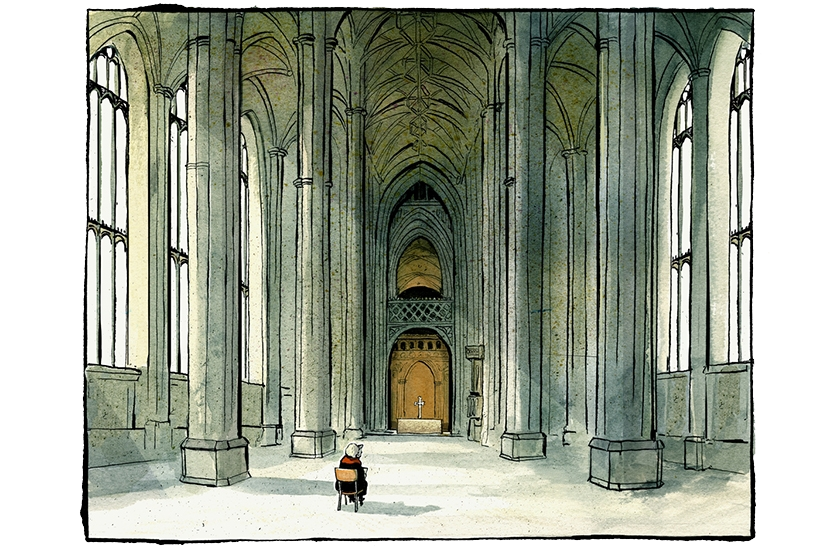

Something amazing happened as I was walking my 91-year-old mother through Ledbury: we saw a bobby on the beat. He was even in a helmet, not a baseball cap. “A real policeman!” squealed various people, reacting as they might to a steam train or an Austin-Healey, reminders of more distinctive days.
The same surprise may soon be evident when we see dog collars. A new scheme, oversight ministry, adopted by some Church of England dioceses, is taking vicars off the streets. Instead of being front-line clergy they will become “oversight ministers” and “area deans,” managers of lay, unpaid “focal ministers.” These focal ministers will take services, undertake pastoral visits and, as the promotional blurb puts it, “be present in the wider community as an available point of contact for anyone connecting with the church community.” David Blunkett gave us plastic Plod community support officers; the C of E is giving us plastic parsons.
Focal ministers will not spend years at theological college but be drilled in the things Church officials revere
Oversight ministry has reached Truro, Leicester, Sheffield, Birmingham and Lincoln and is coming to our patch, Hereford. Our bishop is graciously saying that he will allow vicars to opt out of the scheme. Let’s see. Bureaucrats are quietly applying pressure on priests. Muscular Christianity has been replaced by acidic office politics.
Focal ministers will not spend years at theological college. They will, however, be drilled in the things that modern Church officials revere. They “will be required to complete Safeguarding training to Leadership level as well as Raising Awareness of Domestic Abuse.” Church documents once reserved initial capital letters for God Almighty. Now they are given to Safeguarding and Domestic Abuse.
Readers will know that the C of E is in a pickle. Pews empty while race advisors, environmentalists and Safeguarding experts are marching as to war, spouting passive-aggressive managerialism and citing charity law as they hassle the few weekly worshippers. These bureaucrats benefit from a fund Queen Anne founded in 1704 to help poor parishes. In 1948 that bounty was merged into the Church Commissioners. Today, according to the Save the Parish ginger group, only £85 million of the fund’s annual £653 million income goes to parishes. Rural churches are pitifully impoverished and several cathedrals are in deficit, some near bankruptcy. Vicars are resigning in even greater numbers than those who are retiring, a third showing symptoms of depression. Working for today’s corporatized Church is plainly not much fun. Yet the Archbishop of Canterbury smiles brightly and talks of splurging £100 million on what the C of E insists on calling “reparatory justice.”
Cultural self-hatred, which has included the abandonment of old texts and the sale of spacious rectories, has been evident for decades. The consequences, accelerated by the closure of churches during lockdown, are now impossible to ignore. The Church has often countered calls for disestablishment by saying it had a priest in every pulpit. This argument is used when politicians suggest bishops should be ejected from the House of Lords. “We are close to the people,” flute their graces. Once priests are mere “area deans,” that line will not wash.
I learned that our diocese was introducing oversight ministry because for a decade I have, some five times a year, taken services as a layman. Yes, the idea of a Westminster journalist rising to his hind legs in the vicar’s stall, leading divine worship, sounds satirical. What a posturing pulpiteer! Context might help. The Reformation of the 16th century was, among other things, a revolution against Rome’s clerisy. A liberated English Church found itself short of priests. As it took back control it therefore allowed nonsacramental services such as matins and evensong to be led by congregants. They would do so without pay. Canon B11 of Church law states that such persons will be authorized by a bishop or will be “some other suitable lay person.” The wardens of our rural parish church (congregation 20, weekly collection £100) kindly asked me to do the honors when the rector was busy at one of her six other churches.
When taking matins you stick strictly to the liturgy – we use the Book of Common Prayer – and must not say the absolution or preach. When it comes to the moment for a sermon I give a short talk on history. Prayers are best said in a formal voice, shorn of personality. I model my delivery on that of my late father, a headmaster who took school services for decades, just as his own father did from the 1920s. For me, and perhaps others, churchgoing is an act of generational continuity. The Hebrew saying is l’dor v’dor.
Last week l’dor v’dor went kersplatt when I was told I would need to undergo up to 18 months’ indoctrination, including “Safeguarding training to Leadership level,” if I wished to continue to proclaim Cranmer’s matins. Only after that “formation period” might a certificate be issued to permit me to operate. That would mean complying with the Church’s secular creeds. And there, perhaps, is the reason oversight ministry is being introduced. The clerisy, still reeling from the departure of their blessed Archbishop Welby in – ha! – a Safeguarding scandal, has spotted a way to make today’s Protestants bend to their will. Fusty old sods who lead matins in country churches when the vicar can’t make it will not be tolerated. How many congregants will have the time or patience to submit to 18 months of training?
The noble principle of lay readers, established over 500 years of Anglicanism, is being warped by bureaucrats. Oversight ministry will increase their power and simultaneously hinder priests in their vocation.
So enjoy Anglican priests while you still have them. They have been a staple of our literature and lore for centuries. Consider George Herbert, Trollope’s Barchester, Jane Austen’s Mr. Collins, Woodbine Willie, the Vicar of Dibley or Captain Sam Davies, the padre who led the Glorious Glosters in divine worship before the battle of Imjin in 1951. I met him. What a man.
The dog collar is a reminder both of more distinctive days and of a time when the Church existed in the very weft of Englishness. Now it will be lost to oversight ministry. What an… oversight.




Comments