
Ihad a culinary revelation this week. I like to think I’m an egalitarian when it comes to food – I like beautiful, fancy restaurant stuff and home-cooked one-pot dishes, I like punchy, in-your-face flavour, and subtle, softer flavours. I love trying new-to-me dishes from around the world, and I love the comfort of eating suppers my grandma would make. You can put virtually anything in front of me and I’ll be thrilled.
But as I contemplated this week’s recipe subject, I realised that I avoid foods that ooze. Doughnuts splurging out their jam, uncontainable ice-cream sandwiches, croissants or Danish pastries with custards or compotes that blob onto my clothes. Even really juicy stone fruit or a particularly ripe soft cheese makes me nervous. My name is Olivia Potts, and I have an aversion to squidge.
I don’t know where this avoidance came from, but I was determined to fix it. So this is exposure therapy: nothing has more ooze potential than a custard slice. The squidgy dynamic is the whole point. There is no escaping the fact that at some point, the pastry is going to crack and the custard is going to make a break for it. So I set about curing myself of my squeamishness.
At some point, the pastry is going to crack and the custard will make a break for it
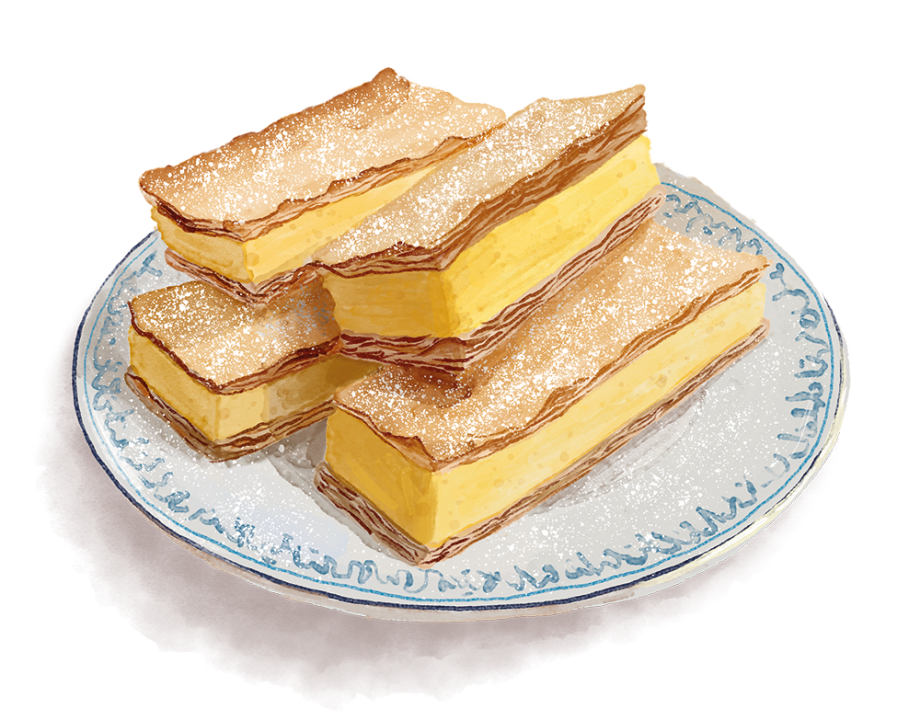
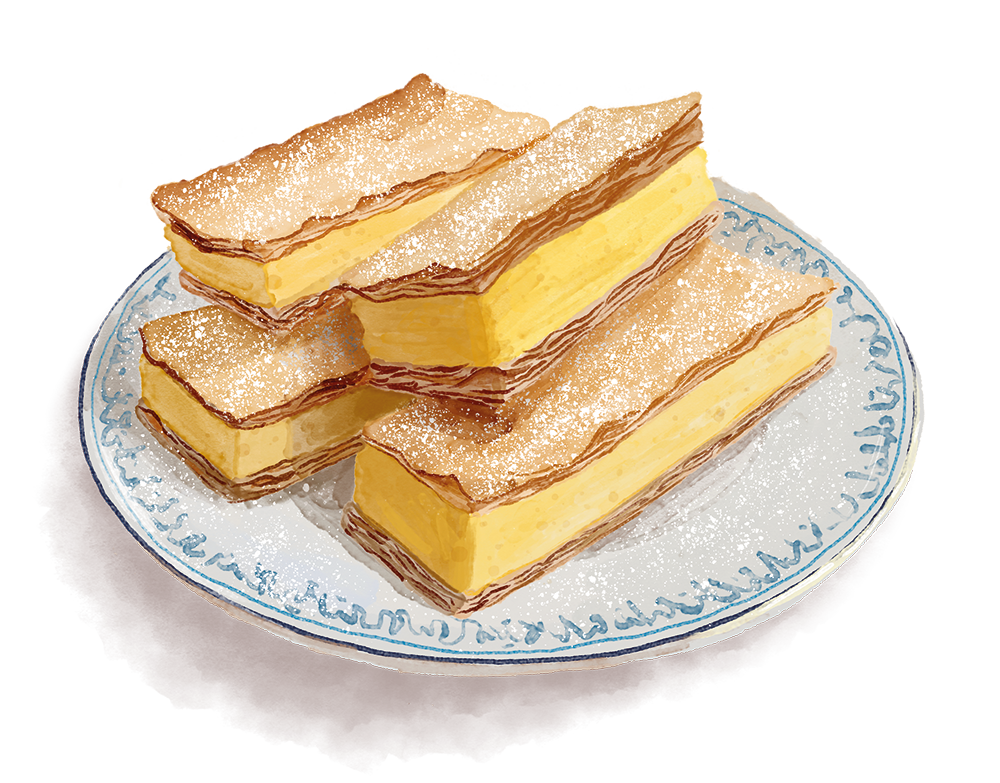
A custard slice – or a vanilla slice in Australia, where it is also beloved – is as much about structural integrity as it is about the vanilla custard flavour. That means the exact level of squish is paramount. It’s not filled with cream or soft custard; it’s not multi-layered like its cousin the millefeuille. It is a single, thick layer of set custard, just firm enough that you can slice through it cleanly, creating a perfect, plane side when portioning it. But once portioned, the custard middle should wibble precariously, presenting jeopardy to the person eating it.
The components of a custard slice are simple, which means that they have to be great: two pieces of puff pastry sandwiching a thick custard. There’s nowhere to hide. The pastry needs to be crisp and golden and as flat as possible; this means baking it compressed between baking trays, so that it doesn’t actually puff but instead becomes impossibly flaky. The custard needs to be thick and wobbly, loaded with egg yolks (eight to be precise), rich with cream and butter and proper vanilla, but never rubbery. This means thickening and cooking it to the point of jellyfish wibble, no further.
The custard filling does bring its own problems, beyond my own culinary neuroticism. It’s the construction. Sawing two very fragile, thin, rigid layers of pastry that contain a very thick, wobbly middle is a bloody nightmare. It’s pretty much impossible to do without squishing the squidge, and shattering at least one of the layers.
Well, thankfully, Sarah Akhurst for Sainsbury’s Magazine has solved the problem. Her solution is, I think, genius. The top sheet of puff pastry is cut into its final rectangular form before it is placed on top of the custard, jigsawed back into its original intact shape. So now, when you come to portion the slices, you’re only cutting through the custard and the bottom layer of pastry. That means you don’t have to exert pressure on the top layer of pastry or the custard, preventing the dreaded shattering and splurging.

The knowledge that you haven’t just undone all your careful work at the last moment makes the finished, impossibly neat custard slice even sweeter.
Of course, that’s the opposite of the lesson I’m trying to teach myself here. Neatness is overrated. Clean, unbesmirched, white T-shirts are overrated. Not having custard all over your face, hands and table is overrated. You can revel in the beautiful, cleanly cut, spirit-level-flat-pastry slices, but don’t think for one moment that you’re getting around the inevitable custard escape. It’s a non-negotiable of the custard slice and – as I eventually realised – it’s part of its joy. Embrace the squidge.
Serves: 10
Hands-on time: 20 minutes
Cooking time: 1 hour 20 minutes
- 2 x 320g sheets of puff pastry
- 600g whole milk
- 150ml double cream
- 1 vanilla pod
- 8 egg yolks
- 120g caster sugar
- 75g cornflour
- 50g salted butter
- 30g icing sugar
- Preheat the oven to 180°C. Place a pastry sheet on a lined baking tray, and prick it all over with a fork. Place another piece of baking paper over it, and then a heavy baking tray on top, to weigh it down. Repeat with the other sheet. Bake for 40 minutes, until a deep golden brown. Set aside to cool.
- Line a 23cm square tin with baking paper, making sure it overhangs the sides generously.
- Using the base of the tin as a template, cut one of the slices of puff pastry to fit. Use a bread knife and a firm sawing motion. Cut the second piece of puff pastry to the same size, and then slice that into two rows of five even rectangles.
- Put the milk and cream in a pan. Cut down the middle of the vanilla pod, scrape out the seeds, and add seeds and pod to the pan. Bring to a boil, then turn off the heat. Whisk together the egg yolks with the sugar, and then the cornflour.
- Fish the vanilla pod from the pan. Pour a third of the milk into the egg mixture, and whisk gently to combine, then return it all to the pan, whisking. Bring to the boil, stirring the whole time, then cook for two minutes more, still stirring. Whisk in the butter.
- Sieve the hot custard onto the sheet of pastry in the tin. Place the ten rectangles neatly on top. Refrigerate for at least four hours.
- Lift the whole thing from the tin onto a board. Using the rectangles as a guide, slice through it firmly, wiping your knife in between each cut. Dust with icing sugar.
Join Olivia Potts for Truffles and Trattoria in Rome on 2-6 December 2026. For more details about this Spectator Club trip, go to spectator.com/tastings






Comments