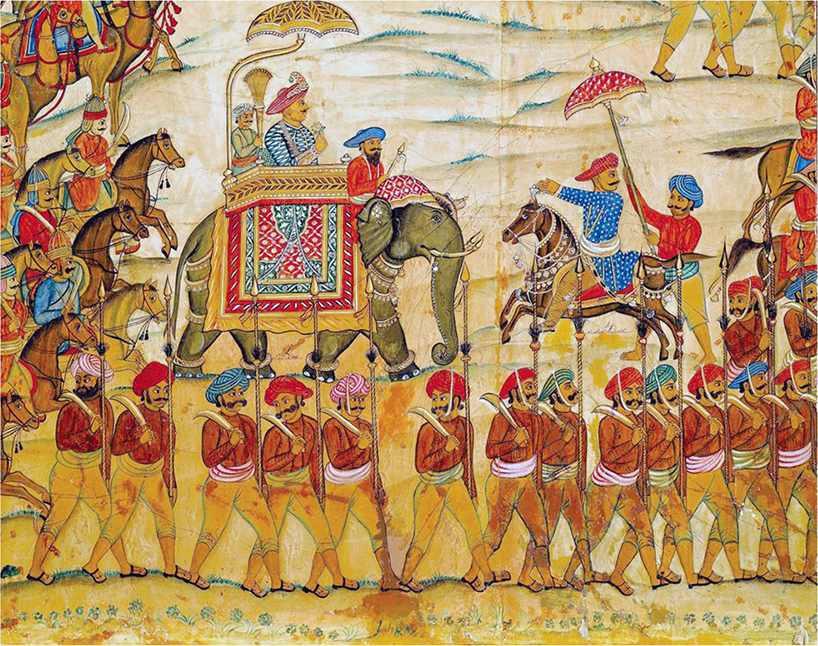
Long before “decolonization” was a glint in the eyes of left-leaning political scientists, Hyder Ali, an upstart mercenary soldier turned sultan of Mysore, and his nepo baby son, Tipu Sultan, fought four bloody wars to keep the British from controlling the south of India.
If wars were like soccer league tables, the Hyder/Tipu team would have come out on top with an enviable record of three wins to one loss. That loss was the final match otherwise known as the Fourth Anglo Mysore War, in which Tipu was defeated by the inspired generalship of the future Duke of Wellington. Tipu died in battle and the general was soon comfortably billeted in his late adversary’s summer palace.
Visitors to London’s V&A museum have long been amused by “Tipu’s Tiger,” a near life-size wooden sculpture of an Indian tiger savaging a prostrate British soldier. The British response to such triumphalism was a commemorative medal celebrating their victory of 1799, now on view at Tipu’s palace in Bangalore, showing a British lion enthusiastically kicking the butt of an Indian tiger.
The Summer Palace also features sensational 18th-century wall paintings of Hyder and Tipu’s armies and a gallery of their fellow Indian princely rulers. Not far down the road, Tipu’s mausoleum is a place of pilgrimage for those honoring the great local hero of anti-imperialism.
As much as Lady G and I would have loved to make camp at the Summer Palace, our digs in Mysore – a thoroughly charming city – were at the Royal Orchid, a classic Indian “heritage hotel.” For those who have not stayed in a “heritage hotel,” think potted palms, ceiling fans, faded photographs of elephant processions and long-forgotten grandees such as “Sir Albert De Lande Long.” There is an abundance of fin de raj charm and not everything quite works as expected.
On our first night in town, we dined at the hotel’s excellent restaurant which presented us with an encyclopedic menu offering everything from Malai tandoori broccoli to spaghetti aglio e olio. Served by a fleet of waitstaff dressed in the sort of handsome ethnic body warmers that have become fashionable in the West, we shunned “English fish ’n’ chips” and greatly enjoyed a vegetarian sheekh kebab, shorba (a light tomato consommé) and a volcanically spiced Mysore fish curry. If you must have wine, try the Sula sauvignon blanc from Maharashtra. Without wine, it was $15 a head.
I have wanted to visit Mysore ever since I read R.K. Narayan’s beautiful and witty novels set in the city he fictionalized as Malgudi. The following day we visited the Maharajah of Mysore’s Palace, an excellent example of the globalization of the Edwardian economy. Our guide was proud to tell us that the chandeliers came from Belgium, the floor tiles from Staffordshire and the magnificent brass gates were supplied by Tonks Limited of Birmingham.

Although not the biggest of Indian palaces, its scale is pretty impressive with a75 meter-wide façade and exterior walls lit with 97,000 lightbulbs, which must have greatly pleased Mr. Edison. Designed in the hybrid Indo-Saracenic style by the expatriate British architect Henry Irwin, who built a great number of government and institutional buildings in southern India, particularly in Chennai, the palace is unlikely to appeal to fans of minimalism.
But even in our age of oligarchs, the ostentation of the maharajahs continues to impress. Our guide remarked that one of the Maharanis had a fleet of seven Rolls-Royces in different colors. Her choice of car was dependent on which color her astrologer advised was lucky that day. It may or may not be true, but sometimes an entertaining guide is preferable to an informative one.
A more spiritual and aesthetic visit involved a 25-mile trip out of town to the Somanathapura Temple, a 13th-century establishment celebrated for the amazing richness and variety of its carvings. The scenes range from the Hindu epic the Mahabharata to illustrations of sex positions which visitors may find either daunting or inspirational. We had a superb dinner that night at the Green Hotel, a social enterprise set in one of the royal family’s minor palaces: spinach and paneer curry, knock-out daal and another blast of exuberant tomato soup.

Comments