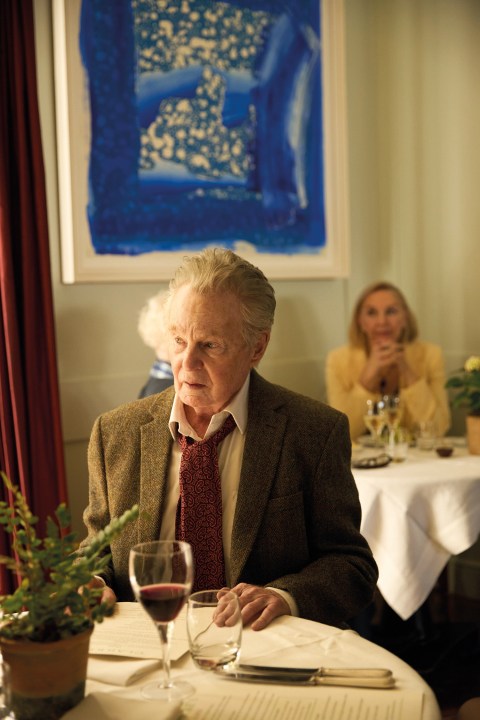

Lucian Freud almost had a second career in the cinema. He acted as an extra in a couple of films during the early 1940s; the only one in which he made the final cut was a farce starring the ukulele-playing comedian George Formby in which his 19-year-old face can be seen peering out of the background in one scene. Years later, Lucian claimed, John Huston asked him if he’d like to play the part of his grandfather Sigmund in a biographical screen drama from 1962 entitled Freud: The Secret Passion (which had, at one point, a script by Jean-Paul Sartre).
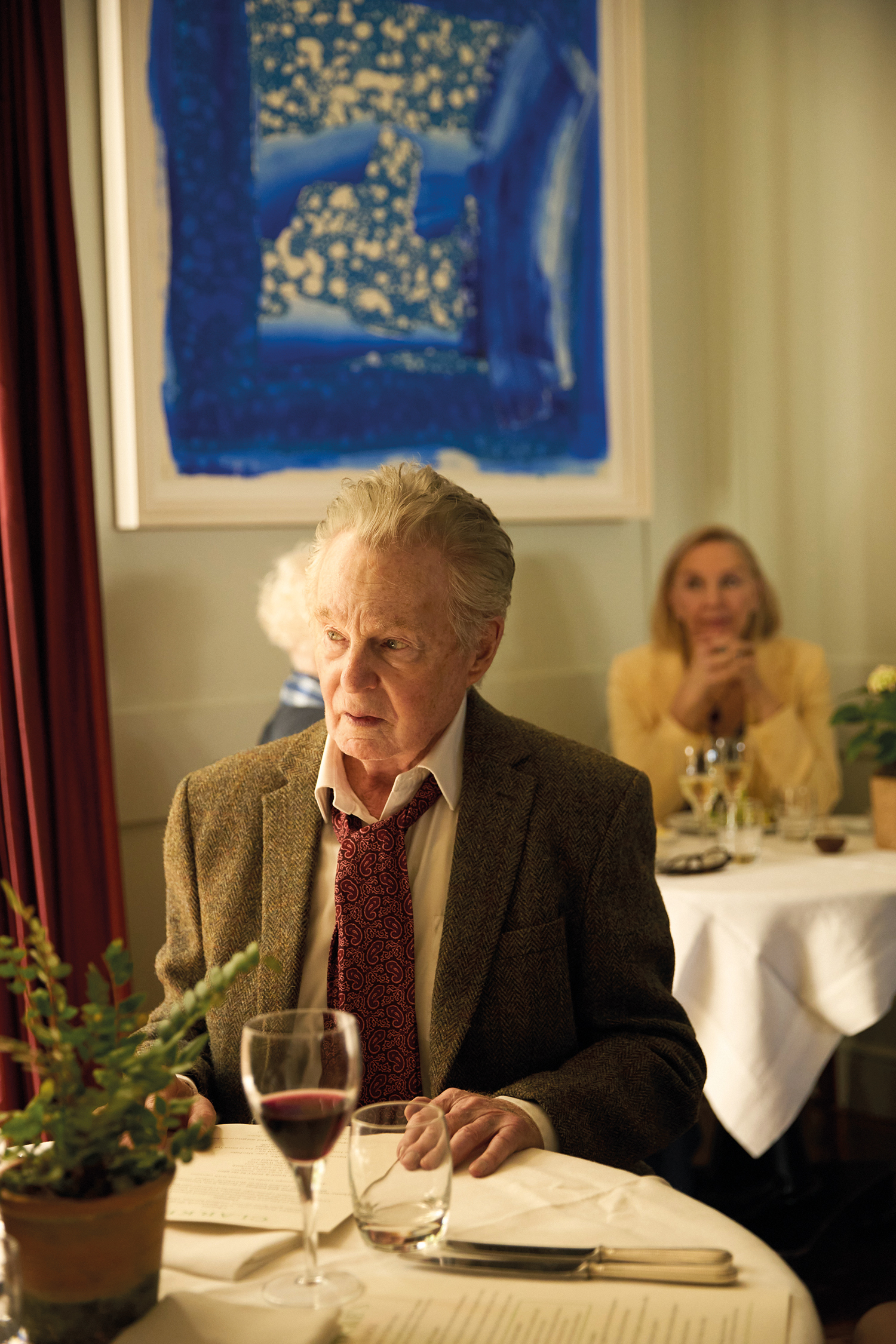
Eventually Montgomery Clift was cast instead, which was just as well because Freud was definitely an observer rather than a performer. This is one of the complications involved in making the movie Moss & Freud, in which the great painter is played by Derek Jacobi, and his model Kate Moss by Ellie Bamber.

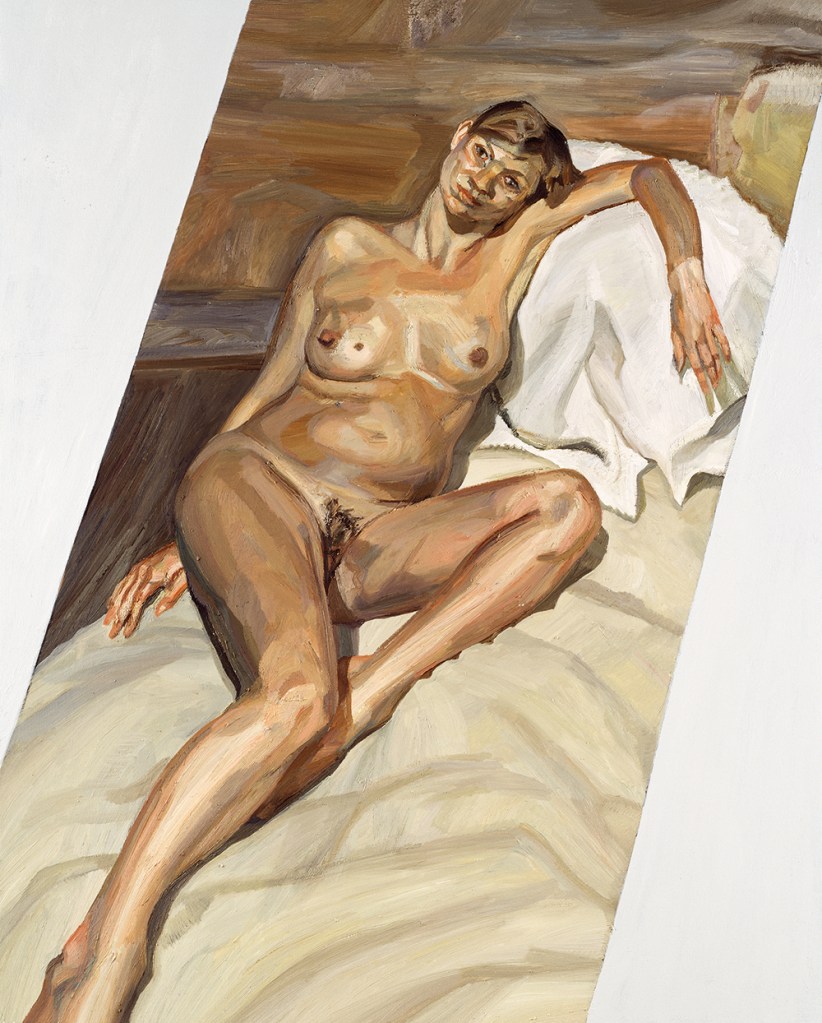
This is a subject close to my own life. I remember that picture “Naked Portrait 2002” being painted. It had to be finished quite rapidly, by Lucian’s standards, since the model was pregnant at the time, which set a natural deadline. A year later, I sat for a couple of portraits myself, although admittedly I was wearing a tweed jacket, scarf and cords, rather than nothing at all. But in many ways, my experience as a sitter would have been close to hers.
When I went to chat with Sir Derek one sunny morning, he explained the problems involved in playing the part of an artist – rather than, to name a few of his many celebrated roles, the Emperor Claudius, the monk-detective Cadfael or King Edward VIII. In some respects, the task of an actor is similar to that of a painter of portraits – and Lucian thought everything he depicted was a portrait, even if the subject was a floorboard. Actors also present a kind of portrait – created with their faces, bodies and voices. Of course Jacobi has done so, time and again, superlatively well. But he finds the portrayal of painters especially tricky. “To be able to recreate humanity on canvas is beyond me. I can understand it as a performer, but somebody using material other than themselves to express their feelings – that is fascinating, but to me a total mystery.”
The lives of the artists have not only provided material for a library of books – starting with Vasari’s – but also the scripts for a sizable sub-genre of films. There have been movies based on the biographies of Frida Kahlo, Toulouse-Lautrec, Basquiat, Turner, Michelangelo – with Charlton Heston in the leading role – and numerous others. Van Gogh has been put on the screen several times, and given full Hollywood treatment in Lust for Life (1956), in which the Dutch artist was improbably but effectively played by Kirk Douglas. In 1998 Jacobi himself took the main part in Love Is the Devil: Study for a Portrait of Francis Bacon.
Films about artists are popular, Jacobi muses, because people want to be able to picture the person behind the work: “It’s a way in to watch someone pretending to be that person. You see a screen adaptation of a painter’s life, then go and see the paintings.”
From an actor’s point of view, however, Bacon and Freud – though close friends for many years, until they eventually fell out – are quite different propositions. Bacon was not at all bothered to have every eye turned to him, as happened when he was the only member of a large audience to boo Princess Margaret’s performance of a Cole Porter song (if you are going to do something in public, he explained, do it well).
On the other hand, Freud was, if not exactly an introvert, certainly someone who didn’t like being the center of attention. He wanted to look at people, rather than be looked at. The late Michael Parkinson, whom one wouldn’t think of as a shrinking violet, once told me that he found it unsettling to discover that Lucian was staring at him across the dining room of the Wolseley. Jacobi sympathized with this reaction: “I think anyone staring at you in a restaurant could put you off your supper.” But of course, Freud was just wondering: “Would those wrinkles, those eyebrows, make a good picture?”
In preparing to play Freud, Jacobi explains, he did his homework, watching, for example, the limited amount of film that exists of Lucian moving and talking. There isn’t much because Lucian had an objection to being questioned, photographed and filmed, except by those he knew and whose talent he trusted (for example, his long-term friend, assistant and fellow artist David Dawson).
The way Freud spoke was unique and – though many in his circle tried – close to inimitable. He had the clipped accent of the mid-20th-century upper classes, but with a soft guttural underlay and sharply rolled Germanic “r”s. Jacobi has got close to that voice. But of course he was acting a role in a drama, rather than attempting an impersonation. “You didn’t write the words and you didn’t make up the stories. Somebody else did all that work. You are really just the face and the sound of the person.”
The actor does, however, have to work out what makes a certain character tick. “Whether it’s Othello, Hamlet or Lucian Freud – you ask the basic actor’s questions before attempting to become those people otherwise you’ve got nothing to base your performance on.”
“Acting is attempting to create a facsimile of life, being, humanity. An actor has to do that often and with many people. I’ve even played female parts, two over the course of a very long career. It’s fascinating – how do you get into the mind of this particular woman?”
With Freud there is a further problem. ‘How do you play a genius?’
When portraying a real person there is an additional difficulty. “Nobody knows what Othello was like. Whereas with somebody such as Lucian Freud many, many people knew him intimately. You’ve got to try to satisfy those people as well as those who just knew of him.”
With Freud – or Bacon for that matter – there is one further problem. “I thought Lucian Freud was fascinating, I thought he was a genius. How do you play a genius? It’s something that he was, but something that you can’t recreate.”
Certain qualities are impossible to present in a performance, but then – in Freud’s opinion – much the same is true of painting. At one point in the film the Moss character quotes an essay Freud wrote in 1954. Back then, he noted that while painting a picture “a moment of complete happiness never occurs.” As a work comes closer to completion “the painter realizes that it is only a picture he is painting.” Previously “he had almost dared to hope that the picture might spring to life.”
Another occupational hazard of both acting and painting is the constant anxiety – and resulting misbehavior. “It’s an extraordinary career; it could lead to madness. Often does, I suppose. Because you take your own personality, twist it, mold and alter it and present it for approval. Next, you go on and do it again with something else and somebody else. And you keep twisting, you keep molding, you keep altering – and that’s your life – so you end up a mess probably.”
Lucian used to narrate his own misdeeds in long enthralling anecdotes, often ending with the words, “to say the least, I was very much at fault” (which is “endearing,” Jacobi says when I tell him). Talking of his profession, Lucian used to ask: “How can you expect anyone who spends most of their time trying to do something which is almost impossible also to behave well?” To which Jacobi responds,”Very true!” adding: “It is also to a lesser extent true of actors as well as painters. We shouldn’t be expected to behave well. But we have to be our own policemen really: to decide ourselves whether we are going to be interesting personalities or good actors.”
Sir Derek is evidently both. I wondered, however, whether Freud would have had difficulty with him as a sitter. Actors can be awkward subjects for portrait painters, because of their protean, chameleon-like qualities. Models are like that too, modeling being a kind of performance – which probably added to the inner drama of that naked portrait of Kate Moss.
Moss & Freud is in cinemas nationwide from 29 May.



Comments