

I know we are not meant to use the term “two-tier policing” in the UK because it upsets Labour politicians – and that is the last thing any of us would want to do. But it isn’t just two-tier policing that is a problem. It is also two-tier justice and two-tier sentencing.
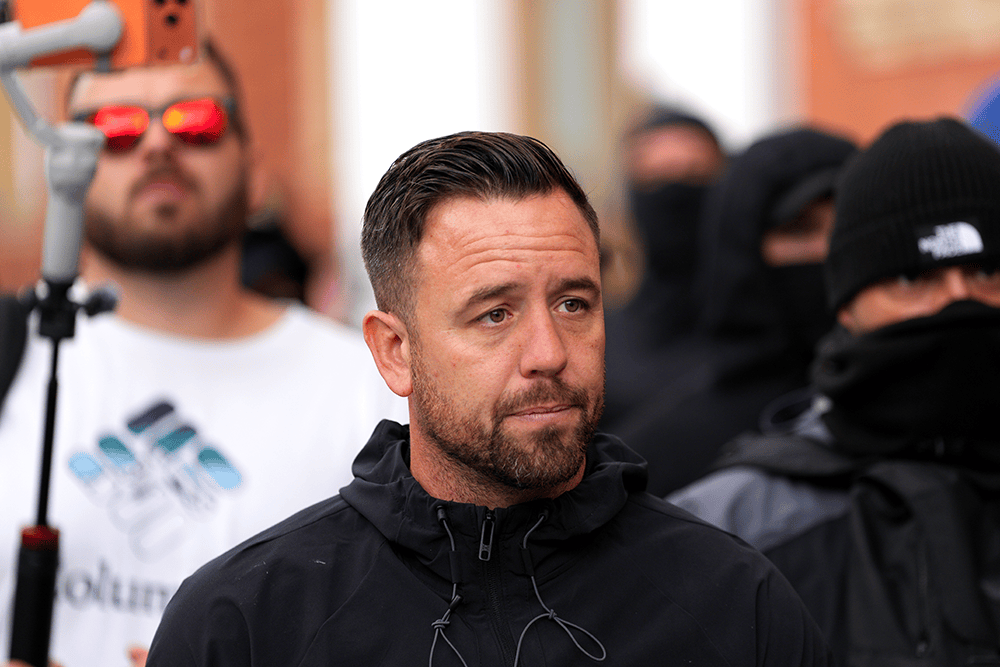
Take the case of Danny Tommo, which I have written about before. Last week the 37-year-old was sentenced to 15 months in prison after pleading guilty to criminal damage. In September he was filmed in the English Channel slashing a dinghy belonging to one of the people-smuggling gangs bringing – with the help of the British and French authorities – illegal migrants into the UK.
Why should a sexual assailant be regarded as fine to be out on the streets and Danny Tommo not?
Tommo is one of those Britons who seems to have had enough of people breaking into the country illegally. Among other protests, he was one of the organizers behind the “Raise the Colors” movement, which saw our national flags being flown across the country earlier this year. He also, unarguably, has a checkered past, having been involved in an attempted kidnapping in 2016. Otherwise he seems to have mainly engaged in various patriotic and anti-migration movements. All of which culminated in him following two boatloads of illegal migrants into the Channel and slashing one of the inflatable vessels. By this stage the illegal migrants had all been safely assisted off the dinghy, although a French “rescue worker” was apparently still on board.
I am sure that slashing an inflatable vessel belonging to an illegal migrant smuggling gang could cause upset. Doubtless the French person was disturbed at the prospect of being on a sinking dinghy – in which case one is tempted to say: “Welcome to Britain.”
But Tommo’s main victims do not awaken my sympathy – for these “victims” are the people-smuggling gangs. Perhaps these gangsters were upset at the damage done to one of their more seaworthy vessels. Perhaps they had a meeting and talked about their hurt feelings and the budget shortfall that Tommo’s acts had caused them. But I cannot pretend to care. If the British and French authorities destroyed every dinghy belonging to the smuggling gangs then I doubt Tommo or anyone else would have a crack at destroying such boats themselves. But the authorities don’t do that, and so the bubbling feeling of resentment and chatter about “two-tier” goes on.

Whenever I discuss these matters with sources in the legal profession, they are keen to stress to me that sentencing guidelines are strict and that judges and the courts in general have little leeway. The judges merely follow the law. Yet even among the legal profession I have found no one who can explain to me why, at a time when the courts are under strict instruction from the government to avoid clogging up our prisons, and do their bit to avoid overcrowding, Tommo should have been detained without bail from the moment he was arrested. Clearly the authorities wanted him off the streets.
If anyone still labors under the belief that the “two-tier” business is a figment of fevered right-wing imaginations, allow me to cite just one case among many of someone who the authorities were not so intent on keeping off our streets.
Qais Al-Aswad is a 26-year-old Syrian-born asylum seeker who came to this country via the usual illegal routes. In August last year he was found guilty of three counts of sexual assault after attacking three different women in Horley in Surrey. He was living at the nearby Four Points By Sheraton hotel – at taxpayers’ expense, naturally – when the crimes took place. In October last year, Al-Aswad was given a suspended sentence. His only punishment was that he was ordered to carry out 200 hours of “unpaid work,” also known as community service. There has been no update on how Al-Aswad has spent his time, nor any information on whether he has found his time in the community to be restorative or not.
I could list any number of similar cases, though The Spectator’s lawyers might balk at the workload involved in listing all the sketchy people who have carried out assaults after leaving the hellhole of northern France for a hotel somewhere on the south coast of England. But why should a sexual assailant be regarded as fine to be out on the streets and Danny Tommo not? It is in comparisons like this that the two-tier nature of our justice system is visible.

It seems to have been the view of everyone from the government down that the problem of people breaking into our country is effectively insuperable. But you will never hear a minister talking about these arrivals as any kind of threat, certainly not compared to the inevitable, nativist opposition that is rising up against them. Mention that some – not all, just some – of those arriving illegally might go on to commit an offense like Al-Aswad and you will find yourself facing a generally female Labour party representative tut-tutting, shaking their head and getting ready to do a full Emily Thornberry on you. They will pucker their lips, furrow their brows, blow out their chest and give you the most high-flown “not all migrants” bollocking that they can muster. Doubtless this makes them feel better, and encourages some deranged activists to post “hero” and similar hashtags on social media. But all they are doing is emphasizing the point.
The point being that the dice are loaded. There seems to be an ongoing presumption from the top of government down that the problem is not the problem. Rather the completely predictable reactions to the problem are the problem. That is why Danny Tommo is in jail and Qais Al-Aswad is not.
The Labour government likes to pretend that talk of “two-tier” is a matter of “perception.” It isn’t. It is a problem of what we used to call reality.






Comments