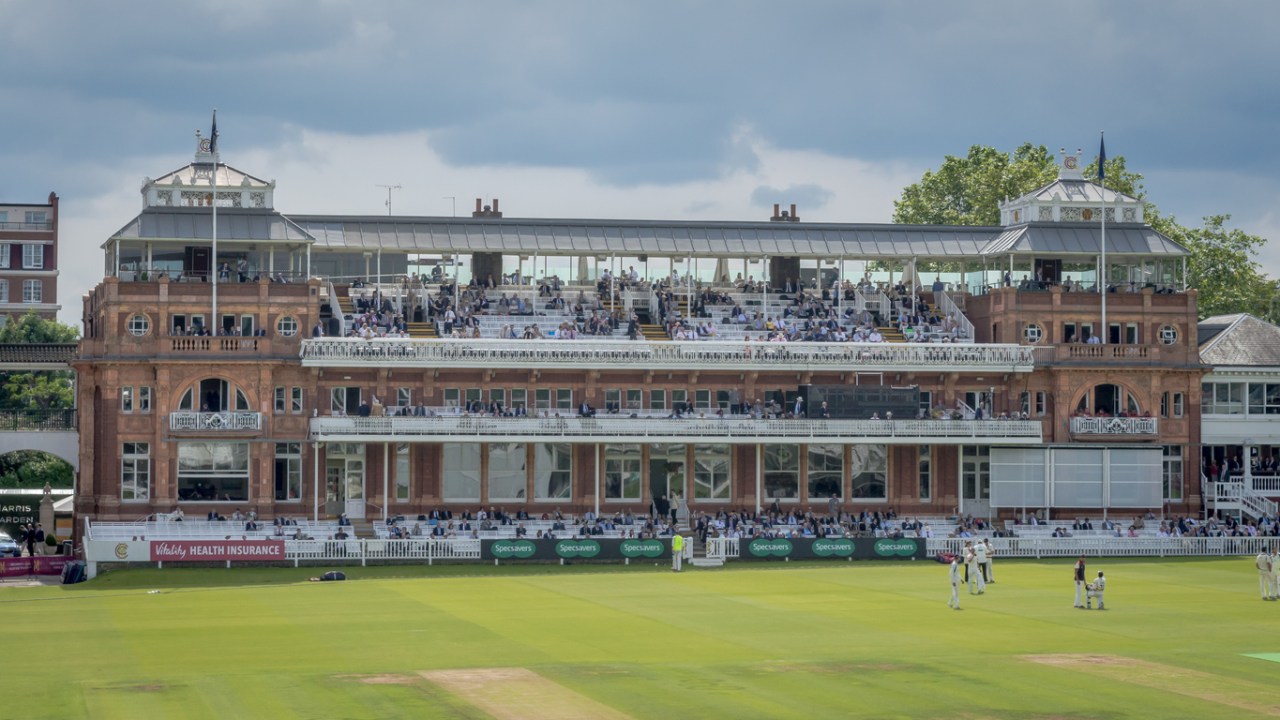
English cricket, in its joyless pursuit of moral purity, has banned naughty jokes. There can be no other explanation for its punishment of Phillip Hodson, a man who has given his life to the summer game as player, administrator, and benefactor, and now finds himself fined £1,000.
Hodson, a former president of Marylebone Cricket Club, which owns Lord’s, and serves as custodian of the game’s laws, has been named, shamed, and forced to cough up for saying the kind of things at a cricket dinner that people have been saying at cricket dinners since W.G. Grace shook crumbs from that famous beard.
Many people who run English cricket are so concerned by the game’s image, and by perceptions of its history, that forms of re-education are now considered necessary
Hodson, who was also deputy-chairman of Yorkshire, made the remarks last July at Scarborough, the club that lends its ground to Yorkshire for a week of festival cricket. Scarborough, one of the great places to watch cricket, has long been associated with fun and frolics. That the club continues to stage first-class cricket is down to people like Hodson, who put their own money behind it.
Cricket-lovers from all over England, and beyond, flock to the seaside every summer, and hitherto nobody has been known to complain about a bit of fruity language.
Regular attenders of those dinners will recognise Hodson’s words, and the spirit in which he uttered them. Noting that he had spoken recently at a local haemorrhoid society, and also a meeting ‘of the Gay Liberation Front’, he told guests that ‘it’s gratifying to see so many friendly and familiar faces here tonight’.
That line is old as the hills, and gets a laugh because it’s funny. The second joke, about the stammering salesman who sold 305 copies of the Bible, is less amusing but hardly offensive. ‘Would you like to buy one’, he asked people on the doorstep, ‘or would you like me to stand here and read it to you?’

Yet, according to a body called the Cricket Regulator, these jokes were enough to put Hodson in the dock. In the time-honoured phrase, uttered on this occasion by Richard Whittam KC, who chaired the disciplinary panel, such attitudes ‘have no place in modern society’.
Whether the jokes are funny is a matter of taste, and age – though it is pretty clear that Hodson was laughing with his guests rather than at them. As for ‘modern society’, what sort of society punishes part-time jesters who tell mild jokes at a gathering of like-minded people? Who shopped Hodson? And why did they take up the matter with the folk at Lord’s, when a quiet word in the bar would suffice? It’s rather sinister.
As well as the fine, Hodson must now undergo a course in – you guessed it – diversity and equality. If he cracks a rueful smile at this requirement it may be because, in his days as a businessman in apartheid South Africa, he coached non-white cricketers pro bono, so he probably knows more about true diversity than the people who have judged him so mercilessly.
There is a subtext, which cannot be ignored. Many people who run English cricket are so concerned – ashamed may not be too strong a word – by the game’s image, and by perceptions of its history, that forms of re-education are now considered necessary.
The game is seen as too white and too ‘middle class’, the province of public schools and ancient universities. MCC has tried to do away with the traditional fixtures at Lord’s between Eton and Harrow, and Cambridge vs Oxford. The members rebelled, and won the day – for now.
A report by the Independent Commission for Equity in Cricket, released in 2023 to the fanfare of a thousand trumpets, began with the conclusion that English cricket was incorrigibly racist, sexist and ‘elitist’, and worked its way backwards to prove it. This followed the imbroglio at Yorkshire, where Azeem Rafiq, a former player, had made claims of racism, upheld by The England Cricket Board. Yorkshire were docked £400,000, and lost 48 championship points.
The ECB also sent in Lord Patel, who began life as a social worker in Bradford, as a trouble-shooter. In December 2021, within weeks of arriving at Headingley, he sacked 16 members of staff deemed to be complicit. One of them was Kunwar Bansil, a physiotherapist with an Indian background.
The following summer, in an interview with Michael Atherton, the Times cricket correspondent, Bansil said that allegations of racism at Yorkshire, where he had worked happily for eight years, ‘couldn’t be further from my experience of the club’. He added: ‘I have always felt included, valued, and welcomed’ by the sport.
Bansil’s observations did not surprise many people who had observed Rafiq since the Pakistani-born cricketer joined Yorkshire in 2008. Rafiq has since apologised for the anti-Semitic tweets he put out as a young man, and has moved to Dubai. His book, It’s Not Banter, It’s Racism, published two years ago, left no trace. Too many people, suspicious of his motives, were reluctant to believe many of his claims.
It is possible to meet the re-educators on common ground. The public schools do cast a long shadow across cricket. But that is largely because state schools no longer play the game in significant numbers. The absence of cricket on free-to-air television since 2005 has proved even more wounding. The game lacks the profile it once took for granted when the BBC covered every Test match, and players like Ian Botham and David Gower were well-known public figures.
There is also a difficulty with cricketers from an Asian (mainly Pakistani) background making progress in the professional game. Yet it is undeniable that many talented Muslim players find the club game awkward, for social reasons.
There have been other casualties in this cultural war, on which prominent members of the cricket media have remained unusually silent, out of fear of sounding ‘racist’. Even Michael Vaughan, a decorated captain of England, felt a cool breeze. Accused of making racist comments during a one-day match while he was playing for Yorkshire, Vaughan stood his ground, and has resumed his broadcasting career.
Vaughan, like Hodson, is neither a racist, nor a sexist, nor an ‘elitist’. These men have given their lives to cricket, a game run no longer by people with a sense of proportion or humour. The virtuous are donning their robes. Their purge is just beginning.



Comments