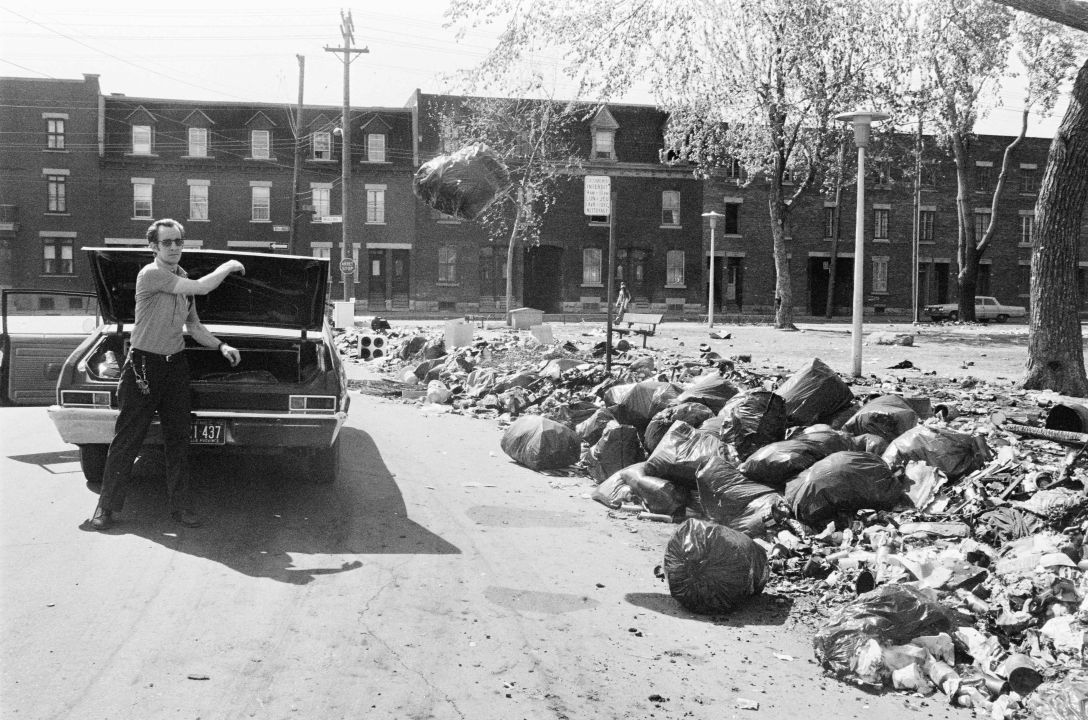
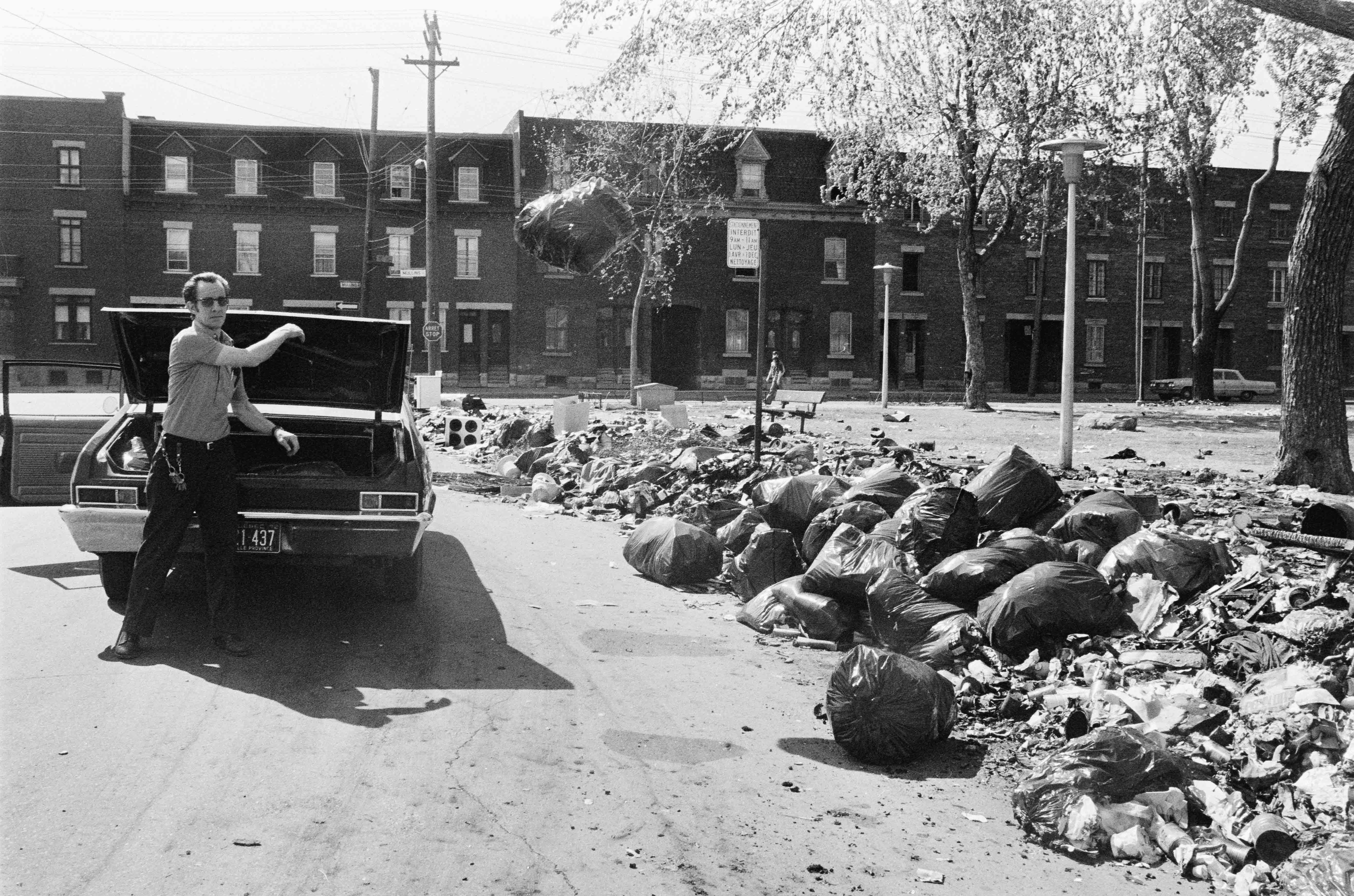
We tend not to think too much about binmen. They operate in a shadow world, their rounds complete before most of us have even left the house. And when we do see them, do we not avert our eyes, recoiling from the filth and, if we’re really honest, slightly ashamed that someone else is doing the dirty work? Yet uncollected rubbish, conversely, is the first sign of a broken or bankrupt society; the winter of discontent, a pile of bin bags. We know, deep down, that we need binmen, even if we can’t quite acknowledge it.
Simon Paré-Poupart is familiar with all of this. In his two decades as a binman – or garbageman – in Montreal, he has been submerged in rubbish, day after day, and observed the people whose streets he cleans. ‘I’ve hauled nearly seventy thousand tons of trash, and this fact cannot help but shape the man I am today,’ he writes in Trash! A Garbageman’s Story. ‘The looks I get along my route show me that people sometimes mistake me for the trash I handle.’
Well, since writing his book, this piece of trash has been on the cover of Harper’s and featured in the New York Times, the Literary Review of Canada, Le Monde and the Atlantic. ‘It’s kind of crazy,’ he laughs. ‘We didn’t expect that at all.’
Trash! does for binmen what Anthony Bourdain’s Kitchen Confidential did for the people who work in restaurants. The curtain is drawn back – and while we may not like what we find, we can no longer ignore it. The insanely long shifts, the bags of industrial waste that pull your arms out, the compost bins that spill ‘their foul-smelling contents all around you’. It’s all here in squalid detail.
Temperatures of the kind we experienced last week in the UK are especially cruel on binmen. Extreme heat does something strange to rubbish, explains Paré-Poupart, bringing it back to squirming life: ‘Before you know it, white worms are wriggling and swarming in every garbage bag and along the walls and floors and underlids of every trash can.’ Grim as this is, it is nothing compared to the exhaustion. ‘You have to drink nonstop, pace yourself like a marathon runner… Dirt and dust are clinging to you, but they’re also washed away by the sweat that beads up on your body.’
‘You have to drink nonstop, pace yourself like a marathon runner… Dirt and dust are clinging to you, but they’re also washed away by the sweat that beads up on your body.’
Trash!, translated from French by Pablo Strauss, takes the reader to uncomfortable places, but there is no self-pity. Paré-Poupart also celebrates the marginalised and ignored, the freaks and weirdos, the people who keep the show on the road – or, rather, the trash off it. ‘I feel solidarity with all the people working behind the scenes,’ he writes, ‘whose anonymous labour keeps our cities clean.’ There is Old André, ‘smoke in his mouth, big stout gut, and always a beer on the go somewhere in the truck’. Beaujeunehomme, ‘running around in a state of inebriation that would make even the hardest drinkers stagger’. And Pompon, who fell out with his boss, so ‘grabbed a shovel to clock [him] on the head’.
‘Some of my colleagues cry when they read the book,’ Paré-Poupart tells me, ‘because I think it connects with these feelings they have. For some of them, this was the first book they’d read in their lives.’ I should add, though, that Paré-Poupart is adamant he does not speak for all binmen. For a start, he laughs, ‘when I began, 99 per cent of the guys were taking drugs while working and I wasn’t’.
In truth, even ignoring the drugs, Paré-Poupart was always a slightly unnatural fit on the back of the truck. A bookish child, who loved playing Dungeons & Dragons, he was ‘certain that I’d be an intellectual one day’. His parents divorced when he was young and he rarely saw his alcoholic father. An uncaring stepfather was dismissive of Paré-Poupart’s interest in literature (‘No one in my house wanted to hear about Emile Zola over dinner, let alone Balzac’) and told him instead ‘to be a man’. Even the ‘garbage’ bit was his idea. ‘He couldn’t have given me a better suggestion,’ writes Paré-Poupart.
What started as a way of appeasing his stepfather, and paying for a college education, quickly became an obsession. The hard work and low social status forges a rare bond between these men. Hold your nose, urges Paré-Poupart, and there is joy, humour and even a kind of muscular romance here. Night shifts on the back of the truck are a particular thrill: ‘In front of me was the infinite darkness of the countryside; beside me, the huge hopper full of trash; all around me, dust mixed with the acrid smell of overheated tyres and brake pads.’
It is moments like these that mean Paré-Poupart can’t walk away. He has a master’s degree, a bestselling book and a deal in place for a second. He is now in his forties and really doesn’t need to do this anymore. But that isn’t the point. The rest of us will never fully understand but being a binman is more than a job for Paré-Poupart, it’s a way of life. ‘If you told me I was going to die tomorrow, I’d go out for one final run on the back of a truck, without a second thought,’ he concludes. ‘I’d go right back where I belong.’
Trash! A Garbageman’s Story is published by Melville House (£12.99)




Comments