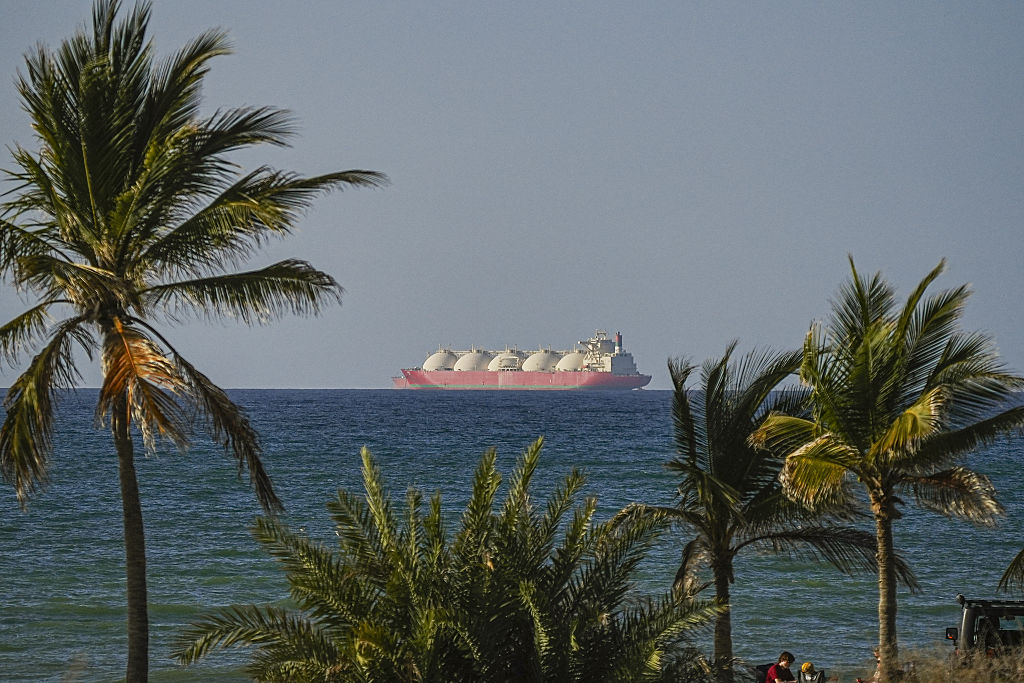
As I argued last month, the Iran war was really about America’s great power competition with China. Not by design, perhaps, but these kinds of conflicts are not easily confined by those who start them. Any disruption to the world’s principal energy chokepoint becomes, whether Washington planned for it or not, a test of the Sino-American balance of power.
China is the country around which the whole episode turns, and the one best positioned to come through it
Trump’s announcement on Sunday of a naval blockade targeting all vessels entering or leaving Iranian ports, after peace talks collapsed in Islamabad, sharpens that test considerably. Hours before CENTCOM confirmed the blockade would begin on Monday morning, two Chinese state-owned supertankers had already passed through the strait under the IRGC’s yuan-denominated toll system, collected their military escort and were heading east into open water. China is not a bystander in this crisis. It is the country around which the whole episode turns, and arguably the one best positioned to come through it.
The strait carries roughly a quarter of the world’s seaborne oil, and China alone receives nearly 40 percent of all crude transiting it. When Trump announced the blockade on Sunday, targeting all vessels entering or leaving Iranian ports, the immediate effect was to shut down the trickle of ships still getting through, most of them bound for China or India. Beijing’s response was measured: Foreign Minister Wang Yi told the UAE’s special envoy that the blockade does not serve the interests of the international community. China, he said, stands ready to play a “positive and constructive role.”
The conventional assumption is that China’s dependence on the Gulf makes it acutely vulnerable. Trump himself claimed in March that 90 percent of China’s crude imports pass through the strait. The actual figure is closer to 40 percent, and even that overstates the vulnerability. China is simultaneously the largest single importer through Hormuz and, paradoxically, among the countries best insulated against its closure.

Start with stockpiles. China’s state and commercial reserves are estimated at roughly 1.4 billion barrels, enough to cover four months of total imports or seven months of what normally transits Hormuz. Japan holds weeks of LNG cover. Then there is diversification. Unlike Japan, which sources nearly 80 percent of its oil from Saudi Arabia and the UAE, China spreads its purchases across eight suppliers, none of which provide more than a fifth. Russia, the largest source, delivers partly by pipeline. The Power of Siberia gas line provides an overland route that no blockade can touch.
Most striking is electrification. China’s electric vehicle fleet is roughly as large as the rest of the world’s combined. New energy vehicles accounted for over half of all car sales last year. The oil displaced by EVs in 2025 was roughly equivalent to Saudi Arabia’s total imports. Oil accounts for only about 18 percent of China’s energy consumption; coal and renewables dominate a power grid almost entirely insulated from seaborne imports. The People’s Daily has been telling readers the country holds its own “energy rice bowl.” That is partly propaganda but not entirely wrong.
The crisis is not costless for Beijing. Independent refiners in Shandong are losing access to discounted Iranian crude on which their margins depend. The chemicals sector faces a squeeze on naphtha and LPG feedstocks. China halted fuel exports in March to conserve domestic supply, triggering shortages across South-East Asia from Laos to the Philippines, and then released selective quotas to Bangladesh, Myanmar and Vietnam as a tool of regional influence. Real money is being lost. But this is not a systemic threat.
Contrast that with America’s actual allies. Japan sources 70 percent of its Middle Eastern oil through the Hormuz Strait. South Korea’s net oil imports run to nearly 3 percent of GDP. Thailand, Pakistan, the Philippines: all are rationing fuel, canceling flights and telling citizens to work from home. These countries are bearing the sharpest costs of a war they had no part in starting. The blockade compounds their predicament while doing relatively little additional damage to China, which had already lost most of its Hormuz supply weeks ago and has since begun buying American crude to fill the gap. Some 600,000 barrels per day of US crude are scheduled for loading to China in April. Chinese state media framed this, with characteristic delicacy, as a competitive victory over Japan in securing American supply. With friends like Washington, Tokyo might reasonably ask, who needs adversaries?
The IRGC toll system, under which vessels pay in yuan routed through China’s Cross-Border Interbank Payment System, does not herald the end of the petrodollar. The Gulf Research Center is right to call the yuan’s role here that of a “corridor currency:” not a universal alternative to the dollar, but one whose utility rises where dollar settlement is constrained. What matters is that alternative payment rails now exist and function, and infrastructure built under wartime pressure tends to persist.
Beijing’s wider posture is “active neutrality.” It condemned the strikes, backed Pakistan’s mediation and is calling for restraint, but will not intervene militarily. If Washington gets bogged down in the Middle East, it is distracted from the Indo-Pacific. The preference is to ring-fence the crisis, keep buying from whomever will sell, and wait.
Britain was right to refuse to participate in the blockade, but the European angle is secondary. The primary contest is between Washington and Beijing, and the real lesson is that China’s energy planners have been vindicated. The EV program, the strategic reserves, the pipeline diversification, the coal-and-renewables grid: all were designed for precisely this contingency. The 15th Five-Year Plan doubles down on every one of those priorities. Whatever happens next, Beijing’s capacity to absorb the shock will only grow. The same cannot be said for Tokyo, Seoul or the capitals of Southeast Asia, still dependent on a sea lane that the United States can no longer reliably guarantee. That asymmetry is the story of this war.




Comments