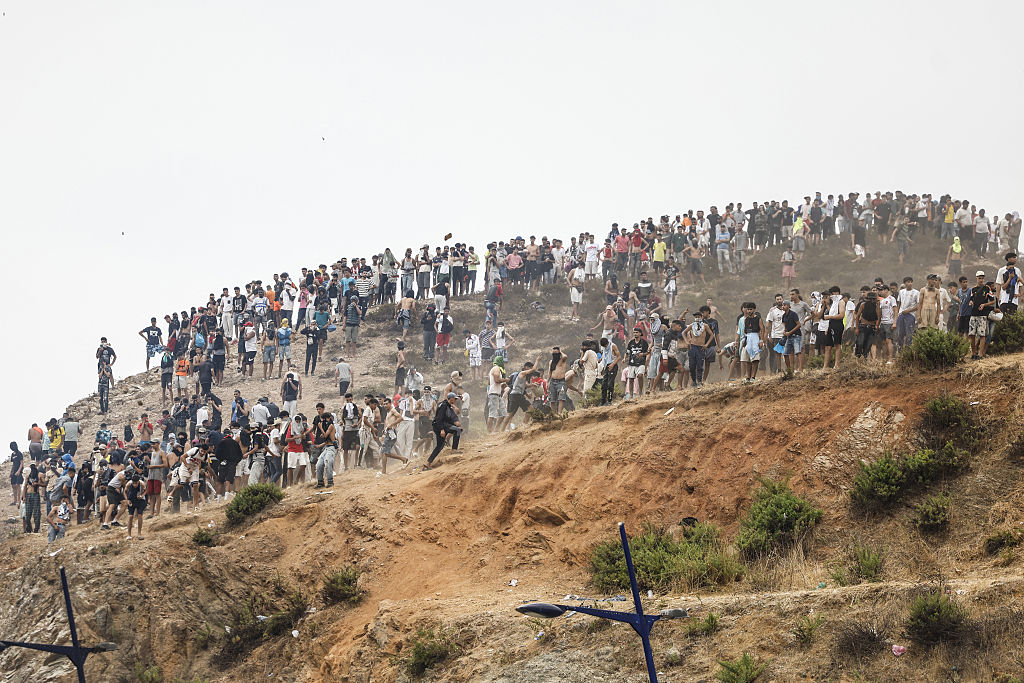
The scenes at Ceuta are eerily reminiscent of aspects of the infamous anti-immigration French novel, The Camp of the Saints by Jean Raspail – in which Western countries are overrun by mass immigration from India.
They also illustrate Europe’s recent asylum crisis in a nutshell. A “luxury belief” ruling by liberal Spanish judges making it harder to deport people, a surge of people from a poor or middle-income country that the authorities in the receiving country are unwilling to resist with force, while the authorities in the sending country are either indifferent or happy to cause their neighbor political discomfort. It has echoes of the Syrian surge in 2015 and the explosion of small boat Channel crossings after 2018.
Much of Spain’s illegal immigration comes from Spanish speaking Latin American countries
The pressing need for European states, as I have argued, is to replace an asylum free-for-all of irregular entry with a system of refugee selection via safe and legal routes. The chaos in Ceuta shows the problem at its worst.
Many of Spain’s European neighbors will be enjoying the discomfort of Pedro Sánchez’s center-left government resulting from the Ceuta invasion. Both France and Italy have said the country should be temporarily excluded from the Schengen travel zone.
They were already irritated by Sánchez’s grand-standing as the last pro-immigration European leader. Earlier this year Spain announced another amnesty for illegal immigrants, the seventh in the past 40 years. And earlier this month it was revealed that 1.2 million people had applied for the one-year renewable residence permit, double the number expected. To qualify for a residence permit you need to have lived in the country for just five months and have a clean criminal record.

Spanish opinion was more or less evenly divided on the amnesty and one reason it is more popular than it would be in most other European countries is that much of Spain’s illegal immigration comes from Spanish speaking Latin American countries. Some 25 percent of amnesty applicants are from Colombia, who integrate easily into Spanish society.
People from most Latin American countries do not require a visa to visit Spain so some of those arriving from those countries then overstay their 90-day tourist visa. (Morocco, a Muslim country, provides the largest number of non-Latin American applicants at 13 percent.)
Still, immigration will be a big issue at next year’s general election in Spain, even bigger now after the Ceuta invasion, with the populist Vox party expected to benefit most. But as in the UK the right is divided between the traditional conservative People’s party and the populist Vox. Increasing support for the latter could even benefit Sánchez’s Spanish Socialist Workers party.
The Ceuta invasion comes at a time when asylum applications into Europe have actually been falling in most countries, one reason for the fall in Channel crossings this year.
According to Eurostat there was a 13 percent fall in 2024 (to 912,000) and a further fall of 27 percent in 2025 (to 669,000). There are several reasons for this. The number of Syrians claiming asylum has fallen sharply. Frontex, the European border agency, has increased surveillance and strengthened cooperation with bordering countries. And national governments have adopted more restrictive policies in the face of populist insurgencies, including Germany, the Netherlands, Italy, Austria, Denmark and Sweden.
There is also an increasingly widespread view that European Court of Human Rights rulings have been too expansive on immigration and some countries, notably Hungary and Poland, have just ignored them.
If enough European countries do finally decide to rein in the ECHR and make it easier to close Europe’s borders – maybe even reversing the 1951 Refugee Convention rule that asylum-seekers have to apply within a country, to insisting that they apply outside at an asylum hub – it could be a lucky break for Andy Burnham. Asylum numbers in the UK, which have been rising relative to most other countries, would fall sharply and draw some of the sting from the immigration issue in the run up to the next election.
This piece is part of a Policy Exchange double bill from three leading experts. Read Richard Ekins and Guglielmo Verdirame’s accompanying piece here.






Comments