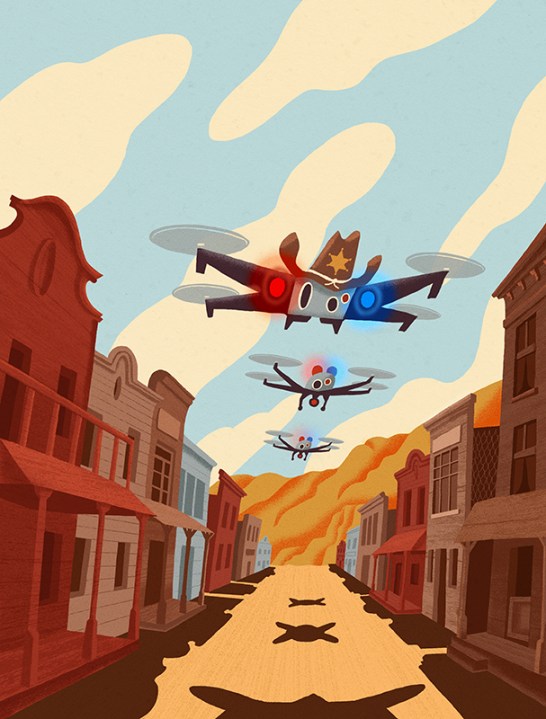

In the Russia-Ukraine war, drones have leveled the playing field between economically unmatched adversaries and have provided unprecedented capacity to monitor enemy troop and equipment movements. In domestic law enforcement, they are already being used for crime scene reconnaissance, for tracking suspects and for finding missing persons.
Their greatest potential, however, lies in detecting and responding to a crime in progress before a victim or witness reports it. This is a line that police agencies have been reluctant to cross.
A quadcopter drone is a battery-powered, unmanned aircraft, held aloft by four helicopter-like propellers. They usually carry cameras capable of recording in detail objects below them or as much as 2,000 feet away. At the start of the drones-for-policing era, an officer would carry one of the devices in his squad car and launch and pilot it himself at the site where it was needed – where a missing person was last seen, say, or at a public event at risk of a terror attack. Federal Aviation Administration (FAA) regulations required drone operators to keep drones in their line of sight to avoid collisions with other aircraft. The drone and its pilot had to be near each other.
The big breakthrough came in 2018, when the Chula Vista, California, police department created the flagship Drone as First Responder (DFR) program. The idea behind DFR is that rather than arriving at an accident, missing person or hostage situation in tandem with its piloting officer, the drone would get there first to provide reconnaissance before officers arrive.
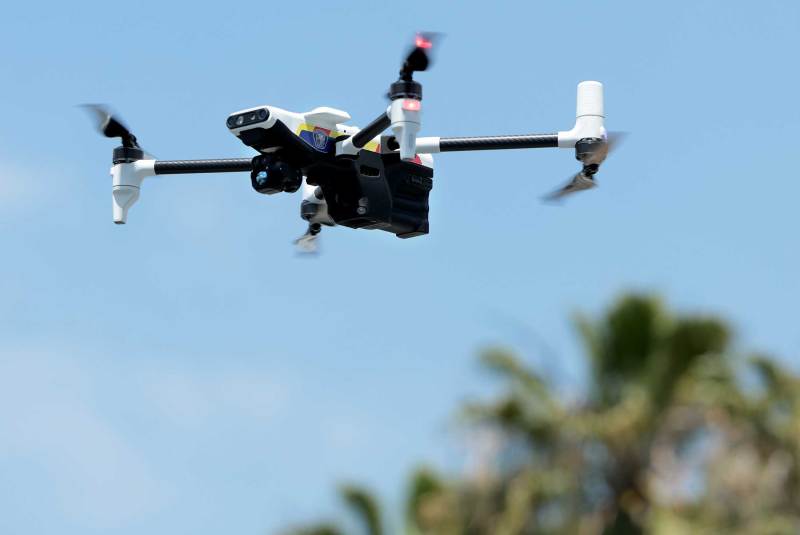
Getting first to a scene required launching drones from a central docking station rather than from an on-scene police car. A pilot in a central command center would guide the drone from afar. But such remote piloting meant that the drone was often beyond the pilot’s visual line of sight, in violation of FAA rules. Obtaining a waiver from those rules was time-consuming and laborious.
A drone can park itself on a table to preserve battery life and continue beaming a live video feed
The second breakthrough occurred in spring last year, when the FAA, spurred on by an executive order from Donald Trump, expedited the waiver process for law-enforcement remote piloting. The applications for waivers from line-of-sight requirements skyrocketed.
A reliable count of the police departments operating DFR programs is unavailable, but estimates put the number at 300 to 400. Further estimates on the number of police departments using any kind of drone vary wildly from about 1,500 to 6,000. But the momentum is with DFR programs.
Drones have found missing dementia patients in minutes after conventional search-and-rescue teams fruitlessly searched for hours. They have located and tracked car thieves as they made their getaways, avoiding dangerous police pursuits (undoubtedly to the disappointment of many cops, who love to chase cars). They have unearthed criminals hiding in the woods late at night.
In April 2024, after a 911 caller reported a fight in progress in Silver Spring, Maryland, a drone recorded 45-year-old Jovan Ali stabbing his opponent and fleeing the scene. The drone led Montgomery County police officers to Ali’s hiding place, where they arrested him without incident. The stabbing victim refused to testify, but prosecutors obtained a conviction anyway based on the drone footage.
In April last year, police in Dunwoody, Georgia, received an alert from a neighboring department saying that an active shooter had driven into their city. Dunwoody’s license plate cameras found the suspect’s car, then a drone traced the car to the roof of a car park and confirmed the suspect’s identity from the tattoo on his neck. Armed with this intelligence, officers were able to effect a safe arrest.
First-responder drones provide officers with what is known as situational awareness, illustrating the layout of a potentially lethal environment before officers arrive. They can even do so indoors. If a suspect has barricaded himself in a house, possibly after taking hostages, officers can breach a door or window and send a drone in first. Some drones can break the windows themselves. Once inside, they can push open doors if they are not tightly shut and fly under tables. A drone can park itself on a table to protect its battery life and continue beaming a live video feed. The very act of sending in a drone can flush a suspect out. “They sound like loud vacuum cleaners and are psychologically intimidating,” says Sergeant Justin Aita of the Talbot County Sheriff’s Office in Maryland.
Their most significant potential use is being squelched by overwrought concerns about civil liberties
Sometimes, what drones do not find is as important as what they do. Last year, Los Angeles Police Department DFR drones responded to more than 3,000 emergency calls. In 11 percent of the dispatches, the drone discovered that the 911 report was incorrect or that the situation, such as a stalled car on a highway, had already been resolved, according to the California Post. In those cases, LAPD officers could abort their missions and turn their attention to more pressing matters.
Drones have prevented officer shootings by discrediting false reports that a suspect was wielding a firearm when in fact the object in question was a BB gun or cigarette lighter.
Until recently, Chinese DJI drones dominated the law-enforcement market because of their low cost and superior performance. (A policing-caliber drone, minus a docking station and other add-ons, runs from about $4,500 to $11,000.) At the end of last year, however, the Federal Communications Commission blocked new sales of DJI drones, citing national security concerns. The manufacturer, SZ DJI Technology, filed a suit in the Ninth Circuit Court of Appeals, claiming that the ban would cost the company more than $1.5 billion in its first year alone.
That suit is still pending. But the ban provided an opening for American companies, previously the underdogs of the drone world, which are now racing to capture market share.
Goals include extending battery life (now around 20 to 50 minutes, depending on wind and other weather conditions), increasing speeds (they can currently travel, on average, at about 32 mph) and developing new capacities for autonomous operations and perceptual reach.
US companies tout the synergies with their other law enforcement product lines – Flock Safety’s license plate readers automatically feed data into Flock drones if the drones used by police have not already been equipped with their own license plate technology. BRINC drones are integrated with the software of partner Motorola Solutions, which provides police department operating systems.
As a scientific matter, American law-enforcement drone companies are squarely within the world of Silicon Valley. Their unapologetically pro-police stance, however, puts them at odds with that world – and sometimes even with police commanders themselves.
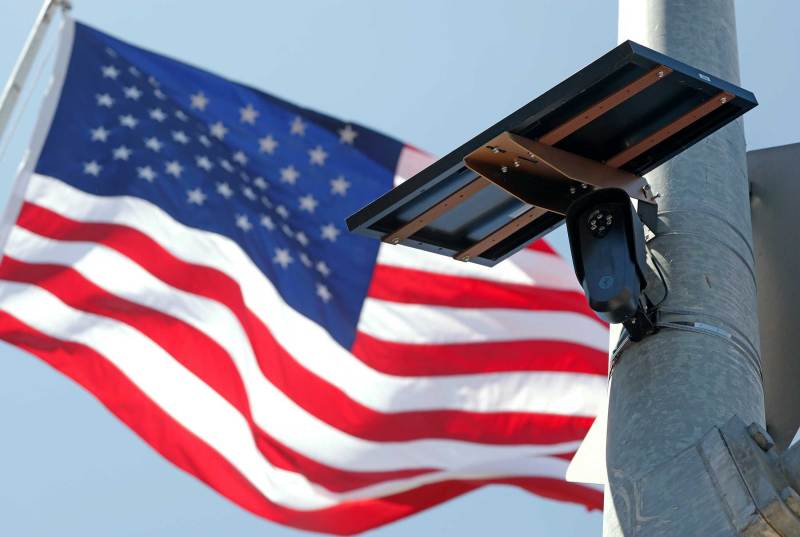
Flock Safety is the most embattled of the American manufacturers, less for its drones than for allegedly sharing its license plate reader feeds with US Immigration and Customs Enforcement and for several dozen cases in which individual officers used license plate readers for their own ends. Its CEO, Garrett Langley, is more than willing to fight back. In December last year, he wrote an email to the police department in Staunton, Virginia, in response to misinformation about the company’s data security. “Flock, and the law enforcement agencies we partner with, are under coordinated attack… We’ve been dealing with this since our founding, from the same activist groups who want to defund the police, weaken public safety, and normalize lawlessness.”
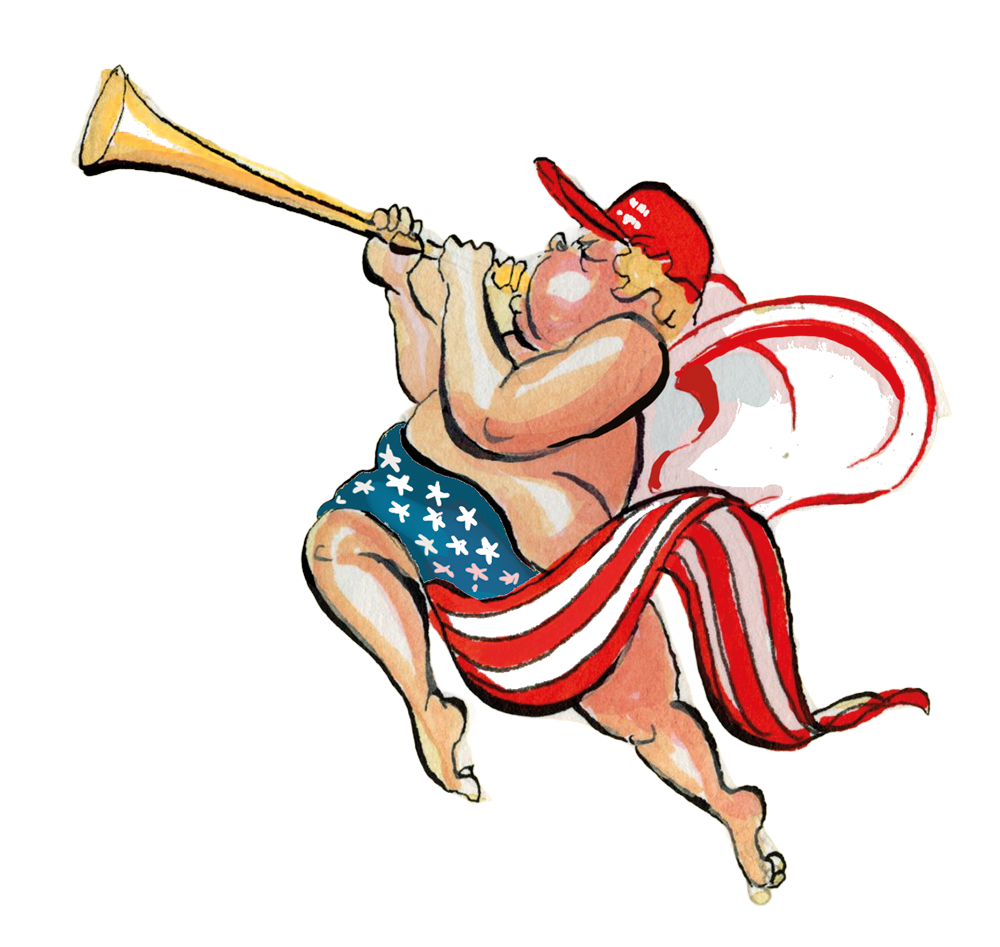
Such language would give many Google employees a fit of the vapors. And it spooked the Staunton authorities as well. The Staunton police chief responded primly, saying his police department was not “under attack” but was simply experiencing “democracy in action.” And the city proceeded with plans to cancel its license plate reader contract with Flock.
Despite such skirmishes, the law enforcement world is wildly enthusiastic about drones, seeing them as a vital “force multiplier” at a time of inadequate manpower. William Bratton, former head of the New York and Los Angeles police departments, says “drones will change American policing. Their potential use is unlimited.”
Their most significant potential use, however, is being squelched by overwrought concerns about civil liberties. At present, most police departments restrict what drone cameras are allowed to see on the way to, and coming back from, first-responder jobs.
Surprisingly, the liberal California enclave of Santa Monica has less restrictive rules. On July 6, 2024, the city’s police department drone was returning to its station after answering a 911 call at the beach. The pilot spotted a man punching through the lock of an SUV with a screwdriver and ducking inside; the suspected thief proceeded to break into nearby cars as well. The drone pilot directed officers to the precise location and the burglar was arrested.
Had a similar situation arisen in, say, West Hollywood or Montgomery County, Maryland, the burglar would likely have continued his crime spree unmolested. West Hollywood requires that drone cameras be turned off while they are flying to and from a job; Montgomery County says cameras must be pointed toward the horizon when drones are in transit.
Police departments are terrified of being accused of “mass surveillance,” especially with the American Civil Liberties Union and the Electronic Freedom Foundation (another left-wing civil libertarian group) nipping at their heels. Their public-relations materials stress the limited nature of their drone use: there will be no viewing the ground until the drone arrives at the scene, unless it is an emergency or the department has obtained a warrant from a judge. The opposition to greater use is bipartisan: many red states, such as Texas, Florida and North Carolina, codify those limitations in statutes.
Police departments are terrified of being accused of ‘mass surveillance’
In July, however, Ohio broke away from the pack. Despite fierce opposition from the Ohio chapter of the ACLU, the state passed a law allowing drones to observe what is “otherwise visible to the naked eye” without a warrant. This position conforms to the long-standing “plain view doctrine” in Fourth Amendment search-and-seizure law, which holds that people have no reasonable expectation of privacy for activities or objects exposed to public view, including from above. If an occupant of a commercial or private aircraft could see something on the ground, the police are allowed to as well, without a warrant.
Fourth Amendment law is notoriously byzantine, however, and a separate line of cases outlaws tracking a person’s public movements, such as via cell phone data or aerial surveillance, if that tracking occurs over an extended period of time.
In 2020, the Baltimore Police Department ran a trial program using air surveillance to apprehend violent felons. Piloted aircraft, operating only during the day, captured pixelated images of cars and people; after a crime, data analysts could identify the pixelated dots representing the suspect during and after the crime and reverse the anonymization of the dots in order to track him down.
Brushing off the fact that the case had become moot, a majority of the Fourth Circuit Court of Appeals, sitting en banc, ruled in 2021 that the discontinued program constituted an illegal warrantless search. Violent crime in black neighborhoods is the product of racism, Chief Judge Roger Gregory wrote in a concurrence, as was the alleged oversurveilling of black neighborhoods. The case, Leaders of a Beautiful Struggle vs Baltimore Police Department, has undoubtedly contributed to the opposition to proactive drone flights among skittish police departments.
In an ideal world, however, drones should be allowed at the very least to observe the ground going to and from first-responder calls. Banning such plain-view recording needlessly forgoes an anti-crime windfall when police departments remain in their post-George Floyd staffing crisis.
Drones should, moreover, be allowed to search for crime as it is happening without a 911 call. If a particular neighborhood is being crushed by nighttime robberies or car break-ins, a drone could be sent on patrol. A drone could follow the public movements of members of criminal organizations, instead of using an organized crime squad to tail the suspects. Drones could watch critical infrastructure and parks. They could form virtual barriers around beleaguered synagogues. They would be automatically connected to other anti-crime technologies such as street cameras, facial recognition systems and license plate readers, so that if a land-based machine spots a warrant absconder’s car, a drone would be automatically dispatched to track him until a cop could show up.
The ever-unbuttoned Flock team articulated the classic response to civil libertarian objections last December: “If you’re not involved in a crime, you shouldn’t be concerned” about a public intrusion on your privacy, a representative for the company told San Francisco’s ABC News outlet. Spotting an opening to diss a competitor, the CEO of dronemaker Skydio mocked this statement in a blog post as an unforced public-relations error. The standard retort to the “if you’re doing nothing wrong, you have nothing to fear” argument is the “slippery slope”: give the police this power and they will expand it until we live in a totalitarian state. This concern is valid; finding an acceptable balance between security and liberty (or, really, privacy) is an ongoing challenge. But another aspect of freedom that libertarians ignore is the freedom to use public spaces and enjoy private domains without predation or fear. The proper response to the slippery slope argument is to demand transparency regarding police activity, not to forgo technological advances that would have such large public-safety benefits.
Finding an acceptable balance between security and liberty is an ongoing challenge
The conflict over drones is part of a broader war on high-tech policing. Like so much today, that war is often prosecuted on racial grounds. In 2024, Chicago Mayor Brandon Johnson canceled a contract with ShotSpotter, which provides automated gunshot detection, in part because the technology showed that most shootings in the city occurred in majority black and Hispanic neighborhoods.
Jay Stanley, a senior policy analyst with the ACLU, claims that a newly announced federal grant program to assist cities buy drones, AI systems, license plate readers and other high-tech would be trained on “communities of color… blanketing communities with surveillance and generally seeking to turn state and local police agencies into instruments of Trump’s federal government – its ideological obsessions, racism and approach of loyalty over law.”
The President’s anti-crime initiatives “target low income Black and Brown communities,” according to the ACLU. Actually they target crime, which is magnitudes higher in black neighborhoods than elsewhere. (Stanley did not respond to a request for an interview; the Electronic Freedom Foundation declined to speak to me.)
Meanwhile, the innovation continues. Drone speeds are reaching 60 miles per hour, though that demands a comparable increase in long-distance visual acuity. A single pilot can now operate four drones at a time, extending the perceptual capacities of a single officer. Some drones instantly generate 3-D maps of interior and exterior spaces.
As policing gets smarter, criminals remain breathtakingly stupid – carrying a gun concealed in one’s crotch to a court date, for example, or having to ask one’s just-hijacked Lyft driver for instructions on driving his car (two recent examples from Chicago). For now, dumb continues to best smart, but that balance may change.



Comments