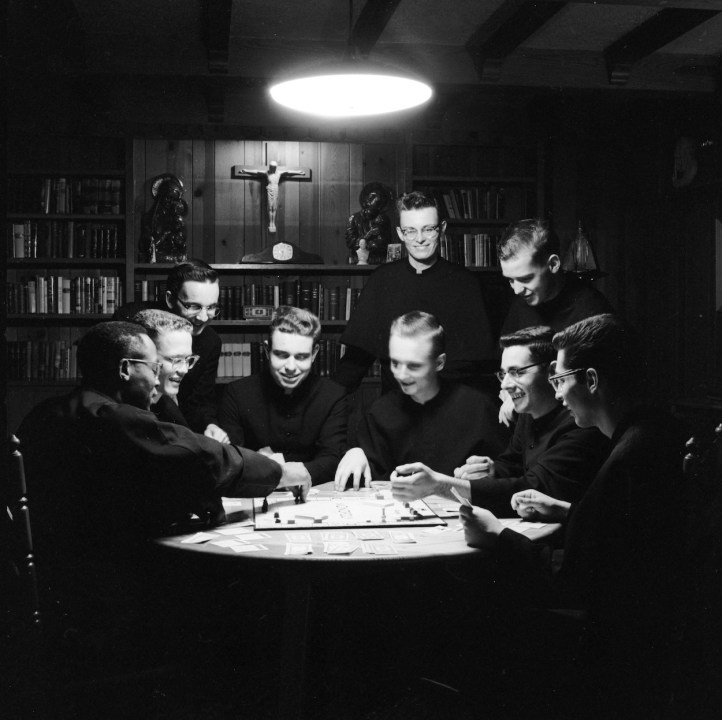

‘What time are morning prayers tomorrow?’ I asked the monk who, after meeting me at the monastery entrance, was taking me to my room. He checked a noticeboard listing the various Offices of the Day, the routine of prayers monks carry out each day of their lives.
I followed his finger along the listings. Oh bloody hell, I thought. Lauds on Friday morning was at 5.30 a.m., and I had arrived at the Abbey of St Matthias late Thursday afternoon. Winter darkness was descending on the German city of Trier and I had trudged nearly 40km of the Jakobsweg, Germany’s Camino.

Fortunately, the monk – like the rest of his Benedictine order – was a practical man and could see my bedraggled state. He shook his head: ‘That’s far too early, don’t worry – you need to rest.’ He was right. I did need rest.
Yet we live in a culture that is obsessed with activity. In his book The Burnout Society, the Berlin philosopher Byung-Chul Han argues that we are rushing so much that we often miss out on real life. Instead, our lives have ‘become bare and radically fleeting’ while lacking meaning. Most of us exist in a state of ‘hyperactivity,’ obsessed with ‘hysterical work and production’.
So try something different: go and stay at a monastery or convent. Many religious houses offer laypeople time and space for contemplation. Just attending Lauds (I made it to the more social time for Saturday prayers at 6.45 a.m.) or Vespers is an unreal experience. Praying with monks in their black cassocks, surrounded by ancient stone, is unlike anything I’ve encountered in my normal life. The utter quiet as I sat there in the abbey church was so potent it was almost shocking. This is not a world designed for us moderns, conditioned as we are to remain stimulated at all times.
As the monk took me back to my room after prayers, I mentioned that I had gone to a school run by Benedictine monks in England. ‘Ampleforth?’ the monk correctly guessed. The next day he approached me after evening Mass and invited me to join the brothers for lunch, although my booking had only included breakfast (and some people say those thousands of pounds spent on an education at a prestigious, if occasionally scandal-ridden, Catholic public school are wasted).
The next day I took my place in a wood-panelled refectory as a monk in an apron brought out big pans of soup. It was simple but hearty stuff: a thick vegetable soup and another soup including slices of wurst, along with fresh bread.
During the table talk, I decided to put my editing for the Catholic Herald to use and brought up the topic of Cardinal Gerhard Ludwig Müller, one of the German Church’s most outspoken traditionalist figures. I said he seemed an interesting man and asked what the monks made of him. My monk, who was sitting opposite me, put down his soup spoon and gave me a steely look. ‘He’s a bit of a hardliner for our tastes’.
The utter quiet as I sat there in the abbey church was so potent it was almost shocking
I decided to leave it there with Cardinal Müller. This I hadn’t anticipated: I was surrounded by liberal Benedictine monks. But that’s part of the joy of staying at a monastery – it gives you a chance to reflect and reassess, including on your own biases and prejudices.
Plus, a humble Benedictine monk is under no obligation to concur with a powerful cardinal given the Rule of Saint Benedict, which underpins how the monks live. The Rule calls for moderation in all things – be it eating, drinking, sleeping, working or praying – to ensure a harmonious balance. Benedict’s short book of precepts is famous for its fusion of spiritual guidance with the saint’s practical advice on what is needed for a community to get along. It has proved highly effective: Benedict forged one of the most significant and successful monastic orders.
While the number of monasteries is tiny compared with what it once was – especially thanks to the reformation – they are still out there. And some are ready to take you in should you need a refresher course on moderation in your life, which might just be the ticket after a rather frantic Christmas.


Comments