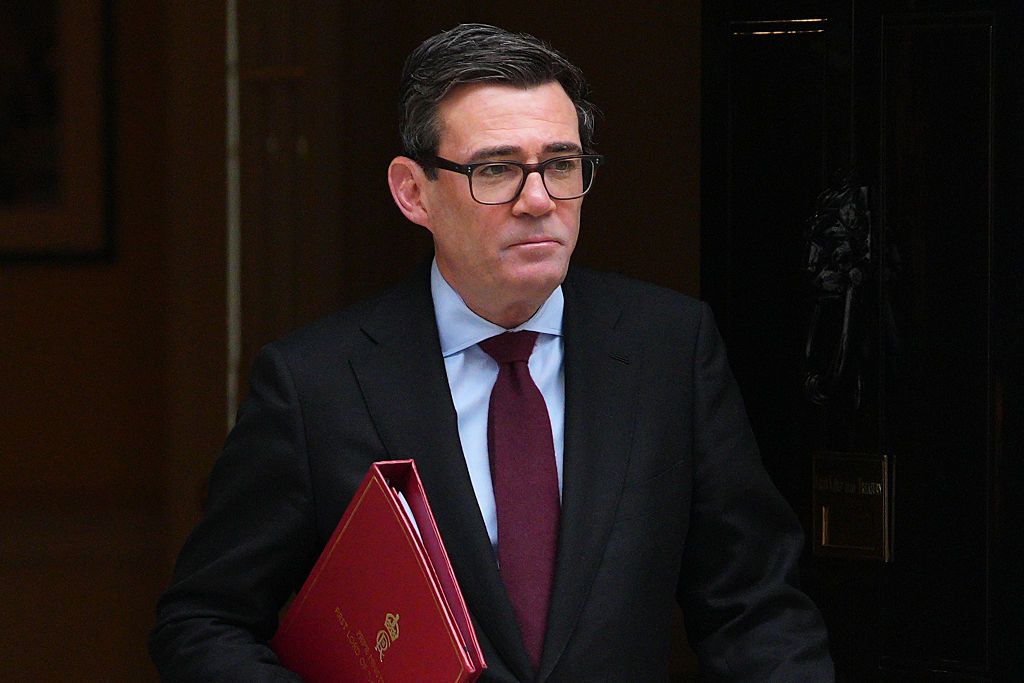
There’s been a very rare sight in Westminster this week – a government blowing the whistle on itself. On Tuesday morning in Downing Street, in front of nuclear test veterans and campaigners, Andy Burnham announced that he would be the prime minister to take on arguably the longest-running scandal in British history.
In the name of ‘national interest’ our armed forces were used as guinea pigs to develop a Cold War deterrent against the Soviet Union
‘The truth will have its own power’, Burnham declared, before underlining how tightly kept state secrets have been for 70 years. ‘I do not know what the full truth will be, but we will get it’, he added, urging ‘all parts of government’ to act with ‘utmost seriousness’.
Many would argue it’s about time. Other governments embroiled in the same scandal, the US, France and the Soviet Union, admitted their culpability many years ago.
Yet somehow this scandal has never gripped the British consciousness. Most people remain unaware of what was done. So what is this ‘criminal cover-up on an industrial scale’, as Burnham terms it?
Between 1952 and 1967, around 22,000 British military personnel participated in several dozen large-scale nuclear weapons tests in Australia and the South Pacific. Unsuspecting troops and scientists watched from a short distance away as atomic bombs were set off or dropped and large mushroom clouds rose. Just picture a repeat of scenes out of Oppenheimer.
No one was given protective suits. Troops were simply told to look away during the blasts themselves. Then they were directed to assess the damage, take samples or even fly planes through the burgeoning dust clouds. None knew that they were part of the experiment too.
It’s now known that the army was ordered to track the effects of the explosions on ‘equipment, stores and men and with and without various types of protection’ as a 1953 Atomic Weapons Trials report bluntly put it. Their bloods were monitored by the Atomic Weapons Establishment throughout. Urine samples and other medical tests were taken. Records show that in 1955, Prime Minister Anthony Eden was briefed by the scientists that the nuclear tests could damage troops’ DNA. A letter records his response: ‘it’s a pity but we can’t help it’.
In the name of ‘national interest’ our armed forces were used as guinea pigs to develop a Cold War deterrent against the Soviet Union and, crucially, measure the real-life consequences on the ground.
The state, with the collusion of Britain’s civil servants, then covered up the very existence of their medical records. Together, they have denied courts and families the truth for 70 years.
As veterans minister in 2017 to 2019, Tobias Ellwood now realises that he was ‘given the lines that were absolutely dishonest’ in being unable to provide information that blood samples had been taken for monitoring at tests. That deception is particularly stinging as a former soldier himself. As a shocked former senior defence official put it to me this week, ‘I had not appreciated the level of deception that appears to have gone on.’
Many veterans and families blame the trials for cancers, blood disorders, miscarriages and chronic illnesses that bloomed in their families in the ensuing years. One of them is 97-year-old Maureen Reeve-Tucker. Her husband, Lieutenant-Colonel Bee Reeve-Tucker, of the 2nd Glosters, witnessed at least three UK nuclear tests in Maralinga, South Australia, in 1956. Bee, as he was always known, died, 16 years later, riddled with cancer, aged 51. He left behind eight children and his beloved Maureen, aged 43.
When I spoke to Maureen recently, the military widow recalled Bee as a ‘magic companion’. She described him as a spirit undimmed, despite spending his twenties as a prisoner of war. He’d been captured whilst taking a rearguard stand at Cassel, Northern France in 1940 to buy time for the Dunkirk evacuees. Once liberated, he was seen as a rising star in the army. He was sent on many tours of duty before arriving at a top-secret test site in 1956.
There was no warning of how his close-range exposure to acute radiation and contaminated dust could harm him.
‘I was on an exeat that weekend from school, came home and he died that weekend and then I was sent back to boarding school the next day’ recalls Maureen and Bee’s daughter, Rebecca, then a teenager, of her father’s death. ‘It’s always been such a trauma that I have found out that when traumas happen, your memory is eroded. I cannot remember.’
Rebecca thinks the characterisation of her father as a guinea pig during the Cold War, in the race for the atomic bomb, ‘is a very uncomfortable feeling. But I think it’s as close as you’ll get to the truth.’ Even before Burnham’s declaration, Maureen told me, in an accent reminiscent of the late Queen, that she was no longer ‘friends’ with the Ministry of Defence. Instead, she feels betrayed.
Maureen, like thousands of others, wants to hear an apology and get fair compensation for her family. She wants the truth so she can finally understand what really happened to her husband Bee all those years ago.
What distinguishes this from other scandals – the Post Office, Police or NHS – is that the British state itself put our troops in harm’s way. It then covered it up, along with the very existence of the state’s medical records designed to track that harm. It is the state’s secrecy, those missing blood records in the face of known radiation exposure, over the past 70 years which is why Burnham has branded this ‘the greatest outstanding injustice of them all’.
‘It’s an unfinished story’, Tobias Ellwood told me on the podcast Out of Order with Mark Lobel. He called for no more cover-ups, rather, ‘openness, transparency, sliding all the documents into the National Archives so everybody can see.’
In 2022 the campaigning journalist Susie Boniface revealed the scandal, pointing to at least 28,000 known documents compiled by the MoD on those present at the nuclear test sites. They cover everything the MoD compiled under the auspices of anything relevant to injury, risk and knowledge of biological harms because of testing. Boniface says that’s just the tip of the iceberg. Since then, there has been an ongoing fight for justice. It has included, as some of its cheerleaders, both Burnham and John Healey. Yet it has never captured the public imagination.
A former senior No. 10 insider tells me now is the moment for Andy Burnham to either apologise to the country or explain very clearly why he cannot do so right now.
Burnham’s proposed inquiry will be headed by the Rt Rev James Jones, who impressed the PM with his work on the independent investigation of the Hillsborough disaster. It is expected to help expose and adjudicate the effects of veterans’ exposure to ionising radiation. Such exposure is akin to being put in front of a firing squad of microscopic high-speed bullets, released in massive bursts, with enough energy to seriously damage cells inside a human body. With another 180,000 files or so to disclose, this could get seriously embarrassing for the state and provide a lot of soul searching.
The government has still not apologised to veterans, or offered them compensation, despite Burnham’s grip of the issue. The inquiry means they will be waiting at least a year for an apology – even if a memorial can be planned at the same time.
This is a potentially radical moment, not least with the impending Hillsborough Law due for ratification by Easter. The hope is that it will force candour from officials, including civil servants, and hold them personally accountable for the truth of their answers, rather than being shielded from prosecution by the state, if they ever try to brush secrets under the carpet again.
But there’s a warning from Boniface that the ‘rapidity’ sought by elderly victims eager to see out this inquiry (there’s an interim report promised in 44 weeks’ time), must be balanced with the ‘rigour’ needed to uncover the full story. Countless families have lost their loved ones. But time is not on everyone’s side.
Mark Lobel is a journalist, BBC TV presenter and podcaster on ‘Out of Order with Mark Lobel’.




Comments