
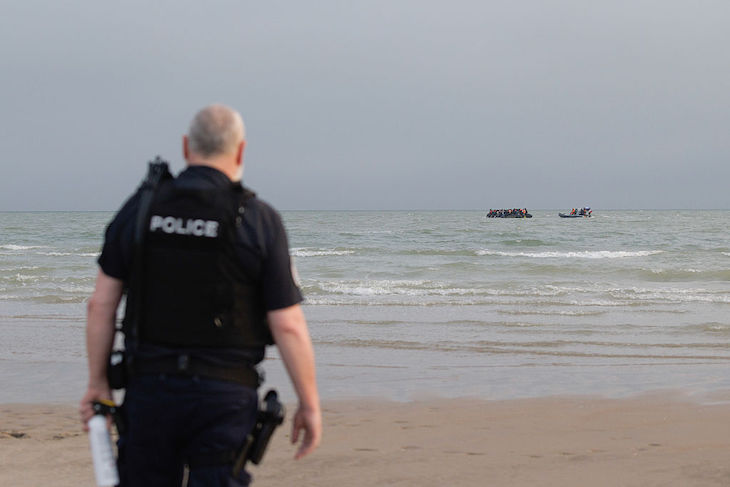
More than 41,000 migrants crossed the Channel in small boats in 2025, a number surpassed only by the 45,000 who made the voyage in 2022. In total, 41,472 people reached England from France, a 13 per cent increase on 2024. The weather was a factor: according to the Met Office, last year provided Britain with the most hours of sunshine – 1,622 – since records began in 1910. But of greater significance is the ineptitude of the British government in stopping the small boats.
A spokesperson for the Home Office described the 2025 figures as ‘shameful’, adding that ‘the British people deserve better’. They would say that, wouldn’t they? It is the hollow rhetoric that the British people have come to expect from Westminster this century.
In 2001, for example, the Commons Home Affairs select committee in conjunction with the Home Office published a report about the deterioration in border controls. Contained in it were 22 recommendations. These included a proposal that ‘the 1951 UN Convention on the Status of Refugees should be updated to reflect changes over the past fifty years’; a suggestion to ‘improve the speed and quality of the asylum decision-making process’ and a declaration that more effective cooperation was required between British and French authorities. Sound familiar?
This year will be no different in Europe’s losing fight against mass immigration
The select committee criticised the Home Office for being ‘dilatory in enforcing the removal of people whose asylum claims have been refused and others who have gained illegal entry to the UK’. This prevarication ‘has attracted more people to the UK’.
It hadn’t occurred to migrants in 2001 that it was possible to enter Britain by boat; they tried their luck either in the back of lorries or by storming the Channel Tunnel. In October that year, 300 migrants launched what was described at the time as a ‘mass bid to board freight trains bound for Britain’.

It wasn’t until highly organised criminal gangs saw the possibility of making a lot of easy money that the small boats were launched. The crossings began in 2018. In the last two months of that year 221 migrants attempt to reach England by boat, a figure that prompted the then Home Secretary – Sajid Javid – to declare the situation a ‘major incident’.
On 20 December 2025, 800 migrants in 13 boats reached England from France. There was no response from Home Secretary Shabana Mahmood. The day before, however, Mahmood did declare on social media that ‘we are working with our German allies to crack down on the criminal gangs behind illegal migration’.
The British people can only hope the Germans are more cooperative than the French, who this century have syphoned hundreds of millions of pounds from successive British governments and done nothing in return to stem illegal immigration.
The truth is that Europeans gave up long ago believing a word their leaders say about ‘smashing gangs’ and ‘stopping boats’. Figures from Frontex, Europe’s border agency, reveal that last year there was a 272 per cent year-on-year increase in irregular entries on the Libya to Crete corridor. In a 24-hour period shortly before Christmas, 600 migrants landed in Crete from Libya.
In the last ten years, the EU has signed treaties with several North African countries, including Libya, in a bid to curb illegal immigration. These deals have been only partially successful. Last year, 26,000 migrants were intercepted in the Mediterranean and forcibly returned to Libya; of this number, 23,126 were men.
But so great are the numbers of people from the developing world seeking a new life in Europe that more succeed than fail. For all of Giorgia Meloni’s promises to stop the boats, 65,642 migrants arrived illegally in Italy last year, a slight increase on the 65,471 who made land in 2024.
In June this year the EU’s Pact on Migration and Asylum takes full effect. Brussels promises that this legislation will be a game-changer, but of course it won’t. For it is not MEPs who make the rules in the EU, it is the courts, such as the Luxembourg-based Court of Justice of the European Union. On 18 December, they ruled in favour of a Syrian refugee who had sought damages against Frontex. He claimed that the border agency had failed to properly examine his alleged expulsion in 2020, a decision that his legal team boasted would end ‘the de-facto legal impunity of Frontex’.
This year will be no different from previous years in Europe’s losing fight against mass immigration. There will be pacts, promises and political posturing but no reduction in numbers.




Comments