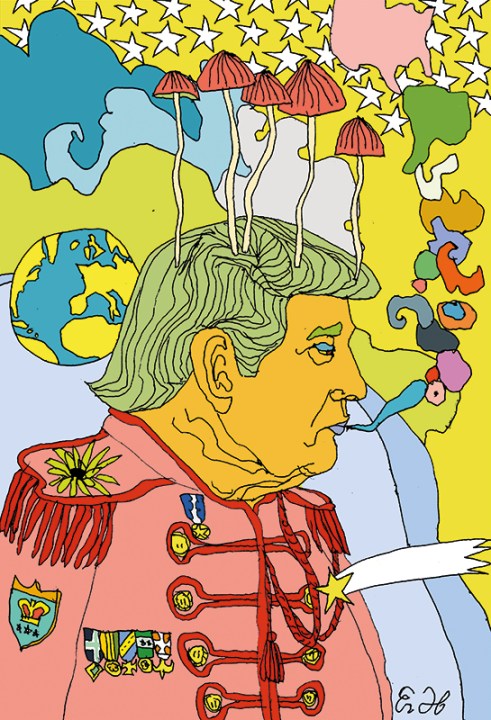
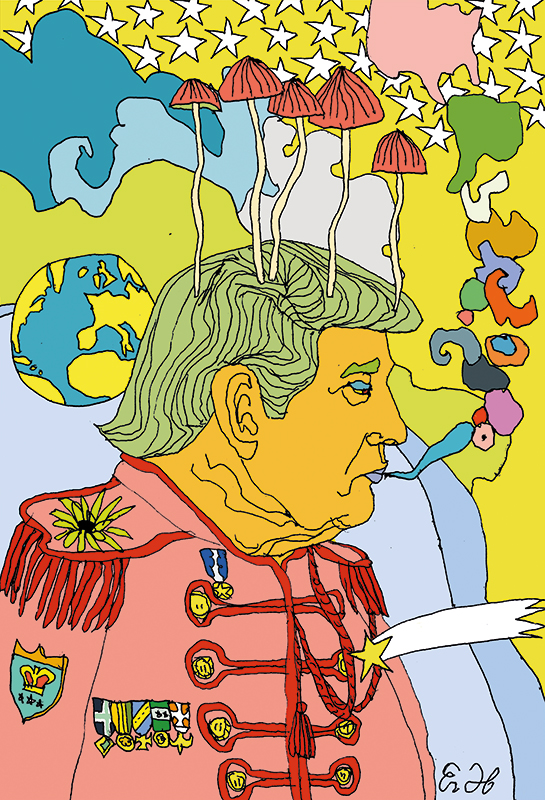
This year is set to be the year of psychedelics – Trump’s trip, you could call it. Since the President signed an executive order supporting the use of psychedelic medicines in April, no fewer than six federal agencies have announced initiatives to help usher the industry along. The agencies, mainly connected to the Department of Health and Human Services, have approved multiple million-dollar initiatives to research, approve and roll out psychedelics. A whole fleet of startups are now circling the Food and Drug Administration.
Three of these have Commissioner’s National Priority Vouchers from the FDA, which means that when they submit their new drug applications, the agency will make a decision within two months of filing. The startups are Compass Pathways, which is trialing a synthetic psilocybin (the active ingredient in magic mushrooms) for treatment-resistant depression; Usona, a nonprofit trialing psilocybin for major depressive disorder; and Transcend Therapeutics, which was recently bought by Otsuka for $1.2 billion. It is trialing a substance similar to MDMA to treat PTSD.
“Regulatory risk is now zero,” says Josh Hardman, founder of the newsletter Psychedelic Alpha. “The leading psychedelic start-ups have good enough data to be approved by any FDA, but with this FDA, with all the political pressure swirling around, I don’t see them not getting approved.”
The market expects either Compass or Usona to be the first classic psychedelic to be FDA-approved, later this year or early next year, but several other companies are snapping at their heels. There’s Definium, trialing LSD for generalized anxiety disorder; Resilient, seeking to resubmit its application of MDMA for PTSD; Reunion, trialing 4-HO-DiPT for post-partum depression; Gilgamesh, trialing non-hallucinogenic “neuroplastogens”; and DemeRx, trialing an analog of ibogaine for alcohol disorder.
A psychiatrist’s clinic could soon resemble the backpack of a high-end dealer at Burning Man
AtaiBeckley has developed a synthetic, nasal-spray version of 5-MeO-DMT for treatment-resistant depression. The substance 5-MeO-DMT is derived from the secretions of the Colorado River toad and often called the “god molecule,” because users describe a state of feeling “at one with everything.” Snuffs containing 5-MeO-DMT have been used by indigenous shamans in the Amazon for thousands of years – and by American wannabe shamans for decades. A psychiatrist’s clinic could soon resemble the backpack of a high-end dealer at Burning Man. After two decades of minimal investment in drugs which affect the central nervous system, Big Pharma is joining the great acid-house party. Besides Otsuka’s acquisition of Transcend, AbbVie bought Gilgamesh’s synthetic psychedelic bretisilocin for $1.2 billion, and AtaiBeckley has just announced that biggest of all the Big Pharma giants, Eli Lilly, (valued at $1 trillion) has agreed to buy it for $3.5 billion, in the expectation that its god-molecule nasal spray will transform treatment for depression.
One Big Pharma insider tells me their board sees psychedelics as the future of mental healthcare. There’s already one proven winner – Janssen’s ketamine nasal spray Spravato, which was approved during Donald Trump’s first presidency. It is now making the company $2 billion a year in sales. The psychedelic industry hopes that the hundreds of psychiatry clinics selling Spravato across the US will also start selling psilocybin, DMT, MDMA and the rest of the psychedelic candy-box.
The industry’s big pitch is that, first, psychedelics work much quicker than Selective Serotonin Reuptake Inhibitors (SSRIs) – people can experience remission from mental health problems immediately after use, rather than after a month or so of taking SSRIs, and that remission can last for months. Second, psychedelics seem to work for about 30 percent of people for whom anti-depressants have failed. Third, they seem to work for all sorts of conditions. They’re being trialed for anxiety, depression, PTSD, anorexia, addiction, end-of-life anxiety, marriage problems, chronic pain, cluster headaches, dementia, burnout – you name it. And then, for the true believers, there are the grander aspirations: psychedelics will shift human consciousness, reconnect us to nature, reenchant the cosmos, usher us unto the Throne of the Lord, or dissolve us all into a pansexual, polyamorous cuddle puddle.
How do they work? No one is quite sure. Maybe they lead to a surge in serotonin which enables new connections to be made in the brain, creating a “window of learning” in which to form new habits. Maybe they trigger a cathartic waking dream in which your subconscious becomes illuminated… or maybe the subjective experience isn’t necessary at all. One theory is that psychedelics work as “super-placebos,” amplifying suggestibility and helping clients believe in new stories. Sometimes, unfortunately, they can also be “super-nocebos,” and people can get stuck in a paranoid spiral, absorbed in more negative narratives about themselves.
As the US hurtles toward the psychedelic event horizon, many questions remain, particularly around the payment model, the care-delivery model and the wider cultural impact of these drugs.
First, the payment model. It doesn’t matter if President Trump, Robert F. Kennedy Jr. and Joe Rogan are all onboard the magic bus. Will psychiatrists sell the treatments, and will insurance providers decide they’re worth funding? Will other national health systems decide to offer these treatments? Many insurers already fund Spravato but patients are using it every two weeks or monthly, in some cases for years. Could classic psychedelics be as effective or more effective than Spravato or SSRIs, and require fewer doses? That’s the hope, but we’ll see. The hype around wonder drugs tends toward deflation. They’re already proving less effective than people anticipated five years ago.
All psychedelic drug trials involve trained therapists preparing the client, sitting with them through the experience and then meeting them afterward to help them “integrate” it. But many psychedelic startups are telling the FDA their treatments don’t involve therapy, just “psychological support.” Stripping the therapy out of treatments reduces costs, but could it increase risks? Do psychiatrists and their teams require training to offer psychedelics – and if so, how much and by whom? There’s no definitive answer as to whether patients should come off SSRIs before receiving psychedelic treatments, or whether they can stay on them.
I run a nonprofit dedicated to psychedelic safety and I worry about informed consent for the general public for substances that can lead to profound and sudden identity shifts. As Aldous Huxley put it, in a 1954 book detailing the effects of mescaline: “The man who comes back through the Door in the Wall will never be quite the same as the man who went out.” The industry needs to prepare not just patients but their partners and families for the fact that they may go to a clinic as one person, and come back as someone who behaves and feels differently, with different emotions, different memories, different worldviews, maybe even different sexual preferences. Is the public ready for mass-produced mystical-magical experiences in a psychiatric clinic? And is the industry ready to support those who become destabilized by treatment? The honest answer is no, but some of us are working on it.
Is the public ready for mass-produced mystical-magical experiences in a psychiatric clinic?
And then there’s the wider cultural impact. For the past 20 years of the “psychedelic renaissance,” the medicalization path to FDA approval has run alongside another path toward wider normalization/decriminalization/legalization of psychedelics outside of medical supervision. Americans’ use of psychedelics doubled between 2015 and 2022. You can now easily buy psychedelics online, in smokeshops and dispensaries, in legal centers in Oregon and Colorado, in retreats around the world and in some of the hundreds of psychedelic churches that have appeared in the US in the past five years. Or you can just grow them yourself.
Some see medicalization as a Trojan horse for legalization for recreational use, and predict that many other drugs will follow the marijuana route – it was approved in many US states on dubious medical grounds before being approved for recreational use. That could undercut the profit model of many psychedelic startups: why spend thousands to go to a clinic for MDMA or psilocybin, when you could take them with your friends in a field? The reputation of psychedelics as a safe medical treatment could also be undercut by adverse events, predatory guides or harmful psychedelic cults in deregulated spaces – we’ve already seen that in the Wild West ketamine industry, whose victims include Matthew Perry.
Whether the world is ready to integrate psychedelics into healthcare systems, or into wider mainstream society, remains to be seen. I suspect that psychedelic prophet Terence McKenna was right: “It’s just going to get weirder and weirder and weirder.”




Comments