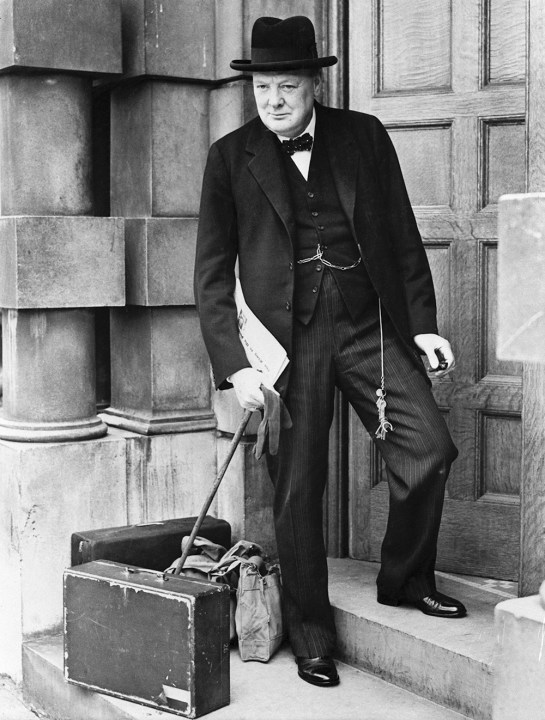
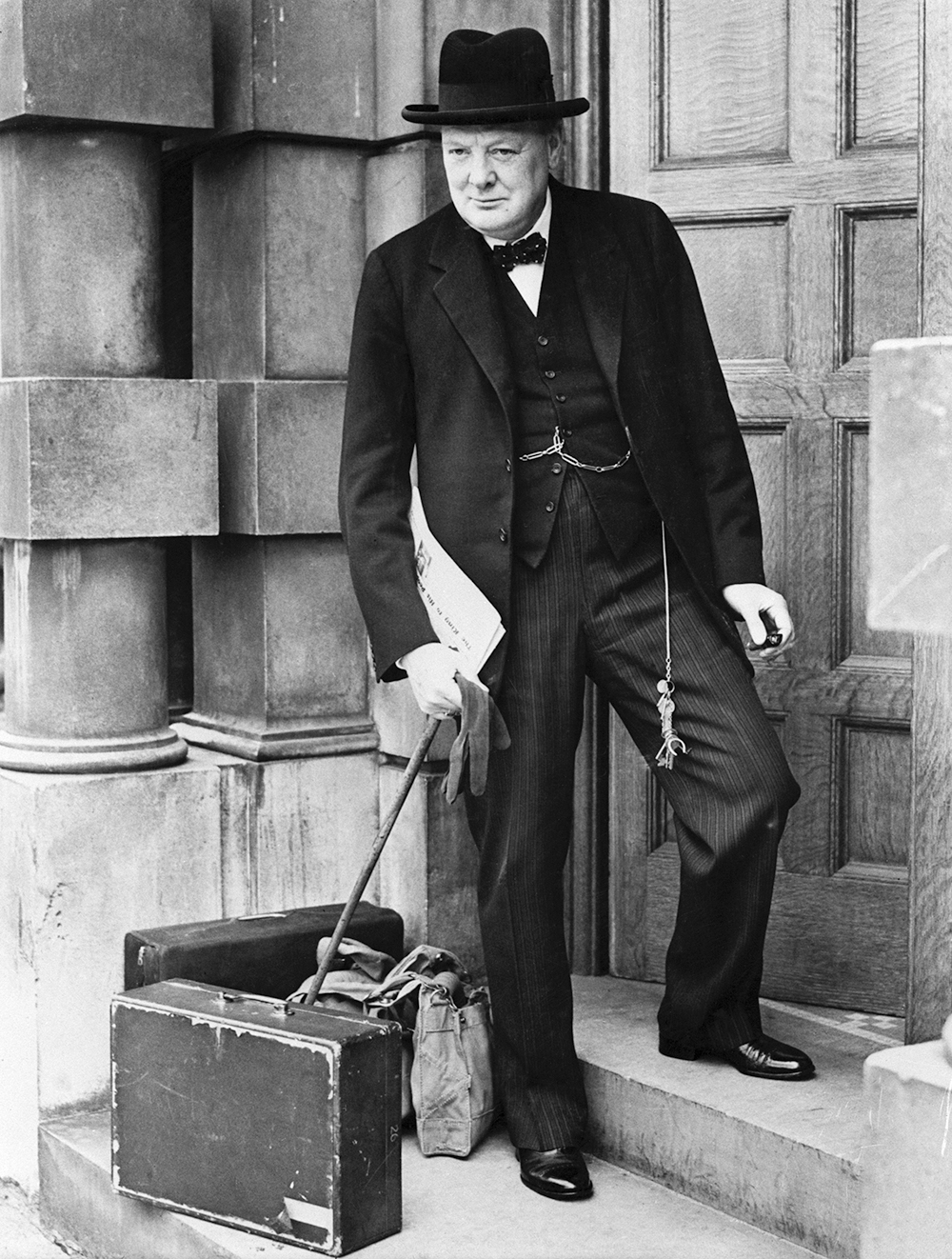
Removed from banknotes, his statue sprayed with graffiti, blamed for Gaza, the Bengal famine, the deaths of millions, Churchill no longer sits comfortably aloft his ‘pinnacle of deathless glory’, as he wrote of Alfred the Great. In the parlance of the late Martin Amis, it’s as if our national hero’s trusted barber at Truefitt & Hill has given him a brutal rug-redo. A further clipping to his reputation is Simon Matthews’s study of his ‘poor record’ at the Admiralty between September 1939 and May 1940 – i.e. just before he becomes ‘Peak Churchill’.
Viscount Stuart famously overheard Churchill reply to a questioner pressing for awkward details ‘Only history can relate the full story’, adding after the right pause: ‘And I shall write the history.’ Selling 560,000 hardback copies, The Gathering Storm (1948) became the official version – a closed book about the origins and start of the second world war. Thanks to Churchill, who gave himself the best lines, many legends have passed out of history into unbudgeable myth, with the author escaping, Houdini-like, from scrutiny. Matthews holds Churchill’s distorted picture up to the light to reveal another outline – one manifest to contemporaries such as General Percy Groves: ‘There are few paradoxes more striking than to be found between Mr Churchill’s deeds as a minister and his words as a historian.’

My great-uncle Geoffrey Shakespeare was Churchill’s ‘indefatigable second in command’ at the Admiralty at the outbreak of war. Although he mistitles it, Matthews relies much on Shakespeare’s memoir, Let Candles Be Brought In. Reasonably illuminating, this book appears quite modern now in giving Neville Chamberlain a makeover, as it were, and rescuing his reputation from the ignominy in which Churchill moved to bury it. Still brushed over today is the fact that on returning from Munich, Chamberlain had been regarded as an international hero and spoken of as ‘the world’s lifebuoy’. President Roosevelt congratulated him in ‘the shortest telegram I ever sent: GOOD MAN.’ In France, one million readers of Paris-Soir subscribed to buy Chamberlain a house at a fishing resort so that he could indulge in his favourite pastime.
In England, Lord Hailsham described his agreement reached with Hitler as ‘the greatest miracle of modern times performed by a single man’. Incredible to recall, not one of those Tory MPs who became such staunch retrospective anti-appeasers voted against the Munich Agreement in the debate on 5 October 1938. Even Churchill abstained. Shakespeare believed that
if Chamberlain had followed the advice of Churchill in 1938 and plunged the country into war, then instead of making the agreement at Munich, the nation would have been split from top to bottom and disunity would have paralysed the national will.
Matthews’s theme rests on Shakespeare’s conclusion, which he says ‘will no doubt bring a hornet’s nest around my ears’:
If Winston Churchill was, I believe, the chief architect of victory in the war when it came, Neville Chamberlain created by his policy the atmosphere essential for the successful prosecution of that war.
One of Churchill’s earliest directives, on 5 September 1939, was for the provision of a fleet of 14 dummy warships as decoys. ‘They had no discernible effect on events,’ Matthews reckons. This was but one example in a lengthy list of how Churchill wasted time and resources in resuscitating impractical ideas he’d had back in 1914 and now implemented with ‘hasty improvisation’ and a ‘striking lack of strategic thinking’. Some, like Operation Catherine, would have ruined him had they proceeded.
The most successful decoy would be Churchill’s account of his eight-month stint at the Admiralty. In his grand sweep of history – which he saw as a glorious epic saga with himself as chief buccaneer – he tidied away what threatened to embarrass his narrative with a Trumpian insouciance regarding awkward facts and a belligerent focus on his own starring role. ‘Never once did he mention anything other than himself,’ groaned Chips Channon in February 1940 after listening to a 40-minute Churchill speech.
With the same grandiloquence, Churchill exasperated war cabinet colleagues with his ‘ceaseless lobbying’ and meddling in various departments. ‘I am concerned about the shortage of fish,’ he told Shakespeare. ‘We must have a policy of “utmost” fish.’ About colleagues fishing to know what he himself was plotting, Churchill said: ‘If anyone starts asking questions, change the subject and talk about the breeding of pigs.’
A pig’s breakfast would be one way to describe the Norway campaign, which was Churchill’s baby – a calamitous operation that became a byword for bungling, throughout which he suffered, according to his cabinet colleague Samuel Hoare, ‘complete wobbles’. Without cabinet approval, Churchill ordered troops already on board destroyers at Rosyth to unload and re-embark on a convoy of liners that changed destination three times.
The upshot was that the troops disembarked in different ports in Norway without their equipment, as I learned from the last survivor of Britain’s first land battle in the war – at Krog’s farm near Steinkjer, on 17 April. Private Tom Fowler had only a Lee Enfield 1914 rifle, four dozen cartridges and M&S overalls. He had no camouflage, no skis and no maps – he had to tear these from geography books. The result was that telephones arrived without lines; guns without predictors; anti-aircraft guns with the wrong ammunition. Above all, there was no air cover. Fowler was evacuated from this Arctic Dardanelles under relentless bombardment from the Luftwaffe, which sank 16 warships in a fortnight. ‘Norway failed because Churchill disregarded the importance of air power’ is Matthews’s succinct verdict.
A pig’s breakfast would be one way to describe the Norway campaign, which was Churchill’s baby
Churchill’s memoirs inaccurately state that his very reactionary view on air power was ‘in common with the prevailing Admiralty belief’; it was not, as Shakespeare is delicate to suggest. The Fleet Air Arm ‘had no modern fighter… no clear conception of what kind of aircraft we needed to produce’. Conversely, Churchill was wrong in casting the RAF in a weak light. Kingsley Wood, the secretary for air, had not only achieved a seven-fold increase in air production but had shifted emphasis towards the fighter planes which would win the Battle of Britain for Churchill – who had tirelessly promoted the heavy bomber.
Animated by few personal details, A Study in Failure is a methodical and forensic short back and sides. Matthews might have let his hair down more on Norway had he consulted recent authorities such, as Geirr Haarr and John Kiszely; or Rear-Admiral John Godfrey’s privately circulated memoirs, in which he fumed at how
the public of our generation will never know the malignant influence Churchill exerted in the early stages of the war because he will probably be the first person to write a proper history which shows that everything that went well was due to his inspiration and when it went badly it was someone else’s fault.
That ‘his failures were many’, as Matthews is right to catalogue, shocks less than to discover how ‘fat, wicked old Winston’, as Chips Channon called him, reconfigured them to become prime minister. Matthews reminds us how, up to 10 May 1940, the emergence of Churchill as ‘a national icon, the image that people have had of him since the summer of 1940, was not foreseen’.




Comments