
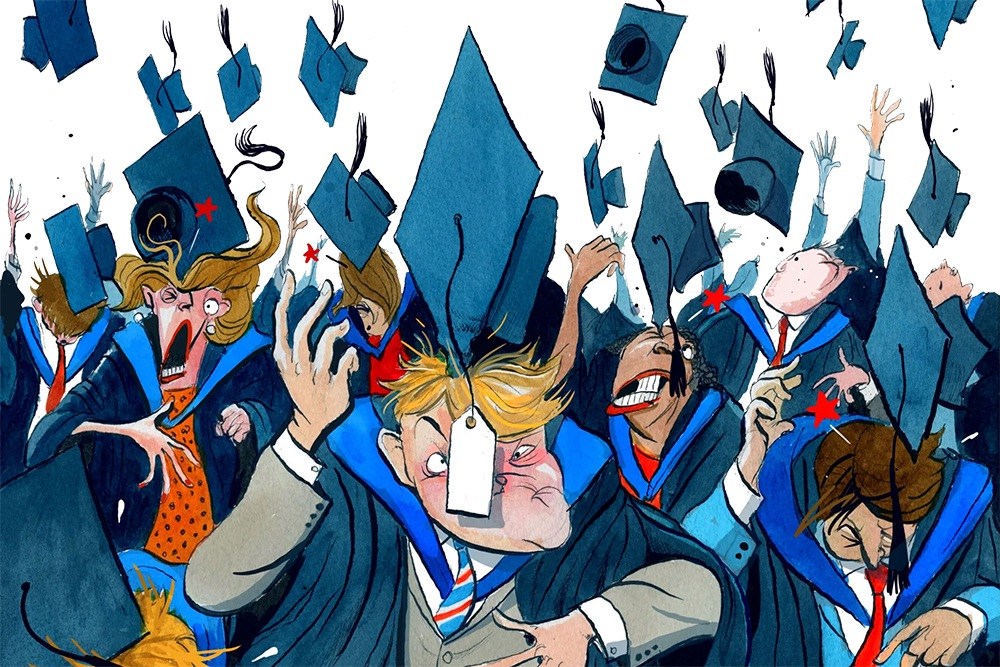
Some statistics are not just illuminating, they are downright shocking. Here’s one. At the University of Texas at Austin, one of America’s top universities, only 300 students graduated with a major in the humanities. That would be a big number if UT graduated 1,200 students, but it actually graduates about 12,000. The percentage of humanities major is 0.025 percent.
It rounds to zero.
That dismal statistic is replicated at universities across the country. While Texas certainly likes to think of itself as unique, in this case, it’s not. At every university, big and small, fewer and fewer students are studying English, History, Philosophy, Art History, French literature or Anthropology.
Those dwindling numbers mark a striking change in higher education. Not too long ago, English and History were among the most popular majors on campus. Students gravitated to them because they liked the subject matter and found the courses engaging and enriching. Those students weren’t preparing to become professors of Renaissance History or 19th-Century Poetry. They expected to go into business, law, or some related field.
Still, they wanted a liberal education before they went out into the working world, and they got it in traditional humanities disciplines. They wanted to immerse themselves in Shakespeare’s plays, the debates around the French Revolution, what Plato meant by the eternal forms, or how African tribes governed themselves. They weren’t seeking pre-professional training. They wanted an education in what a 19th-century British author, Matthew Arnold, once called, “The best that had been thought and said.” Today’s students hardly dip a toe in those deep waters.
Since we mentioned the number 300, we might wonder if today’s students know why that number resonates with history lovers. It was the number of Spartan warriors who stood together at Thermopylae, facing certain death from the massive Persian army. The Spartans who stood athwart that narrow mountain pass sacrificed themselves to defend the polis they loved. Their city and their sacred honor mattered more to them than their lives.
That same spirit could be heard, two millennia later, when the young American patriot Nathan Hale uttered his final words to the British soldiers about to execute him: “I regret that I have but one life to give for my country.” His statue stood outside my college dorm room. We always added the phrase, “But not right now! Please.”
Sophomoric humor aside, those stories of the American Revolution and ancient Greece are a precious legacy, freely given to us. The question is whether we are willing to receive them. We should. They are the high points of Western culture. Understanding that culture – our culture – should be a fundamental goal of higher education.
Losing sight of that goal and failing to pass it on to the next generation is why the decline of the humanities is so troubling.
That education doesn’t mean passive book worship. It means active, critical engagement with great works like the autobiography of Benjamin Franklin, the novels of Jane Austin, the defense of free speech by John Stuart Mill and Gibbon’s Decline and Fall of the Roman Empire.
Why do those works and others like them matter? Because they offer profound insights, worthy of critical engagement, first in the classroom and then as citizens in a free society. Studying those works should spark free and open debate, a spirit of inquiry and a willingness to wrestle with differing views, not shout them down. The goal is to transmit that intellectual inheritance from generation to generation, not as an embalmed carcass of dead texts but as a living legacy.
This engagement with big ideas, argued in depth, should be the heart of the humanities on campus. That heart includes the capacity to criticize, to highlight flaws and to tolerate those with different views, while demanding that they reciprocate that tolerance and make coherent arguments.
The decline of the humanities reflects the decline of those basic values in our society and contributes to their further erosion. The result is more than a loss for higher education. It is a loss for our democracy and the ideals we should strive to meet.
Four factors are driving this downward spiral, combining to erode student interest in the humanities and our universities’ commitment to teaching them in a serious way.
One is the backbreaking cost of college. When tuition, room and board are more expensive than a new Rolls-Royce, students and their parents naturally think about recouping those expenses. They wonder, quite sensibly, how a college education will lead to a job that can repay student loans. The financial pressures encourage majors deemed “more practical.”
Second, the content of humanities courses has changed, and not for the better, as far as students are concerned. They are voting with their feet as department after department has become a hotbed of left-wing ideology, some stressing Marx, others stressing gender, sexual orientation or post-modern nihilism. Those ideologies suffuse the syllabus and the grading.
While some students love this ideological kulturkampf, most don’t. It’s not what they want when they consider majoring in English, or taking a few elective courses. They don’t do it to explore the latest in Queer Theory. They do it because they love Charles DIckens’s novels or August Wilson’s plays. They take history courses because they are fascinated by Abraham Lincoln, Harriet Beecher Stowe, Franklin Roosevelt and Martin Luther King, and by the vast events they helped shape.
Students want to think critically about those subjects, but they don’t want to endure a forced march through a rigid ideological agenda and then be graded by their abject adherence to it. Students who reject that agenda – who simply want to read, enjoy and wrestle with great works – don’t bother fighting a losing battle in the classroom. They know the professor holds the winning hand. So, students simply avoid those teachers, those courses, those majors. They find it more attractive to take an interesting course on modern evolutionary biology.
Science courses like that have flourished. That’s the third factor in the decline of humanities majors. There is enormous student interest in the biosciences, computation and artificial intelligence, which are transforming the economy and the job market awaiting students after graduation.
A fourth factor is more amorphous but real nonetheless: the faculty who once supported a liberal education have lost confidence in its value. They have lost confidence, too, in their right and responsibility to impose basic standards on students. That process began in the late 1960s and has continued apace. It can be seen most easily in the complete collapse of grading across the university. In some departments, virtually all students get an “A,” or, at worst, a “B.” The grade of “C,” once commonplace for average students, has gone the way of the dodo.
Can anything be done to fix this mess? Perhaps, but it won’t come easily. It will meet entrenched opposition from the faculty and administrators who created the problems.
One answer is to trim departments which now have far too many faculty for their meager student enrollment. First on the chopping block should be departments established to meet ideological demands, as many have been since the 1960s. It’s up to their faculty to prove their intellectual merit beyond the corrupt game of mutual citation by like-minded faculty in other universities.
Another attack on the “cost of education” should be a purge of the bureaucratic bloat that plagues every university. That should begin by axing the DEIdeologues. They will have to be ferreted out since they have renamed their sinecures.
What should be fully funded, not cut, are direct student services: advising for course selection, psychological help and so on. More resources should go to the offices responsible for internships and career placement. Internships are especially valuable in helping students choose careers and gaining work experience to show future employers.
Finally, there are course requirements to consider. All students should take basic courses in English literature, American history and expository writing. Those were the traditional features of the humanities, and their reintroduction should be the starting point for a discussion among faculty and senior administrators. The goal is not to increase the number of students majoring in the humanities. It is to expose all students, whatever their majors, to the best the humanities have to offer.
In mulling those requirements, university leaders need to ask themselves, “Should a student who is gifted in math and determined to explore astrophysics be able to spend four years at our university without taking basic courses in literature, history and culture? Should those requirements also include a general course in the values of Western civilization? Or would imposing those requirements simply drive our best young science students to other schools?”
And they should ask – and answer – one more basic question about the purpose of a university in a free society, “Does our university have a fundamental responsibility to educate students for citizenship in a democratic society?”
The answer, I think, is obviously “yes.” The decline and fall of the humanities on campus tells us we are failing to meet that responsibility.





Comments