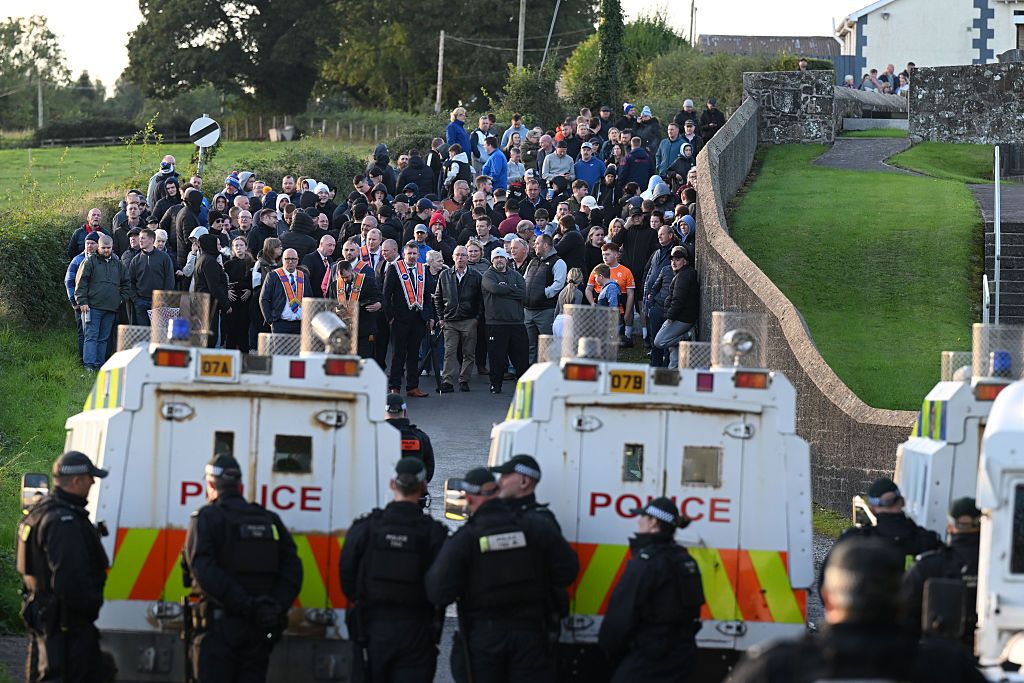
Once again events on an otherwise nondescript stretch of road in Portadown are likely to have an outsized impact on politics in Northern Ireland.
The Drumcree parade dispute, stirred into life and public consciousness after a near 30-year hiatus, has thrown the future of devolved government and power-sharing into doubt.
The dispute began following a decision by the Parades Commission to permit a contentious Orange Order march down the nationalist Garvaghy Road on Sunday morning. This was followed by a further decision by the High Court to throw out an attempt to stop the parade. In response, Irish nationalism swung back into protest mode.
Sinn Féin activists were bussed in to augment the ranks of the local residents’ association, who are led by a former IRA operative Brendan McKenna – imprisoned for six years for his role in a bombing in Portadown in the 1980s and now affiliated with a dissident group opposed to the peace process.
At the time of writing, the march, which would consist of 35 Orangemen walking in silence, has been unable to proceed because of a human chain spanning the breadth of the road which Northern Ireland’s police service elected not to clear.
The Police Service of Northern Ireland have, as ever, been put in an impossible position. On the one hand, nationalist protesters were chanting ‘SS-RUC’ at them. On the other, the Orangemen and their outriders are enraged that they have not facilitated the parade; the PSNI were forced to rebuff an attempt by the Orangemen to march in the early hours of Monday morning. The Portadown District has since called for the Chief Constable, Jon Boutcher, to resign for failing to allow the march.
Among those on the road was Northern Ireland’s First Minister, Michelle O’Neill, nominally responsible for upholding the rule of law.
It is clear that Irish nationalism and Sinn Féin only support the rule of law in Northern Ireland when it dances to their tune and agenda. For 28 years the Parades Commission has been viewed as sacrosanct when it prevented the Orangemen from marching. Yet it has immediately become worthless now that it has decided the other way.
O’Neill branded the decision of the High Court to reject the appeal to stop the parade as ‘disgraceful’. Sinn Féin’s Dublin leader Mary Lou McDonald swept northward to threaten a ‘reckoning’ should the march go ahead. The protest also served as an impromptu reunion for some old IRA men, acting as a timely reminder of who deep down determines Sinn Féin’s direction.
Since becoming First Minister, O’Neill has walked a ridiculous and insincere tightrope; styling herself as ‘the First Minister for all’ on one hand, while attending commemorations for IRA murderers on the other. The events of the past 24 hours show an ingrained world view which no amount of PR-friendly buzzwords can finesse.
There is already strain in the Northern Ireland Executive over budgets, yet this good old fashioned orange versus green dispute may be what tips it into collapse. Many unionists will ask in good conscience how the DUP can continue to share power with people who seem to flagrantly view the rule of law with disdain. The DUP leader Gavin Robinson has said that O’Neill has ‘stuck two fingers’ up at the police and courts with her actions this weekend.
Unionism being seen to collapse devolution is fraught with risk. It would undoubtedly galvanise nationalist support around Sinn Fein. And direct rule by a government headed by Andy Burnham, whose First Secretary Louise Haigh is in a relationship with a senior SDLP figure, would not be particularly friendly to unionism’s long-term wellbeing.
The great strategic loser from the weekend’s event, however, is the movement which claims we are on the cusp of a New Ireland. Nationalists have spent the years since Brexit saying that not only has unification edged closer, but that it would be done in a spirit of accommodation and respect towards unionism. Ireland is, in that world view, ready to reconcile and ready to unite.
It was always a cynical stance, and that has been thrown into stark relief by the absolute hysteria which has greeted the prospect of 35 men walking in silence down a road on a wet Sunday morning at 8 a.m.
There is mileage yet in the Drumcree dispute. The Orangemen remain determined to parade and the nationalist protestors are ready to dig in. As we head towards the thirtieth anniversary of the Good Friday Agreement in 2028, it is clear – despite what the professional peace caste in London, Dublin and Washington say – that not much has fundamentally changed in the lanes and backroads of County Armagh.





Comments