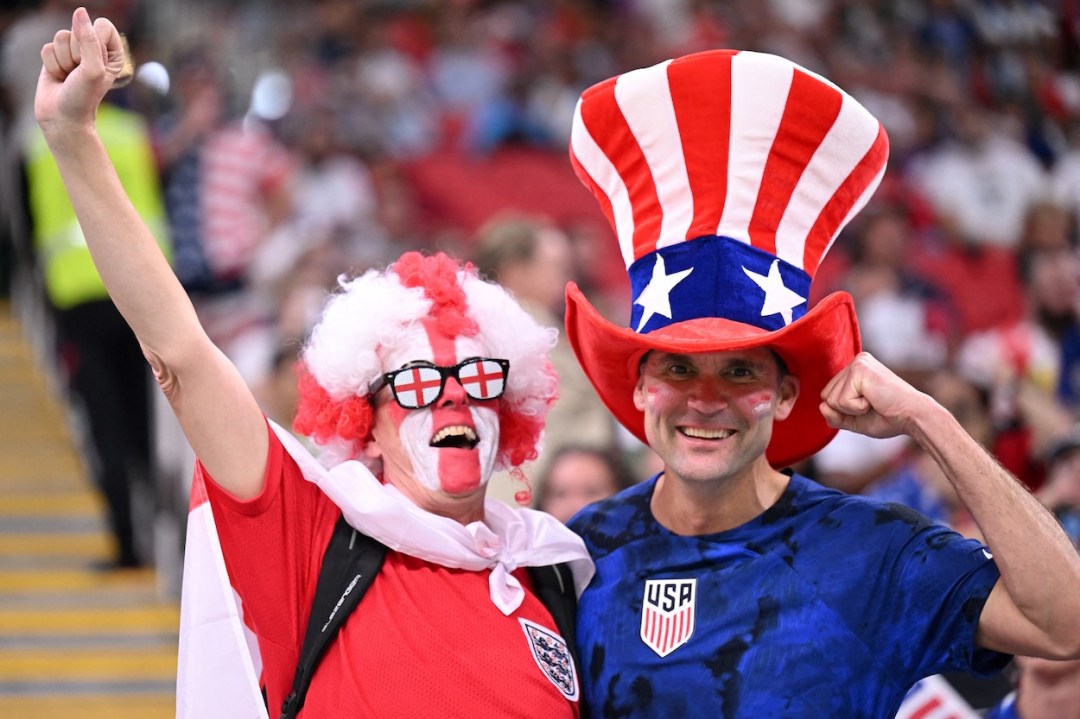
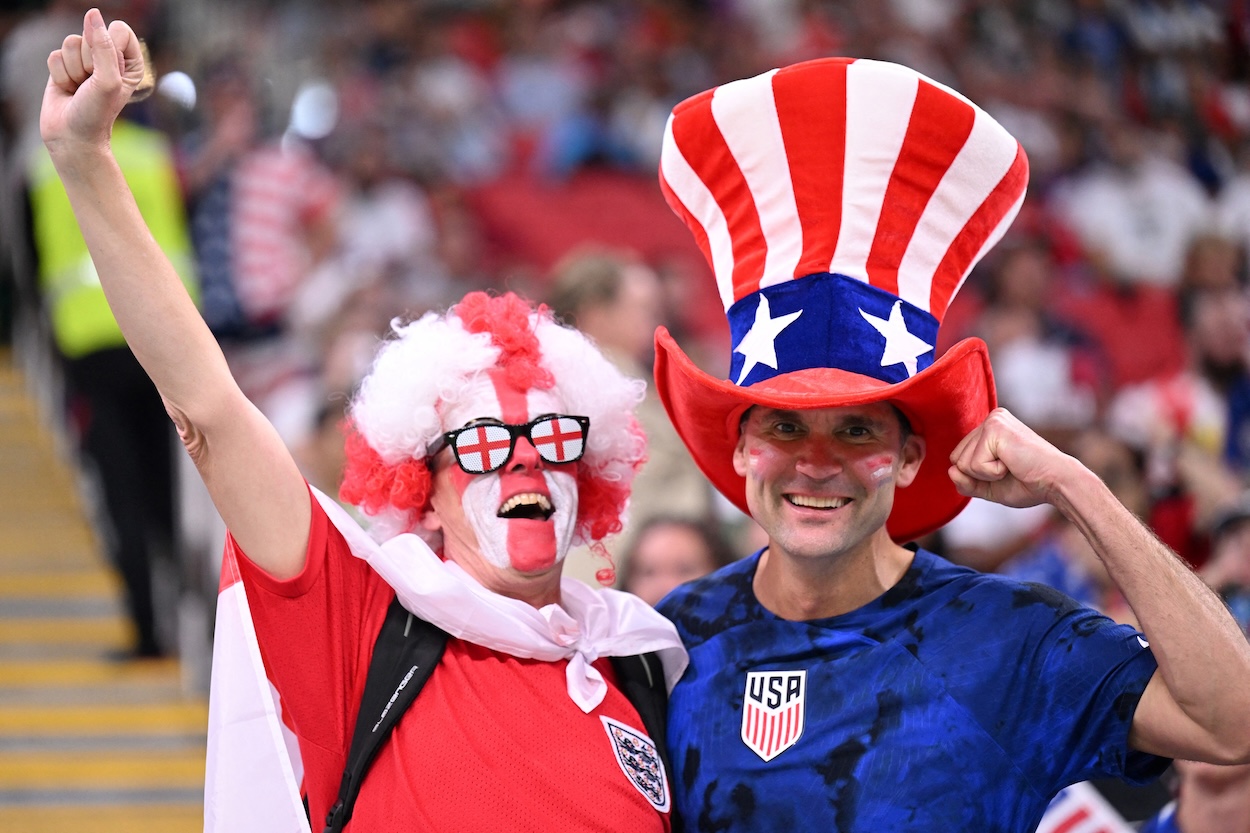
Soccer is not a quintessentially American sport. Just as Brazil is forever the country of tomorrow, soccer is always the American sport of the the future. It is always coming but never quite arrives, or at least not to the extent that its most-fervent advocates would wish. Wearied British or European readers may be bracing for American anti-soccer invective. This is not that: soccer is a glorious game that deserves to be a major American sport, and though it will never eclipse football or baseball, it is possible to envision it as a second tier American sports.
Britain and America have been joined by fate and inheritance for generations now
Major League Soccer in the United States delivers a quality game (although hampered by an exclusivity deal with Apple TV that throttles its potential viewership). Liga MX also has a strong foothold in America that will only grow. The more indigenous soccer becomes, the more widely available it is, the better it will do. You’ll know it has arrived when a Major League Soccer franchise carries with it the civic identity of some beat-down place – think the Eagles for working-class Philadelphia or the White Sox for South-Side Chicago – and that fan base erupts in joy at a championship or defeat of a hated rival.
Still, American soccer is not there yet. And American involvement in the ongoing FIFA World Cup is over, after the somnolent American team lost to Belgium. But there remains an American interest in the final games and eventual championship. That interest, surprising as it may seem to some in the month of the 250th anniversary of American independence, is in supporting England. England commands American support on the basis of favors done, sentiments shared, and the nature of sport.
The favor done was executed in extraordinary fashion on Sunday, when England defeated the Mexican national team in its home arena, the famous Estadio Azteca, where its losses are so rare as to be measured in decades. That Mexican team was genuinely excellent and played with energy and fortitude, only to fail before an English last stand.
The Mexican fans, meanwhile, are widely reviled as among the most base and vicious even in Latin America. (There is a reason that many Latin American diplomatic-corps personnel took to social media to declare their support for England before the game.) Some of us on the American side remember well the Olympic qualifying game of February 10, 2004, in Estadio Jalisco, in which the Mexican team handily dispatched the Americans – and in which the Mexican team’s fans drowned out the American national anthem with boos, and taunted the American team with chants of “Osama! Osama!”
Memories are long, and though in sportsmanship we can acknowledge the excellence of the current Mexican team – we are not, after all, Mexican fans – we can also acknowledge that its fans deserved heartbreak at home. Those desserts have been accumulating for a generation. The fact that throngs of them spent the night prior to the game attempting to keep the English team awake in its hotel with horns and boomboxes only emphasizes the justice of it. Therefore: thank you, England.
The case for supporting Argentina against England is somewhat stronger. Neither the Argentinian team nor the Argentinian fan base have a record of injustice or rivalry toward the Americans. In fact, Argentina’s most-eminent player, Lionel Messi, has almost singlehandedly injected new life into MLS in America with his presence on Inter Miami. Furthermore, to expand the aperture to the political, one may argue that Argentina under Javier Milei is more positively aligned with the United States than is Britain under Keir Starmer. (This evaluation will not change under Andy Burnham.) So why, then, support England against Argentina?
One major reason is the conflation of sports and politics in the Argentinian context. It is news to no one, although worth restating for an American readership, that Argentinian politics even in the best regime is positively deranged by the obsession with the Falkland Islands – a British territory with British citizenry for the past two centuries. The ascent of Argentinian soccer’s fortunes coincides with the inflammation of that obsession, especially when playing England. There is history to this: in the near aftermath of the 1982 Falklands War, which Argentina started and Britain finished, the Argentinian team positively cheated to defeat the English in the 1986 World Cup quarterfinals.
Now that Argentina is again on a run to a plausible World Cup championship repeat, the Argentinian official apparatus is, no doubt coincidentally, again pushing the Falklands to the fore. The Argentinian Foreign Minister on July 11 wrote an extended opinion piece reasserting the Argentinian claim, and the Argentinian President endorsed it. The American interest in the Americas is in peace, not war. America also believes in the self-determination of peoples, so we have no interest in a scenario in which Argentinian nationalism makes the Falklands again an arena of contestation, armed or otherwise.
Americans who need further persuasion should also recall that the United States is widely blamed within Argentina for its military defeat in 1982 – although the real authors of that loss were in the Casa Rosada – and in tense moments in June of that year mobs in Buenos Aires briefly menaced American citizens and property. In a region in which soccer matches have literally contributed to the inception of wars, the path of peace runs emphatically through an English victory on Wednesday.
Furthermore, much of Latin America is rooting for England, making American support for the Three Lions the pro-Latin American position. The reasons vary. Peruvians are supporting England because Argentina supported Ecuador in the 1995 Cenepa war, which Peruvians regard as a betrayal after Peru’s support for Argentina in 1982. Chileans are supporting England because of the robust record of territorial disputation between both countries. Paraguayans are supporting England because Argentina was in the allied coalition that devastated it in the 19th-century War of the Triple Alliance. Nearly everyone across the region is supporting England because of longstanding resentment at perceived Argentinian arrogance across generations. Sports isn’t supposed to be politics, but any American who remembers Lake Placid in 1980 knows it lives right next door. Americans can support the Latin American majority in joining them to cheer on a longstanding South American power, England.
Finally, Americans should support England on the same grounds on which the American naval commander Josiah Tattnall rendered aid to the Royal Navy in the 1859 battle before the Taku Forts outside Tianjin. America was not at war with Qing-dynasty China, but there is a fellowship – call it a special relationship – between the two nations that superseded any proximate circumstance. We saw it again in American aid to Britain well before December 7, 1941, and we can see it again in sports fandom now. The plain fact, worth remembering especially in – not despite – our 250th anniversary, is that England is the principal font of America, and we were founded as the culmination of a specifically English inheritance of liberty.
Much of Latin America is rooting for England, making American support for the Three Lions the pro-Latin American position
“And were they not English, our forefathers, never more / English than when… they dared to be / Rebels against her,” wrote the American poet Alice Duer Miller in 1940, and she was right. In the sole recorded direct exchange between an American Founder and King George III, the former, John Adams himself, said that the work of Anglo-American relations was in “restoring an entire esteem, Confidence and Affection, or in better Words, ‘the old good Nature and the old good Humour’ between People who, tho Seperated by an Ocean and under different Governments have the Same Language, a Similar Religion and kindred Blood.”
The American Founders, as it happened, knew something of sympathy for other nations in their contests. The King himself gently needled Adams on the latter’s antipathy toward France. Of the four nations now remaining in the World Cup, the Founders would have understood an affinity for France, although it would have been a minority sentiment. They would not have understood an affinity for Spain. They would have found Argentina simply incomprehensible. England, though, they would have known and understood.
That restoration Adams spoke of took decades, but it succeeded, and Britain and America have been joined by fate and inheritance for generations now. If we may express it on battlefields, we can express it too on what a great American general called “the fields of friendly strife.” England, battling, may or may not be the best team left in this tournament – that remains to be seen – but here we come to the final reason for Americans to support it now, in the nature of sport.
The striving and endurance of England, holding fast in dire straits in the hostile Azteca against Mexico, though down a man, and then against a tough and persistent Norwegeian team, exemplifies the vigor and virtue that first drew Hellenes together in organized sport millennia ago. Others have their epics too – even Argentina, which has fought its way to more than one improbable win of late. You learn something of the nation in watching the team. And in learning, you make your choices.
Our choice is ultimately less against England’s opponents than it is for England itself. We are Americans. We value fair play, persistence against the odds, and last stands. Perhaps soccer is not our sport – but these virtues are our virtues. We did not create them: we inherited them. We know from where the inheritance came. That’s why, come Wednesday, the American choice is England.



Comments