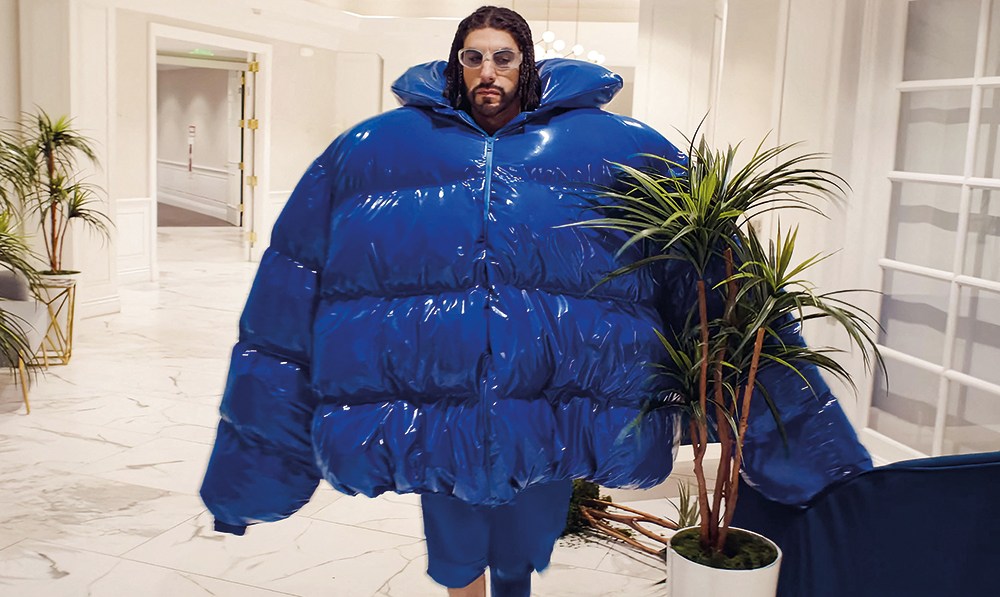
The two main problems with Ali G are, one, that it’s old hat (or old durag if you wish), and, two, that it somehow took hold that the programme was satire. Fair enough, he first appeared on a ‘satirical’ TV show but the joke was always incongruence, the juxtaposition of an expert – or Donald Trump – with a complete idiot. And a very good joke it was. But if it were satire, it must have had a target. Hence the tedious debate about whether Ali G was satirising black people, or white people who think they’re black, or white people who aspire to be black. (The film includes clips from commentators condemning the character for this cultural appropriation – the only one I recognised was Rachel Dolezal.)
Ali G: Who Iz I? is his first appearance on screen for 20 years and it starts with an epigraph from Voltaire – yes, this is the sort of comedy film that has an epigraph. It might be more accurate to describe this as the thesis for the film: if someone can make you believe absurdities, they can make you commit atrocities. There are two parallel subplots – basically live-action Milgram experiments – in which callow left-wing youths and grizzled old Republicans are incited to commit felonies. Major felonies. A caption on screen reminds us that they have no idea that they are taking part in a movie; this jolt of reality ensures that the absurdity is horrifying rather than in any way amusing.
The remnants of the clowning interviews that made Ali G famous are the best things in the film
This incitement does not come from Ali G himself – who is given far too little to do except go through the beats of a gross-out romantic comedy with ‘me Julie’ – but by two less successful characters, both played by Sacha Baron Cohen. The Republicans are gulled by former Mossad agent Erran Morad – a one-joke character and that joke stolen from Monty Python’s Life of Brian. The only thing in Morad’s favour is that he does have a range of prosthetic buttocks that fire live ammunition or diarrhoea – funnier than it sounds.
The more interesting character is Dr Nira Cain-N’Degeocello, a keffiyeh-wearing gender studies academic – his sidekick is his unpaid black intern, whom he shipped in from Gambia – who makes it his mission to ‘cancel’ Ali G. He is a brilliant parody of the woke academic: but it seems self-indulgent that the only real satire in the movie is against anyone objecting to the return of Ali G. There is a very good scene where Cain-N’Degeocello – wearing a dashiki this time – lectures a room of black people on cultural appropriation, and finishes by saying, ‘Ali G must be stopped!’ ‘Why?’ one of them asks. It’s a funny moment, and it’s only afterwards that you realise it’s the equivalent of the ‘permission cut’ in stand-up shows: the cutaway to a black audience member laughing so you know everything’s fine.
The annoying thing is that there are still remnants of the clowning interviews that made Ali G famous, before he felt the need to spend 30 minutes of a 90-minute film asking permission. They are the best thing in the film. Some of them are literal remnants – but you can forgive him for recycling a 20-year-old interview when the subject is now president of the United States. Others are updated: the 2026 equivalent of an expert is a DEI consultant. ‘Do you know where the durag comes from?’ she asks him. ‘Egham Market,’ he replies confidently. Respect.




Comments