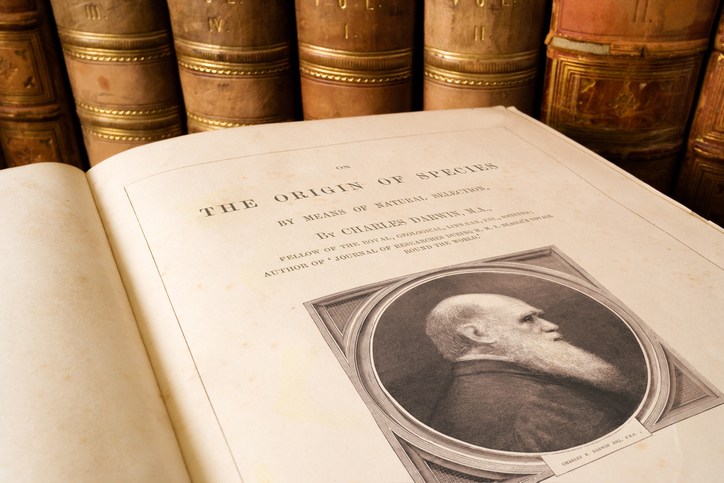
Charles Darwin’s On the Origin of Species appeared 167 years ago this week, in 1859. The same month saw the publication of Bernhard Riemann’s notoriously intractable conjecture about prime numbers, which now appears, with AI’s help, to have been proved.
Darwin’s book landed on ground that had been shifting for 70 years. James Hutton had pulled the foundations out from under the idea that the world was 6,000 years old. That figure hadn’t been thoughtless; it came from summing the ages described in the Bible, and much of ancient history seemed to fit. But Hutton, staring at the geology of Scotland, found himself gazing into what came to be called ‘deep time’ and concluding the world was unimaginably old:
The result, therefore, of our present enquiry is, that we find no vestige of a beginning – no prospect of an end.
Haunted by time, Tennyson spoke for his age when he looked on his own bereavement – the death of his closest friend, Arthur Hallam – and then on the fossils in cliffs and quarries. He despaired at a world careless not only of individuals but even of species, of genera: ‘A thousand types are gone: / I care for nothing, all shall go.’
We are seeing marvels emerge from the accumulation of tiny changes in data centres
Darwin’s Origin put forward a mechanism by which species might change, that of natural selection. That all species had a common ancestor had already been suggested by his grandfather, Erasmus Darwin, whose poetry on biology and on the outrageously polyamorous love lives of plants had enchanted and shocked his readers at the turn of the 18th and 19th centuries.
Victorians were dismayed to discover they were related to other animals; we still have mixed feelings about how much we have in common. Darwin gave us no reason to believe intelligence had reached its limits in us. Small changes summed together, his book argued, create unimaginable consequences. Seashells end up on the top of the Himalayas or get crushed in tropical seas and make the stone that builds Cotswold homes.

Inherited traits flourish when they confer reproductive advantages. That simple principle yields complex results. Sexual competition produces love and civilisation, art and technology and beauty: it produces creatures who value other qualities above sex. ‘I could not love thee (Dear) so much, / Lov’d I not Honour more,’ wrote the cavalier soldier Richard Lovelace.
But the principle that made Lovelace write his poem to Lucasta also made Ichneumonidae, parasitic wasps, whose larvae prey on their hosts by slowly eating them alive from within. And they preyed on the minds of the age too. In a letter Darwin cited them – alongside cats playing with mice – as reasons to doubt that a benevolent God designed Creation’s particulars. Too much that happened was too cruel.
‘I feel most deeply that the whole subject is too profound for the human intellect,’ Darwin continued. ‘A dog might as well speculate on the mind of Newton.’ I have thought much the same watching my cats study doors – they understand normal door handles but, no matter how they try, cannot figure out doors that slide. I see no reason to believe I have the capacity to understand Creation.
I know computer scientists who believe artificial intelligence cannot exist because it’s nothing more than an algorithm. Their mistake is to forget Darwin. The simplicity of a process tells us little about the limits of what it can produce. The beaks of birds gradually change, and birds with them. Worm casts remodel fields. Man – noble in reason, infinite in faculty, in action like an angel and in apprehension like a god – is a quintessence of dust and time.
We are seeing marvels emerge from the accumulation of tiny changes in data centres. I have to take it on trust (which is different from faith) that the Riemann hypothesis has been proved. Even professional mathematicians, who cannot have read the 17 million lines of code, have needed computers to verify it – and verification is different from understanding.
Anthropic’s mathematician Levent Alpöge spent weeks working with the AI and found that ‘Claude far outpaced me near the finish line’. He wrote that it was natural to feel this as an end, ‘in my case a loss of a principal guiding light,’ but he also saw in it a dawn. AI will solve more problems currently beyond us. Soon AI will solve problems whose answers we cannot understand even with its help. After that, perhaps, it will solve problems whose questions we cannot fathom. Already we are sitting in front of our own sliding doors.
The earth is not 6,000 years old, and it orbits the sun rather than the other way around. Much of our thought is unconscious; our capacities are the result of tiny changes put together over stretches of time we can hardly conceive of. These realisations diminished our sense of importance. We must get used to not being the cleverest things on earth. Intelligence is not the measure of all we value, and our unimportance, except to each other, is no bad thing to discover. Our loves are still worth pursuing, our tragedies no less keen, and that the world rolls on regardless is cruel but also comforting.
Darwin ended his Origin in the present tense:
There is grandeur in this view of life, with its several powers, having been originally breathed into a few forms or into one; and that, whilst this planet has gone cycling on according to the fixed law of gravity, from so simple a beginning endless forms most beautiful and most wonderful have been, and are being, evolved.



Comments