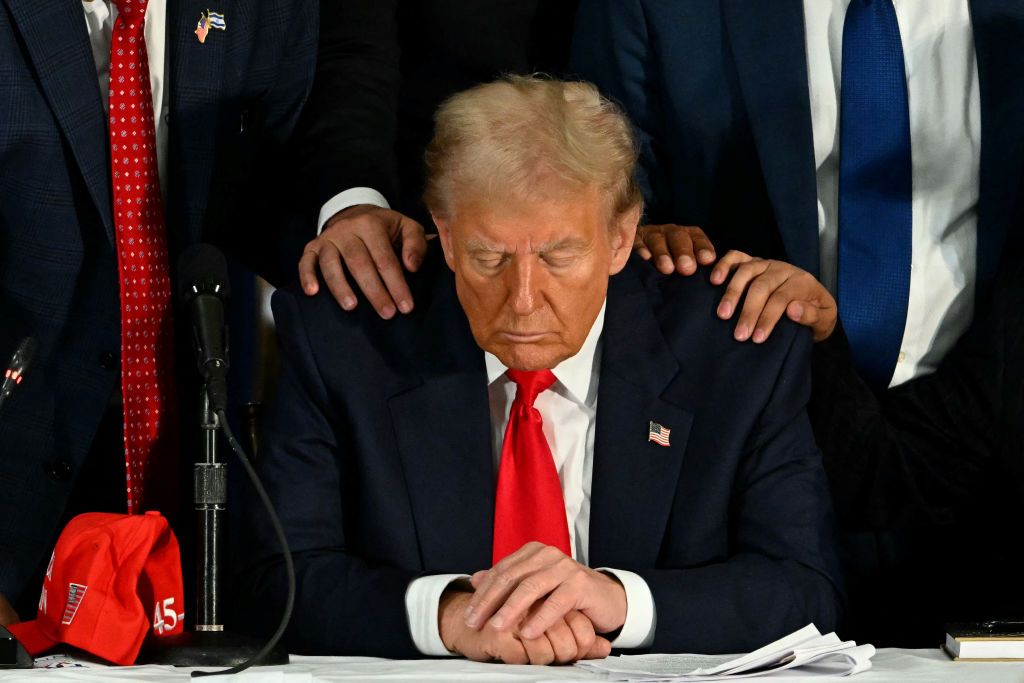
Two years ago, before Donald Trump was re-elected, I was asked to write a foreword for a book called Esoteric Trumpism. The title was a Groyperous wink at the doctrine of “esoteric Hitlerism,” which was developed mainly by the Chilean occultist Miguel Serrano and the French-Greek former Nazi spy Maximiani Portas, otherwise known as Savitri Devi. Serrano and Devi both believed Adolf Hitler to be an avatar, a divine figure sent to earth to free the Aryan race from the Kali Yuga, the long dark age that precedes a new golden age in Hindu cosmology.
Bonkers, I know – and that’s before we even get on to Hitler’s escape to Antarctica at the end of World War II or the secret Nazi base on the dark side of the moon.
But Esoteric Trumpism at least had a serious point. There really is something about Trump that defies rational explanation.
Like the Wagogo chief whose struggle with nature embodies the life of the tribe, so Trump himself embodies the American Dream
Trump’s critics flatter themselves by calling him “Orange Hitler” or likening him to Caesar. These comparisons function as little more than a pat on the back for those who make them – we’re the good guys, we’re on the right side of history. Perhaps they also justify whatever extraordinary measures are needed to get rid of him, including the one I like to call the “Brutus Option,” for obvious reasons.
In truth, though, these people fail to consider what it might actually mean for America to be returning to a more primitive kind of politics, where charisma and something ineffable, something beyond the scope of business-as-usual, determine the rise and fall of leaders.
The great anthropologist James G. Frazer, in his masterwork The Golden Bough, described how the very first kings in history were powerful sorcerers. These men emerged from the mass of tribal societies, distinguishing themselves from the other tribal elders by their unique ability to command the weather and ensure the good will of the ancestral spirits.
“Among the Wagogo of East Africa,” Frazer explains, “the main power of the chiefs… is derived from their art of rain-making. If a chief cannot make rain himself, he must procure it from some one who can.” In Melanesia, the southwestern Pacific Ocean, the tribal chief has exclusive contact with terrifying spirits and ghosts, whose favour only his intercession can secure.
In trying to understand Trump, it helps to think of him as a kind of sorcerer king. Just like the Wagogo chief whose struggle with nature embodies the life of the tribe, so Trump himself embodies the American Dream and the struggle to prevent its death. Trump is brash, bold and vulgar, possessed of overweening ambition and a refusal to quit; he hates his enemies, and will stop at nothing to beat them. His hair is spun gold.
Trump also has had a lot of luck, an almost preternatural ability to succeed when the odds are stacked against him. That luck was most on display at Butler, Pennsylvania, during the election campaign. He turned his head – to look at a chart of immigration statistics, by Jove – altering the course of an assassin’s bullet by millimetres and American history by a far wider margin.
Unsurprisingly, Trump and many of his followers interpreted Butler as a miracle, a mandate from heaven for his second term.
And that taps into a kind of sympathetic magic which links Trump to his supporters, who believe his financial and romantic successes will be replicated for them. They repeat his incantations, principally “Make America Great Again,” while others – “covfefe”? – remain opaque.
One of Frazer’s most important insights is that these sorcerer kings occupy a transitional state, somewhere between the primitive gerontocracy and a fully developed monarchy.
Sorcerer kings only remain in power so long as their magic continues to work for the benefit of the tribe. Their rule is unstable. No principle of divine right or heredity preserves them or ensures a succession.
And so the sorcerer king just as easily becomes the sacrificial king, whom the tribe must throw off to regain their fortune. The fall may be even faster, even more spectacular, than the rise.
The midterm defeat was brutal. So were the reactions to it. Even Trump’s most blindly loyal adherents, the so-called “plan trusters,” who believe Trump’s every move to be part of an intricate game of 4,000-dimensional chess beyond the comprehension of mere mortals, have abandoned him in droves.
In his post-election interview with Ross Douthat for 60 Minutes, Trump came off as contrite but also unsure, plaintive even, suggesting he would “love” to make a deal with the Democrats on immigration, even though immigration barely registered as an issue during the election.
Many interpreted this as a call for amnesty and a betrayal of the central pledge of the divine mandate of Butler: “the largest mass deportation operation in American history.”
Trump never said the A-word, but the mere hint is enough to send America First patriots into paroxysms of rage.
What can Trump do? Come January, renewed persecution by the Democrats may very well be his best friend, providing a fresh opportunity to mog his enemies with style and turn the tables on them, as he always seems to do.
But Trump will also have to demonstrate that the old magic remains in other ways. That means results. Like a Melanesian Big Man, Trump has always promised his supporters an unceasing flow of triumphs – “We’re gonna win so much, you may get tired of winning,” he famously said in 2016 – but now, with a hostile Congress and allies turning on him, victories may prove hard to come by.
The deportations, certainly, must increase, and the cost of living has to fall. Americans need to feel prosperous again. But then there’s Iran, a djinn even the world’s most powerful sorcerer king will have trouble putting back in the bottle.





Comments