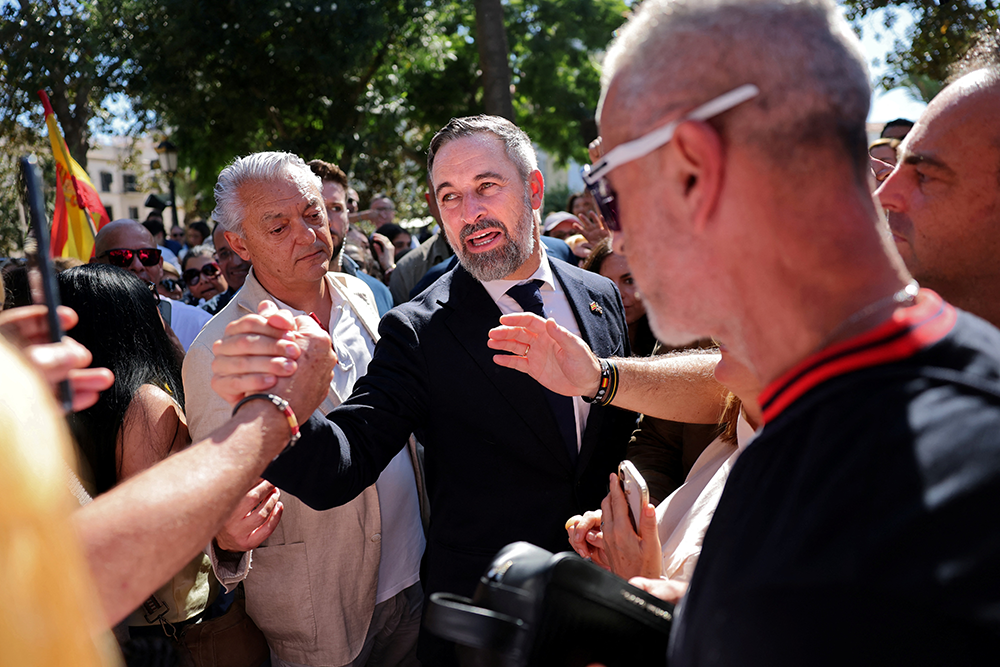
Good-looking and always smartly dressed, Vito Quiles sports a wristband with the red and gold of the Spanish flag. It is ubiquitous among Vox supporters. He has made a name for himself in Spain by supposedly reporting on the hate figures for the far-right: migrants, housing rights protestors, students and far-left leaders. He confronts these figures to create provocative content online.
Quiles, who has 1.5 million followers on Instagram, is part of a small but growing number of right-wing agitators who are attracting young people to Vox, a far-right party which less than a decade ago was regarded as a political joke.

When Spaniards vote in a snap election on 29 November, however, polls predict that Vox may form part of a coalition government with the centre-right People’s Party (PP), heralding a return of the far-right for the first time since the death of the Spanish dictator General Franco in 1975.
Vox could be about to capitalise on the wave of support for the populist right sweeping Europe, from Reform in the UK, to the National Rally in France, Alternative for Germany and the Brothers of Italy, which leads the country’s coalition government.
The party, which is led by Santiago Abascal and has adopted green as its colour to show support for the Spanish countryside, including traditions such as bullfighting, shares many of the policies of Reform: it is anti-migration, anti-European Union, nationalist and aligned with President Donald Trump and the MAGA movement. It distances itself from Franco, though, at least superficially.
Formed in 2013 by disillusioned elements of the PP, Vox was in the political wilderness for years, its members regarded as crazies. I attended an early meeting in a hotel in Barcelona where the number of people could have been counted on two hands. In 2017, all this changed when Spain was torn apart following an attempt by Catalan separatists to declare independence. It caused the country’s biggest political crisis since a failed military coup in 1981.
Vox’s virulently pro-Spanish rhetoric captured the popular imagination. Here were the first signs that it was a political party with something to say on the national stage. At the November 2019 election, its anti-migration, anti-separatist policies won it 52 seats and it became the third biggest party in Spanish politics. Now, as Spaniards prepare to vote, a series of polls have shown the PP (which is closest in political terms to the Conservatives in the UK) will fail to win enough support to rule alone and will depend on Vox to govern. Spaniards who have spent 50 years trying to come to terms with the last far-right leader to rule the country now seem to accept that Vox may be needed to rid the country of the Socialist Prime Minister Pedro Sanchez and his left-wing government.
A series of corruption scandals which have enveloped Sanchez’s family and former close aides, his perceived mishandling of the migration crisis this summer, when more than 70,000 people crossed the border from Morocco into the Spanish exclave of Ceuta, and an amnesty law for Catalan separatists which still infuriates many Spaniards, has persuaded many voters that change is needed. Rising immigration in Spain, promoted by the current government, means that in a country with a population of nearly 50 million, one in five was born outside its borders. Vox’s rhetoric against ‘invaders who steal Spaniards’ jobs’ is winning voters.
Two polls published last week showed that Vox is the only party to have risen in popularity since the 2023 election. A survey for El Pais newspaper projected that it would double its seats from 33 to 66 in the 350-seat lower house of the Spanish parliament. Meanwhile, the PP would lose seats, falling from its current number of 137 to 132. The Socialists would show a similar dip, from 121 to 112. Smaller far-left parties and regional nationalists in the Basque Country and Catalonia would not show any gains. Both parties of the right together would clinch 198 seats, above the 176-seat threshold needed to form a parliamentary majority. Another poll for El Confidencial, an online newspaper, showed a similar result, with Vox again the only party to record significant gains. The survey gives 200 parliamentary seats to the PP and Vox.
Vox’s rhetoric against ‘invaders who steal Spaniards’ jobs’ is winning voters
So who are the voters propelling Spain into the hands of the far-right once again? Mostly they are young people who were born long after Franco died and whose only knowledge of the dictatorship is what they have learned in school. Part of the secret of Vox’s success is that it targets young people on social media. ‘In 2015, 2016, we noticed that only 21 per cent of the Spanish population – especially young people – used conventional media to get information,’ Jose Antonio Fuster, the party’s national spokesman, says. ‘That number has grown extraordinarily. Now almost 40 to 45 per cent use social media exclusively to get informed.’ Just as Trump adopted X and then Truth Social to communicate, Fuster prefers to use social media posts to get the message out.
Apart from party videos, Fuster says that the likes of Vito Quiles and other young influencers also help to draw voters to Vox. Steven Forti, who teaches contemporary history at the Autonomous University of Barcelona and has studied far-right movements, finds that young men and, increasingly, young women are preparing to vote for Vox for the first time, but says ‘it seems that Vox is rising in support among all age groups. And they are stronger among lower income groups.’
He says the reason for this is that ‘the right is hyper-mobilised and hyper-radicalised. All recent studies show us that voters prefer the real thing to copies. So on the issue of immigration, people think “Why vote for the PP, which says it will close the borders [to migrants], when Vox has been talking about this for a long time?”’
Forti adds: ‘The apocalyptic rhetoric about Sanchez, branded a “communist dictator” by some leaders of the PP, has only strengthened Vox.’ He says Vox avoids drawing comparisons with Franco by playing ‘dog-whistle politics’. Vox leader Abascal once told the Spanish parliament that Sanchez’s left-wing government was the worst ‘for the past 80 years’ – thereby implying the Franco dictatorship was better. ‘You do not make an explicit reference to the dictatorship,’ says Forti. ‘Vox is like other far-right parties in that respect.’
Miquel Ramos, a Spanish journalist who specialises in European far-right parties, says Vox has stolen many voters from the PP: ‘Many leaders of the PP are repeating slogans from Vox as the PP has moved to the right. Vox is taking advantage of that.’
In Spain, an increasing number of voters now accept Vox will be part of their future.




Comments