
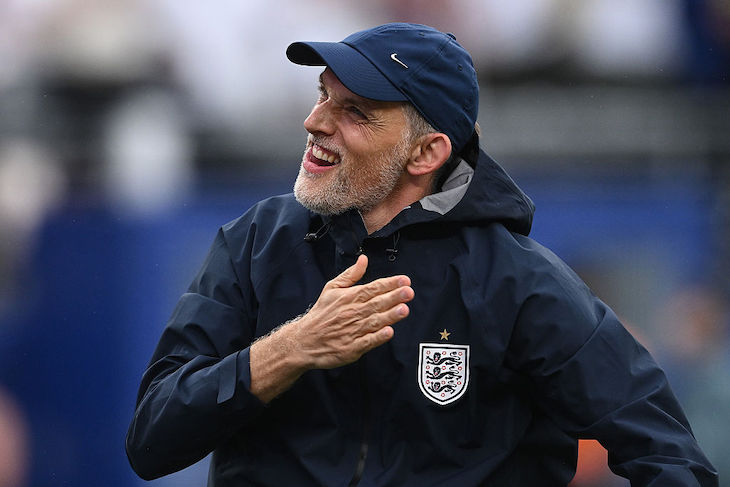
As Pride Month comes to an end, please indulge me in a confession. I think I’m in love with Thomas Tuchel. Obviously, like you, I wish to God he wasn’t a kraut. But that’s only because he’s manager of the England football team. Otherwise, as far as I can tell, he’s perfect. The rock star charisma. The thrilling sturm und drang style of play. Very clearly, he’s a heaven-sent antidote to the touchy-feely corporate torpor of the Sir Gareth Southgate era.
The German is a manager of the national side suddenly in keeping with the times
Is that too harsh on Gareth? Perhaps. As the media narrative that developed quickly around the man never ceased to remind us: Southgate was just a good guy doing his best in a difficult job. In fairness, he was appointed in 2016 just as the nation was commencing a fairly vigorous nervous breakdown occasioned by the result of the Brexit referendum, and then leant astonishing momentum first by the murder of George Floyd and subsequently by the Covid pandemic. It was a deeply weird time and perhaps Southgate’s preternatural blandness was exactly what was needed.
But it was also a very disappointing time for England fans during which we contrived while playing dull football not to win two European Championships – despite by some margin having the best players – and also to crash out of the 2022 World Cup at the hands of France in the quarter-finals. When it mattered most, which is to say when there was jeopardy, we played desperately uninspired defensive football.
Southgate’s tenure also coincided almost exactly with the extraordinary era of so-called “corporate purpose”, the decade during which CEOs across Europe and America without shame claimed to be guided by motivations far loftier – and indeed more deeply rooted in social justice – than the accumulation of mere lucre for themselves and for shareholders.
During this period, these same CEOs attempted as one to rush to fill the void left by the decline of Christianity in the West by ceaselessly weighing in as quasi-spiritual leaders on the important issues of the day: climate change, for example, or the extent to which black lives matter, or whether women can have penises.

Gareth certainly wasn’t above this sort of thing. Do you remember his own corporate-purpose-style statement – the assertion that winning isn’t the only thing – issued in his toe-curling Dear England letter to the nation ahead of the 2021 European Championship?
“It’s the players’ duty to interact with the public on matters such as equality, inclusivity and racial justice, while using the power of their voices to help put debates on the table, raise awareness and educate… The reality is that the result is just a small part of it. When England play there’s much more at stake than that.” Please.
Naturally, it was under Southgate’s tenure the England team took to making performative displays of obeisance to the demands of the Black Lives Matter movement by kneeling on the field ahead of kick off, no matter how volubly the paying fans in the stands booed.
Rainbow laces and armbands were likewise worn to demonstrate support for the LGBTQIA+ coalition – that is, until authorities in Qatar announced any player caught making such gestures at the last World Cup would be penalised.
Blessedly, times have changed. The people of the UK are heartily sick of wokery and the self-sustaining mania for whining about so-called intersectional hierarchies of grievance. This is why, for example, corporate support for Pride Month has gone off a cliff, with organisers this year complaining that three quarters of planned events have seen sponsorships slashed. Businesses still taking part are doing so much less conspicuously, too, with a more than 90 per cent decline in self-congratulatory social media posts since 2023. For what it’s worth, it’s also why, in a less direct manner, the achingly liberal poseur Gary Lineker was defenestrated as the face of the game on the UK’s state broadcaster, but I digress.
Perhaps it’s a stretch to say that the coming of Tuchel was a reward from the football gods for this type of progress, but certainly the German is a manager of the national side suddenly in keeping with the times.
I experienced my first flutter of adoration for him in 2022 when as manager of Chelsea he wouldn’t accept Tottenham manager Antonio Conte’s impolite refusal to look him in the eye during a cursory post-match handshake. Tuchel yanked the Italian’s hand as he tried to walk away, spinning Conte around to face him. Hello, I thought.
Tuchel doesn’t care for precisely the kind of social niceties upon which a grievance culture is built, which is to say he is not overly bothered by what people think. His stellar club career – Chelsea, Paris Saint-Germain, Bayern Munich – is punctuated whenever he felt his values were compromised by bust ups both with star players and his bosses. Chelsea chairman Todd Boehly said Tuchel was a “nightmare” to deal with, and PSG sporting director Leonardo demanded the German learn to “respect the people above him.”
Shortly after taking the England job last year, Tuchel very publicly admonished star player Jude Bellingham for his preening arrogance on the pitch, rightly branding it “repulsive”. Isn’t this precisely the kind of stern leadership the nation’s feckless youth are crying out for? Enough of the welfare carrot. Time for some old fashioned stick.
Refreshingly, from the get go, Tuchel has said he has no interest in using his position to crowbar himself into national conversations unrelated to football. “I think we have the best chance if you allow the head coach to focus on football…Maybe I can hide a little bit behind not being English and not talking about everything that happens in your country.” He’s also said he believes football teams at tournaments have the right “not to be a political statement.”
Most importantly, as least for those of us hoping England perform well this summer, is that it’s abundantly obvious watching him speak that Tuchel is incredibly bright – indeed, a playful intelligence seems to crackle off him as he talks. This is a new tactic, I believe, at least in my four decades of watching the national team: appointing a manager who is cleverer and more cunning than the opposition’s. I suspect it will work, not least because all precedent says it will.
‘The good guys, they never win’, was the theory put forward by Jose Mourinho, a man who would know. Gareth Southgate – who tried at all times to please everyone – proved him right. Tuchel is something new: a new leader for a new era, on the pitch and across the nation. Bring it home, Thomas.





Comments