
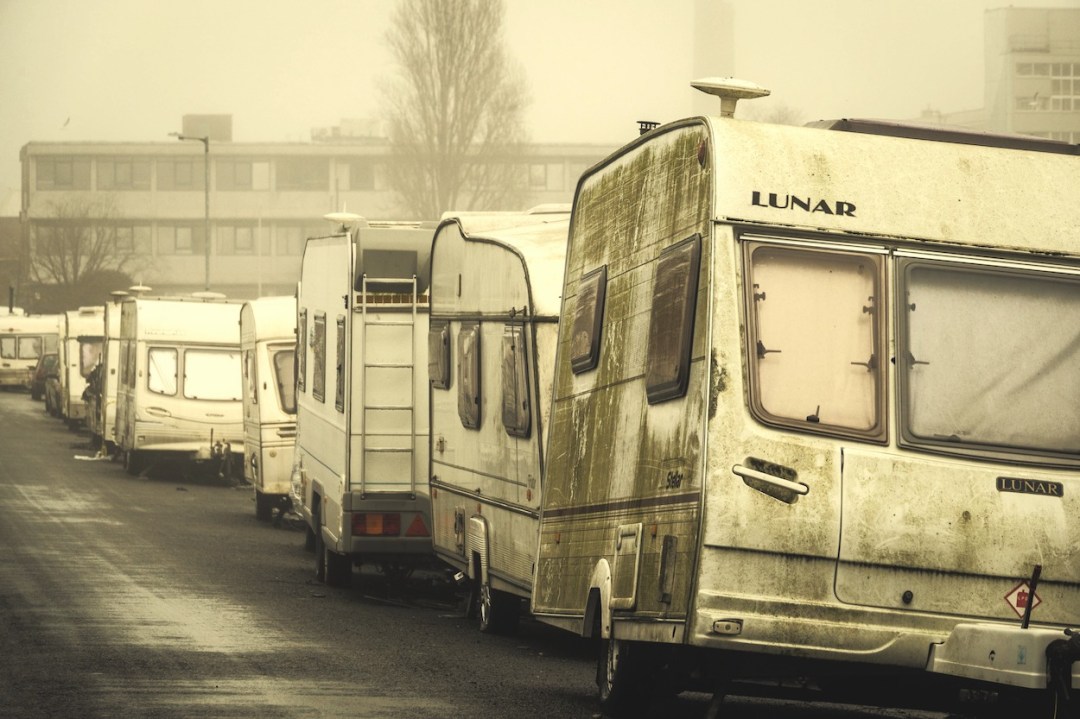
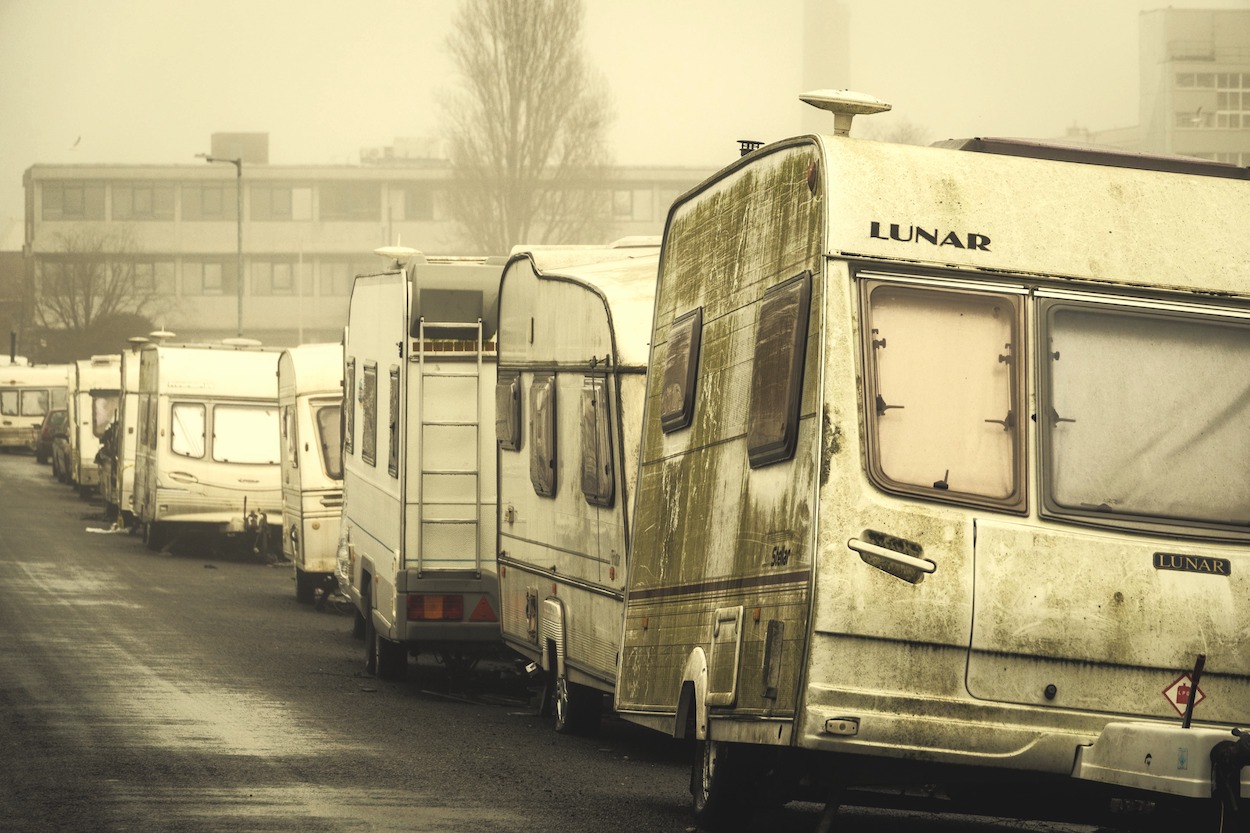
Four weeks since a caravan was torched on Goodneston Road in north-east Bristol, and still no one has bothered to clear the debris. The black carcass of the caravan remains, dressed with yellow tape reading ‘CRIME SCENE DO NOT CROSS’ and sitting among expired syringes, used laughing gas canisters, a shopping trolley of indiscriminate electrics, and unmarked bottles of off-coloured liquids. The caravans settled on this street some time ago. They brought drugs and left faeces on the pavement and made many local people unhappy. Police think the fire was started deliberately. By luck, nobody died.
In Bristol, caravans are everywhere. They squat on residential roads and outside parks and under bridges and right in the city centre. Bristol Council says it knows of 800 van dwellers, but everyone here thinks there are more. Usually the occupants are people with jobs who cannot afford rent, which rose by 7.5 per cent last year and in expense is second only to London. Other times the vans are homes for waylaid people, seeking shelter from the storms of life.

After the fire on Goodneston Road, the Green-led council successfully applied for a court order to clear the van dwellers from the area. On 19 January, a document was stuck on all the nearby caravans’ doors, requesting the occupants leave within seven days. Failure to comply could result in legal action, so now everyone is off. It is through this cat-and-mouse game that the council manages its caravan problem. Vans show up; businesses and residents get annoyed; perhaps a van gets burnt; the council asks them to move; they go elsewhere. The problem is never solved, just shuffled.
Last year, Bristol Council secured an order for caravans to vacate the Clifton Downs, a nice part of town. Soon that order will run out, and the council will have to reapply for another, with all the political and legal bureaucracy that entails. In August, the occupants of caravans on New Stadium Road, on the approach to an Ikea a couple of miles from Goodneston Road, were told by Bristol Magistrates’ Court to leave. That was fine by them. They just moved onto the adjacent streets.
Marlow, 26, works for a renewable energy firm and lives happily in his van about 50 metres from the banned zone on New Stadium Road. ‘I don’t wanna be paying a grand a month in rent,’ he told me. ‘You know, I’ve got so much more disposable income. I can spend my money going climbing. I can spend my money going to indoor skate parks. I eat really well. I’m having good food every day because I can afford it. I can park wherever I want. My job is remote. So it just makes sense, you know. Just like, park up, do my job wherever. A lot of people just get into the fucking rent trap nowadays and they can’t save any money. They’re stuck just not saving anything and spending years of their life renting. I need progress. I need to be putting money away. I need a future.’
Marlow seemed posh. He had long hair and a lisp and told me he was from Stroud. We spoke about the homeless people he lives around. ‘They sell a lot of drugs,’ he said. ‘You often get people asking you “Where can I buy crystal?” and shit like that. You just ignore them, you know.’ Bristol’s housing crisis has forced an odd communion between people on the way up like Marlow, who will probably have a nice house and family of his own in Stroud one day, and people whose lives are slipping away, for whom a caravan is the last stop before the streets.
By an Aldi on Petherbridge Way, a 10-minute drive from the centre of Bristol, I met Luke, who was four months out of prison, he didn’t say what for. Luke told me he used to live in a caravan on this road, but after he did his time he found it taken over by crackheads. ‘I had brought it from a junker,’ he said. ‘I gutted it and made it wicked. Copper fittings. It was really cool. Done some good carpentry on that. And they trashed it. Graffitied all the wood up. The door was hanging off. My home it was. They nicked everything.’
Bristol’s housing crisis has forced an odd communion between people
Luke said he had come back to the Aldi to see if anyone would sell him their caravan. There were 20 in a row opposite the shop’s car park. He had brought a friend with him who looked pale and unwell and didn’t talk and kept eyeing up the generators on the back of the people’s vans. One of the occupants saw him. ‘They’re very dirty,’ Samuel, 29, said to me when Luke and his friend had left. ‘They watch my generator.’ Samuel was from Brazil. He had come to Britain on a tourist visa and had a child while over here and now he was trying to get permanent residency. ‘I used to live by Ikea on New Stadium Road. I used to live there for two years,’ he said. ‘I love this van because I have everything.’
The council’s latest fix for Bristol’s caravan problem is ‘meanwhile sites’. Local politicians want to open up bits of land that are awaiting development and move caravans into them. They’re gated areas, so there’s probably less risk of arson. The council says the sites will house 250 vans by spring, but that ambition is a long way off. Two weeks ago, a site opened up for 14 caravans in Lockleaze, a working class area in Bristol’s suburbs. It is already full.





Comments