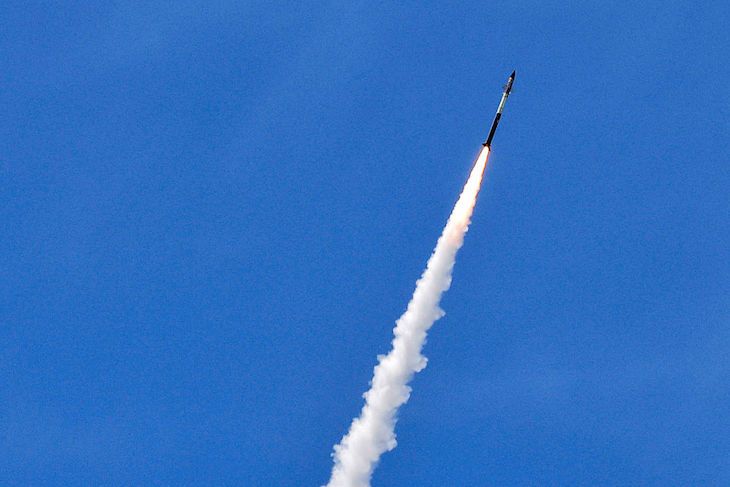
When Donald Trump announced with great bombast his plan for an American ‘Golden Dome’, he promised an all-encompassing shield that would neutralise all incoming aerial threats. It remains no more than a grand political concept. Yet Kemi Badenoch appears to be taking a leaf out of his book. The Conservative leader is proposing investment of up to £10 billion over ten years in an integrated air and missile defence system dubbed “Britannia Shield”.
Finland has put ideology aside and has acquired Israel’s David’s Sling system
Badenoch is entirely right to sound the alarm over the state of the UK’s defence. Britain is badly exposed. Though the Conservative party cannot escape blame after holding power for fifteen of the past seventeen years, the reality of the threat is undeniable.
Russia issued an explicit warning in August that Britain’s continued military support for Ukraine would carry grave consequences. The former Russian Deputy Foreign Minister Andrei Fedorov claimed Moscow has the “full right” to strike the UK because it supplies drones to Ukraine. Recent reports on a potential Iranian drone attack on aircraft and U.S. forces at the RAF Fairford air base and the attacks on Leipzig airport underscore the urgency of the need for Britain to counter the growing threat of long-range missile and drone attacks.
Labour’s plans to defend Britain from missile attack are woefully insufficient to meet the threat. Yet high-stakes political theatre is a diversion. Badenoch is not the UK’s leader. The present Labour government must move beyond token missile defence allocations and the opposition should offer workable solutions rather than grand rhetoric.
The Liberal Democrats have described Badenoch’s plan as “fantasy economics”, ironically echoing the scepticism of her heroine Margaret Thatcher who reacted with alarm to President Reagan’s Strategic Defense Initiative (SDI) – the space-based missile defence dubbed ‘Star Wars.’ When Thatcher met with Reagan at Camp David in December 1984, she asked him point blank, “is there any such thing as a perfect defence?” She was not convinced of the need to deploy such a system, particularly if it could eventually be knocked out by other technological advances.

Thatcher feared that Reagan’s SDI would undermine deterrence based upon the threat of nuclear retaliation. She told Reagan that these technological advances threatened superpower crisis management. Even after the collapse of the Soviet Union, many European countries were unenthusiastic about President George W. Bush’s plans to deploy missile defences on European soil. They doubted their feasibility and were particularly concerned about the damaging impact on arms control. They were also anxious that U.S. deployment without European agreement would leave them vulnerable to missile threats and blackmail.
Today, these longstanding concerns and doubts have vanished. For decades, Moscow claimed that Nato’s missile defence system overseen by successive U.S. administrations was a Western plot to nullify Russia’s nuclear deterrent. By invading Ukraine to halt what he claimed was Nato’s expansion, Russia’s president Vladimir Putin guaranteed the exact opposite: he pushed the Europeans to overcome their previous doubts and fears over missile defence.
Yet the concerns voiced by Thatcher and other European leaders in decades past have not lost their substance. There is no such thing as a hermetic missile defence system, and interceptor missiles are infinitely more costly than the offensive missiles they target. Badenoch acknowledged on the BBC that she is not trying to emulate Israel’s defence system, noting: “We are designing something specific for the kind of threat that we face here.” However, as General Sir Richard Barrons told MPs on the Commons defence select committee earlier this year, the true cost of even a minimal missile defence system could easily reach £80 billion over ten years.
Even partial missile defence coverage has strategic value as long as one accepts its inherent limitations. Israeli strategists have long wrestled with the dilemma of prioritising the location of defence systems. Should they be deployed largely in civilian areas or around military installations? Badenoch has spoken about the importance of protecting critical national infrastructure. In a situation of war, the protection of military bases and vital infrastructure will inevitably be prioritised over population centres. Yet even limited coverage introduces uncertainty for an adversary, raising the threshold of conflict.
Paradoxically, it is the famously uncharismatic governments in Berlin and Helsinki that are quietly getting it right. The Germans and Finns have simply gone out and bought proven off-the-shelf defence systems, most notably from Israel, with minimal political hoopla and maximum speed. The former German Chancellor Olaf Scholz was a deeply uncharismatic leader, yet he showed vision and prescience in taking the lead with the purchase of Israel’s Arrow 3 and the European Sky Shield. In his eyes, the risk of triggering a new arms race with Moscow was far less dangerous than remaining entirely vulnerable to Russian blackmail.
The case of Finland is even more intriguing. Despite standing with Britain along with seven other countries in supporting sanctions against Israel ‘s West Bank settlements in September, it simultaneously quietly extended a ten-year major defence cooperation agreement with Israel. Facing an increasingly aggressive Russian neighbour and drone incursions, Finland has put ideology aside and has acquired Israel’s David’s Sling system, developing a multi-layered air defence shield.
Britain must follow their example. It does need high concept “domes”. It just needs to buy what works today and follow the quiet pragmatists.





Comments