
When the Alternative for Germany (AfD) condemned America’s strikes against the Iranian regime last week, the reaction in Washington must have been one of genuine confusion. For months, perhaps years, the party had presented itself as the natural German ally of the Trump movement. AfD politicians travelled to Washington; Alice Weidel was warmly received and endorsed by J.D. Vance at last year’s Munich Security Conference.
In Maga world, the AfD was increasingly spoken of as Germany’s conservative insurgency – a mirror image of how Trump sees his so-called revolt against liberal elites. Then came the first real test.
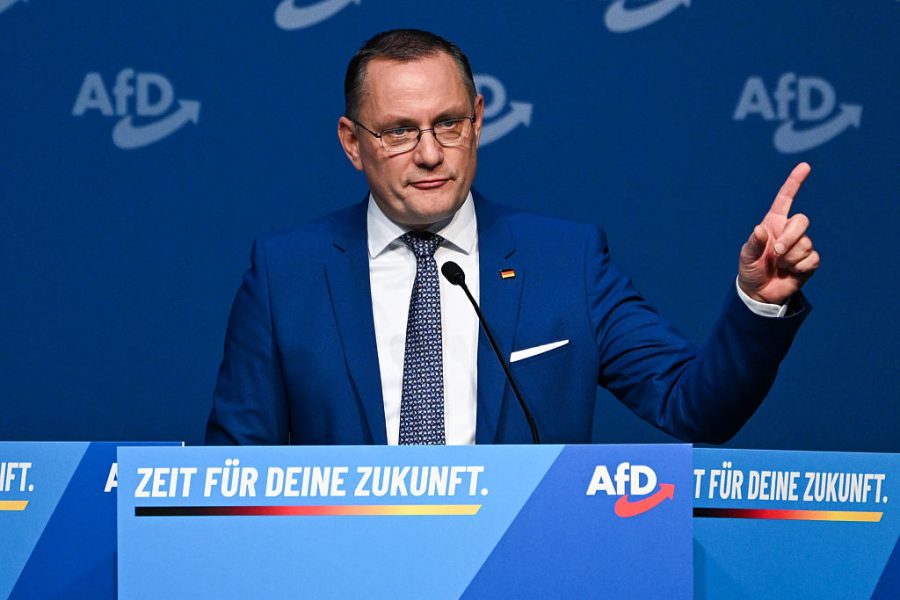
Tino Chrupalla, the AfD’s co-chairman, declared last week that Donald Trump had ‘started as a president of peace’ but risked becoming a ‘president of war’. The party leadership lamented the ‘renewed destabilisation of the Middle East’. Iran itself barely appeared in their statements. Tehran’s regime – sponsor of militias, builder of missiles, murderer of dissidents – was treated almost as a background detail. The real villain, once again, was Washington.
The more radical fringes of the German right still speak openly of Germany as an ‘occupied country’
In Republican circles the reaction bordered on disbelief. Had this not been the party that courted the American right? Had its leaders not spent years presenting themselves as ideological cousins of Maga? Yet the truth is that the real mystery is not the AfD’s position. It is that anyone in Washington found it surprising.
The AfD’s response to the Iran strikes was almost identical to that of Sahra Wagenknecht’s far-left alliance. Both condemned the attack. Both called for German neutrality. Both framed the United States as the aggressor. Both avoided describing the Iranian regime as the problem. Germany’s political extremes had once again arrived at exactly the same place – and their statements could have been written by the same person.
The far-left’s anti-Americanism is familiar. It stems from its close ties to Moscow and from the Cold War peace movement, the protests against Pershing missiles in the 1980s and the demonstrations against the Iraq war. In that worldview, the United States appears less as an ally than as the engine of global capitalism and military intervention.
What is less widely understood abroad is that the German far-right harbours its own, equally deep suspicion of America. For some nationalists, the defeat of 1945 was not merely a military catastrophe but the beginning of a political order imposed from the outside. The Federal Republic, in this interpretation, was not entirely a sovereign rebirth but an American creation. Nato, American military bases and the cultural influence of the United States are therefore seen not as the pillars of stability but as signs of continued dependency.
The more radical fringes of the German right still speak openly of Germany as an ‘occupied country’. In their imagination, the United States is not an ally but the architect of a system designed to restrain German sovereignty.
There is also a deeper ideological tension. The United States is, after all, a civic nation. Its identity rests on a constitution and a set of ideals rather than ethnicity. It is an immigrant society by design. For ethno-nationalists, this concept of nationhood is profoundly alien.
They may admire American power or even particular American politicians. But the American system itself – diverse, pluralistic and universalist – contradicts the core assumptions of their worldview. The flirtation between the AfD and the American right therefore always contained a certain illusion.
One of the architects of this transatlantic courtship was Markus Frohnmaier, the young AfD Bundestag member who has spent years cultivating links with American conservatives. Frohnmaier travelled frequently to the United States and presented himself as a bridge between the AfD and the Maga movement. Within the party, he became one of the strongest advocates of closer ties with Republican circles.
To many Americans, this seemed natural. Here was a politician who criticised mass immigration, progressive ideology and bureaucratic supranationalism. The parallels with Trump’s rhetoric appeared obvious. But those similarities were always superficial.
For the AfD, this relationship with Washington served a very practical purpose. The party remains ostracised within Germany’s political system and faces increasing scrutiny from domestic intelligence services. Parts of the party are already under surveillance. In political circles there are periodic discussions about whether it could one day be banned altogether.
Cultivating sympathy in Washington therefore offered a kind of political insurance. If the White House appeared friendly towards the AfD, it would become far harder for the German state to move decisively against it. Maximilian Krah once revealed this logic with unusual candour when he spoke of using American ‘foreign policy pressure’ to ‘blackmail’ the German government into leaving the party alone.
The remark was striking, but it exposed the calculation clearly. The relationship with Washington was not about shared values. It was a tactical instrument.
The Iran strikes have now revealed the limits of that strategy. When confronted with an actual consequential American decision, the AfD reverted immediately to a familiar reflex: suspicion of American power. Its rhetoric was almost indistinguishable from the radical left. Both camps warned of escalation. Both framed Washington as reckless. Both insisted Germany should distance itself from its closest ally.
The irony is that the most pro-American voice in Germany during the crisis was the man the AfD has spent months attacking as a supposed Atlanticist puppet: Friedrich Merz. The Chancellor defended the American strikes and described Tehran as a ‘terrorist regime’. More striking still was the sentence he delivered shortly afterwards:
Legal classifications under international law will achieve relatively little – especially when they largely remain without consequences.
For a German leader to speak so bluntly about the limits of international law was not merely unusual, but historic. Germany’s political culture has long treated such questions with near-religious seriousness. Yet Merz was acknowledging something obvious: that alliances and power remain the foundations of international order.
The AfD’s response was predictable. Merz was accused of ‘pathetic submission’ and described as a ‘US vassal’. The language could easily have come from Wagenknecht – or from a Kremlin press release.
The lesson for American conservatives is uncomfortable but important. Ideological kinship cannot be assumed from a shared antipathy to immigration or progressive politics. The roots of European populism are tangled in history, and in Germany they draw nourishment from soil that is profoundly hostile to the American project.
The AfD’s anti-Americanism is not a bug; it is a feature – one it shares with the very far-left movements that American conservatives most despise. Germany’s political horseshoe is a reminder that the most reliable allies are not always the loudest populists but the quiet institutionalists who understand that the Western alliance, for all its imperfections, remains the best arrangement available.
In Berlin, that man turned out to be Friedrich Merz. The Trump administration would do well to take note.




Comments