In politics, there has always been an assumption held by atheists, humanists and many liberals in general that those of a modern, secular persuasion act with autonomy and reason because they are unencumbered by religious belief. They believe themselves in possession of an intellect that needs no external crutch or sanction. While this enables them to achieve objective detachment, those who cling to religion can never attain such a refined plateau of enlightenment: their convictions are indelibly shaped and clouded by religious dogma.
The accusation levelled at ‘religious people who have their own beliefs’ appears to assume that only religious types have peculiar beliefs
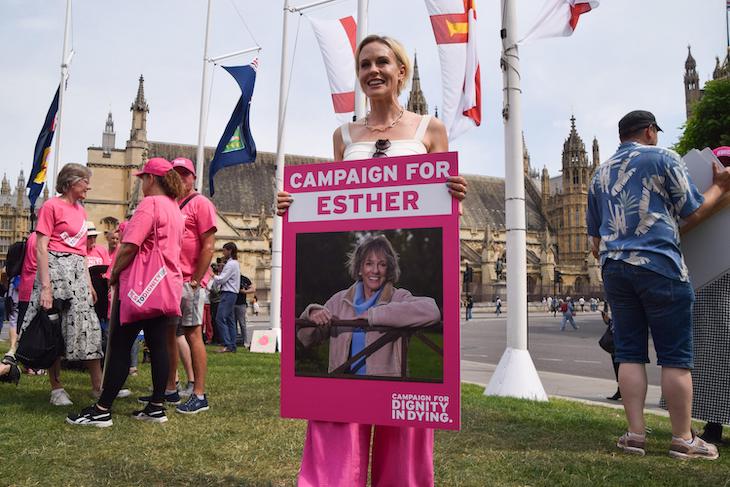
This assumption has been unmistakeably lurking in the assisted dying bill debate, discernible among those who have been scarcely unable to suppress their annoyance at campaigners whose opposition to euthanasia has been informed by their religious convictions. You sense their seething indignation at those who fall back on their own belief in a deity in order to halt the passing of legislation which could affect the lives of millions of people, millions who don’t share their frankly baseless belief system.
You could sense it once more yesterday, as it came to pass that the bill would most likely fail in the House of Lords. As Dame Esther Rantzen, who has led the charge for the legalisation of assisted dying, told Sky News in response to this likelihood: ‘It was always difficult because there were always lobbyists – particularly, I think, religious people who have their own beliefs.’
Sometimes just a few words say so much. The accusation levelled at ‘religious people who have their own beliefs’ appears to assume that only religious types have peculiar beliefs, implying also that ‘religious people’ are an odd, outlier sub-section of society beholden to skewered thinking.
Yet there is no such thing as pure autonomy or absolute objectivity when it comes to human judgements or politics. Indeed, that’s the very essence of the democratic process: we perpetually argue and discuss points of contention because nobody knows for sure what is right and who is right. And everyone is partial. Even the hallowed, mythical ‘centre ground’ is not where it was twenty or thirty years ago. This shifting place is not even where the establishment presumes it to be right now – the public are more to the right on social issues than it thinks. The centre never holds.
Irrespective of our metaphysical persuasion, everyone holds subjective beliefs and prejudices, many of them without question and most of them the inheritance of our culture and environment. Even the language we speak, the language of our internal monologue, isn’t of our own invention.
No-one is as robustly independently in their thoughts and opinions as they would like to believe. ‘You’re only saying that because you were brought up a Catholic’ is a charge a liberal friend used to make against me years back when we clashed over abortion – which is perhaps true, even though I’m a non-believer. It’s only now, in the l’esprit de l’escalier, that I would reply to her: ‘You’re only saying that because you were brought up a humanist by a mum who was a feminist’. We are all brought up with culturally and temporally-specific values imbued in us by others.
‘Religious people’ aren’t unusual or strange in this respect. No-one’s political views are formed without external influence or without the hand of history, not least secular humanism, which was the child of the French Enlightenment, and found expression in various forms in the writings of J. S. Mill, Auguste Comte and Karl Marx.
Indeed, these last two figures remind us how secularism is far from being neutral, and, instead the product of a particular culture and at a particular time: a Christian civilisation that emerged in Europe. Comte was infamous for propounding a ‘religion of humanity’ that would supplant a Christian creed that was no longer fit for purpose, while Marxism’s comical dependence on Christian theology and teleology is legendary – replete with its own holy book, prophets, belief in progress and promise of a future heaven for all the meek of mankind.
Comte and Marx may have been extreme examples, but the Enlightenment in its entirety was no less the product of its setting. As the late Larry Siedentop wrote in Inventing the Individual: The Origins of Western Liberalism (2014) the very concept of individualism, wholly alien to all cultures through space and time, was conceived first by Christianity.
Enlightenment secularism took from this inheritance ‘the firm belief that to be human means being a rational and moral agent… It puts a premium on conscience rather than the blind following of rules.’ Even Immanuel Kant, the man whose thinking is the acme of clinical rationalism, devised a doctrine, the Categorical Imperative, barely distinguishable from the fundamental tenet of Christianity: do unto others as you would have them do unto you.
So yes, religious people ‘have their own beliefs’. But so does everyone.


Comments