
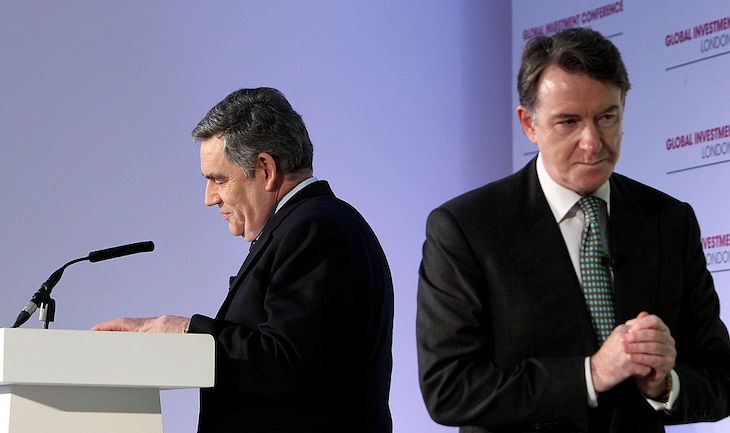
Peter Mandelson may just have achieved the impossible. He has made me feel sorry for Gordon Brown. When I was a lobby correspondent in the 2000s, I spent a great deal of time covering Brown, first as chancellor, then as prime minister. I did not emerge from the experience with a particularly warm impression of the man. He was thin-skinned, prickly, self-righteous and often very, very angry. He is not, as his public image sometimes suggests, a cuddly saint. Many colleagues would take a similar view.
Brown – a sensitive man, always quick to detect a slight, real or imagined – came to believe that he had been the victim of betrayal and conspiracy
And yet, as I reflect on the revelations about the way Mandelson behaved while serving in Brown’s government – and on the way he privately wrote about Brown during that period – it is hard not to feel some sympathy for even the former prime minister.
To understand why, you have to go back to the early days of New Labour. Brown and Mandelson were once, if not close friends, then certainly close colleagues. A bond formed between them as they, alongside Tony Blair and Philip Gould, helped to create what became known as New Labour. It was an intense, conspiratorial political partnership, forged in late nights and long days and sustained by a shared sense of mission. It is no coincidence that both men have their demons – they are brittle characters, psychologically fragile in a way that the supernaturally robust Blair could never be. They are all too human; like all truly consequential leaders, Blair’s psyche borders on the superhuman.
Then came the great fissure. Mandelson backed Blair for the leadership and Brown – a sensitive man, always quick to detect a slight, real or imagined – came to believe that he had been the victim of betrayal and conspiracy, a belief that is a recurring feature of his worldview. A gulf opened between Brown and Mandelson that endured for more than a decade.
That is what makes the events of 2008 so striking. By then Brown was prime minister and in serious trouble. His young government was faltering, authority draining away. And in a dramatic, almost theatrical gesture, Brown reached out to Mandelson – then a European Commissioner – and asked him to return. Come back. Be part of my government. Save me.
Mandelson’s return, as the de facto deputy prime minister, probably did keep Brown’s premiership afloat for a time. But the psychological cost Brown had to pay to make that approach should not be underestimated. This was an enormous gesture for an enormously proud man like Brown to make – a gamble with his own emotional equilibrium. To trust Mandelson again required him to suppress old grievances, deep suspicions and a sense of historic injury that had never really healed. In other words, to go against the fundamentals of his own personality.
Why he did so is an open question. Critics would say it was to save his own skin. Brown’s admirers – they still exist – would say it was just more proof of what he was prepared to sacrifice for public service and the national interest.
But the result was a government that was psychologically fraught from the outset: two dominant figures bound together by necessity and history, but never fully trusting one another. Brown needed Mandelson’s political skills; Mandelson needed Brown’s authority. Each depended on the other, but the relationship rested on foundations that were fragile at best.
That, then, is the background to Brown’s – I think genuine and heartfelt – bellow of rage on learning of Mandelson’s behaviour during that period. Not just the leaking and briefing, but the personal nature of it: the insinuations, the character judgements, the attempt to portray Brown not merely as difficult or flawed, but as somehow unbalanced.
For a man like Brown, who extends trust not through warmth but through action, that is not simply a political betrayal. It is a personal one. And whatever one thinks of Gordon Brown, that is a pain he did not deserve.
This is, of course, an offence of a far lesser magnitude than consorting with a convicted child sex-offender – knowing that Mandelson was so cosy with Epstein after his first conviction remains the greatest stain on his name.
But those of us who had front-row seats for the New Labour psychodrama, Mandelson’s final, appalling betrayal of Brown means this whole dreadful affair has an especially bitter aftertaste.



Comments