On March 6, 1959, nine-year-old Candice “Candy” Rogers of Spokane, Washington, went out after school to sell campfire mints door-to-door. Sweet-natured with strawberry blonde curls and a button nose, she was small for her age. Her mother, Elaine, had one clear rule that Candy must be home before dark. But Candy never came home. Her disappearance triggered a 16-day manhunt involving thousands of people, the Marines and the US Air Force. In fact, three airmen lost their lives on the second day when their helicopter hit high tension cables and plummeted into the Spokane River.
After two weeks of searching for Candy, all detectives could find were her scattered mint boxes. Then a pair of children’s shoes was found leading to the discovery of Candy’s body hidden under pine needles and brush in a wooded area of Northwest Spokane County, seven miles from her home. It was a crime so heinous that hardened cops found it hard to talk about what they had seen. The autopsy revealed that Candy had been savagely raped and strangled with her slip. Her killer was never found.
Over six decades, the baton of solving Candy’s case was handed down to the next generation of detectives. Sergeant Zac Storment, a Spokane police detective who worked on the cold case, said this was a case not “measured in hours” but “measured in careers.” Despite leads, suspects and even DNA testing in 2001, it remained “the Mount Everest of cold cases” – until Othram, the pioneering Texan forensic genomics lab, cracked it in 2021 and identified Candy’s killer.
Othram just might be the most important science lab no one has really heard of. Founded in 2018, Othram is the brainchild of a husband-and-wife team of geneticists, David and Kristen Mittelman. David and Kristen (née Sykoudis) met as students at Baylor College of Medicine in Houston, Texas, in the 2000s. A quarter of a century later, these science “soul mates” have a big family, a big science laboratory and an even bigger mission: to crack cold cases, identify human remains, give families closure and stop serial killers in their tracks.
I heard about Othram from their first investor, John Burbank, and was intrigued by the story of their high-tech detective work. When I met the couple around Christmas, in London, I felt like I was meeting celebrities. David wore a baseball cap with the Othram logo, dressed-down in a “Silicon Valley of the South” kind of way. Kristen was glamorous: a Science Barbie, with big eyelashes, glossy makeup and a voice of honeyed bourbon. They don’t look like scientists, they look like the actors playing forensic scientists on CSI. They are also unassuming, warm and serious people.
The name, Othram, comes from The Lord of the Rings and is Elvish for “Fortress” which is apt given Othram’s custom-built laboratory in a specially designed district known as The Woodlands, “a hotbed for biotech and engineering companies” just north of Houston, Texas.
The case of Candy Rogers is one of thousands of investigations that Othram has assisted in. The company has tackled some of the most high profile and “unsolvable” cold cases in America: identifying perpetrators and victims known as UHRs (unidentified human remains), such as Evelyn Colon, a teenager from New Jersey who was found dismembered in suitcases along with her unborn daughter in Pennsylvania in 1976. Othram also successfully identified Septic Tank Sam, Delta Dawn, victims of Hurricane Katrina, as well as bones found in a barn wall dating back to an 1881 alleged homicide. In 2022, it was Othram technology that identified psychopath Bryan Kohberger, the Idaho College murderer. It took them weeks, where traditional methods might have taken years or decades.
“In the case of Candy Rogers,” Kristen Mittelman said, “our own daughter was nine years old at the time and Candy’s story brought chills to both of us. We knew we wanted to try to help.” David added, “We have five kids, I love kids and I would want someone to fight for them.”
In 1959, when Candy was murdered, DNA testing did not exist. It was first used in criminal court in the USA in 1987, and in the year 2001 Spokane detectives decided to try DNA testing on Candy’s case. The evidence (semen on her underwear) had, in a stroke of unwitting genius by investigators at the time, been preserved in a glass mason jar.
Scientists were able to pull DNA markers from the evidence and successfully develop a profile. But, frustratingly, there were no matches in CODIS, the FBI’s database of DNA. Traditional DNA testing only works if it matches a DNA profile already on file.
This news was crushing for another reason: every time you test a DNA sample, you essentially destroy it. And for years, because of the fragility of the remaining DNA sample, no other lab would touch Candy’s fragile evidence. The case went cold again for another two decades.
Fast-forward to 2021 and The Golden State Killer has been caught using genealogical DNA evidence. The now-legendary detective on the case, Paul Holes, rang up Sergeant Storment and said, “you need to speak to Othram labs in Texas.” So Sergeant Storment collected Candy’s precious evidence, packaged and shuttled it a nail-biting 2,000 miles from Washington State down to Texas where it arrived intact at Othram.
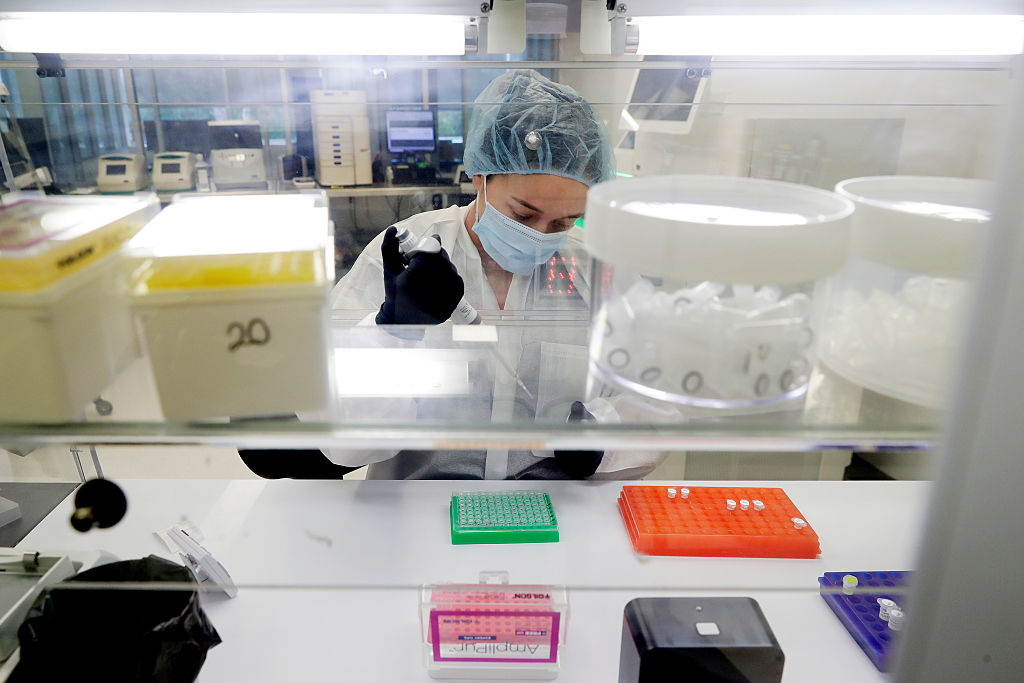
Othram was able to create a SNP profile (like a genetic fingerprint) and this “fingerprint” was uploaded to consenting forensic genealogy databases to identify genetic relatives. It was Labor Day weekend 2021 when Sergeant Storment saw an in-coming call from David Mittelman. “For the CEO of the company to be calling me late on Labor Day weekend, I knew this was a big deal. It was one of those tingly neck moments,” said Storment. They had a match: one of three brothers who had all lived in Spokane, Washington around the time of Candy’s murder. “I think we have the name of Candy Roger’s killer in this group,” reported David. They discovered that all three of the brothers had since died, but one, John Reigh Hoff, a US Army Deserter, had four children. Storment tracked down Hoff’s daughter, Cathie, now aged 59, who agreed to give a cheek swab DNA sample. The case went from stone cold to red hot. Police got a warrant to exhume John Reigh Hoff’s body (which was buried just yards from Candy) in order to be sure that his DNA matched the one from the crime scene. It did.
Without Othram’s tech it’s unlikely the case would ever have been solved. At no point in the history of this cold case had John Reigh Hoff’s name ever been on the list of suspects. In 1971, aged 31, he shot himself when his own daughter, Cathie, was nine. At a packed police conference held in Spokane in 2021, the news was announced. One 93-year-old man was visibly emotional. He was the young detective who discovered the little girl’s body, quietly adding, “I waited every single day my entire life to hear this answer.”
The Candy Rogers case was a turning point for Othram. As David Mittelman said, “Sadly, cases like Candy’s are not anomalies. We work hundreds of cases where answers are available but they simply were not given the benefit of modern forensic DNA technology which is frustrating because we’ve demonstrated that regardless of the circumstances, if there’s an unsolved crime and there’s DNA evidence, there’s an answer that’s waiting.”
Othram’s unique approach is three-fold: all casework is handled in-house, they are able to pull and repair DNA from challenging forensic samples and instead of needing an exact DNA match they can infer kinship in closely and distantly related individuals through genealogy. Othram has developed two (patented) testing methods for this: FGGS® (Forensic-Grade Genome Sequencing®) which gets genetic information from forensic evidence that is too challenging for other lab methods because the DNA samples are degraded (either in terms of quality or quantity); and KinSNP® Rapid Familial Relationship Testing.
So how does DNA testing work? If you hold up your naked hand and touch the arm of the person nearest you, you will leave hundreds of cells on them. This is called touch DNA. There’s also semen, bodily fluids, bones and more. If you want to upload your DNA to AncestryDNA or 23andMe you will take a clean swab to the inside of your mouth, seal it up and send it off. But forensic DNA isn’t like that. It isn’t pristine, as human remains have often been left to the elements, buried, submerged in water, mixed with animal or plant DNA, burned or stripped and damaged by detergents. And from a quantity angle, sometimes a crime scene sample has as little as 15 or even fewer cells.
But Othram has a special weapon, a machine called the Illumina NovaSeq Sequencing System 6000; a high-tech genome sequencer used by many research institutions and diagnostic labs worldwide. “For the last 30 years people have used a technology that can measure 20 data points,” but this NovaSeq machine “can give us between 100,000 to a million data points” said David. The key technology (“sequencing-by-synthesis,” or SBS) behind the machine was developed in the 1990s by two Chemistry professors at the University of Cambridge, Sir Shankar Balasubramanian and Sir David Klenerman. Developed by US-based company Illumina, the NovaSeq 6000 looks like a scanner in your local library except it does ingenious genomics work and retails for around $1,000,000.
Othram built the DNASolves® Genetic Database, a website where ordinary folk can upload their DNA to enrich the genetic library. Unlike commercial DNA sites like AncestryDNA or 23andMe, you cannot voluntarily add your DNA to government databases used for criminal analysis (CODIS in the US or NDNAD in the UK). So, Othram has developed their own database and you can help by uploading your DNA to DNASolves.com.
One case Othram is currently assisting is the chilling case of the Fox Hollow Farm Murders. In 1994, at the 18-acre farm in Indiana, owned by family man Herb Baumeister, his little boy discovered, in their wooded backyard, a human skeleton. When suspicion fell on Herb, he fled to Canada and shot himself. It’s suspected that over a period of a decade in the 1980s and 1990s, while his wife and children were away, he cruised the gay bars in downtown Indianapolis and lured at least 11 teenage boys and men back to his multi-million dollar property, equipped with a swimming pool and murdered them, dissecting and burying their bodies in the woods. Baumeister’s now ex-wife noted that as a college student, Herb was an “eccentric” and used to drive around in a hearse. Red flag? Over 10,000 bone fragments have since been found on the property which Baumeister had turned into a burial ground. Othram has played a key role in the identification of these men, bringing closure to the victims’ families.
Som people have criticised Othram for making a profit. A typical cold case at Othram costs around $10,000 for end-to-end processing of evidence, DNA sequencing and genetic genealogical research. Othram argues they are a private laboratory with around 90 employees and a huge amount of time and money spent on research and development. They have crowdfunding available for cold cases through DNAsolves.com and work with local, state, federal and international law enforcement. When asked why they don’t work with individuals, Kristen answered, “if an individual contacts us to work on a case we always contact law enforcement to follow up but it has to go through state or federal channels to prevent evidence being sequenced that shouldn’t be touched.”
Othram’s founders are frustrated that more governments and police departments worldwide aren’t using the lab’s technology and resources. “In most cases we work, the DNA was always good enough. What was missing was the decision to use the right technology,” David pointed out. Othram is faster, more cost-effective and more precise than traditional DNA testing methods. When I asked the Mittelmans why governments were slow to take up the technology, they said, “it’s not lack of funding, it’s bureaucracy and red tape… forensic genomics is reshaping criminal investigations worldwide and outdated assumptions about DNA still dominate policy and funding decisions. Change to policy could dramatically improve the efficacy and cost-effectiveness of policing. Most cases could be solved if it became a priority.”
Othram is certainly a good news story – a triumph of science over decades of secrecy and savagery. Othram may be named after The Lord of the Rings but what David and Kristen Mittelman are doing is better than J.R.R Tolkien could ever have imagined: this is not fantasy, this is fact, and it’s the future.



Comments