
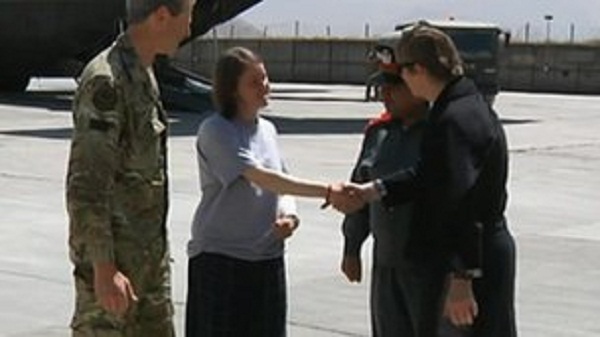
A visibly relieved David Cameron gave a statement outside No. 10 earlier today about the successful rescue of four aid workers from a cave on the Afghan/Tajikistan border, including a Northern Irish aid worker, Helen Johnston. The Prime Minister said he had personally authorized the operation, which must have been some decision given the recent history of such rescues. He praised British troops, and gave a brief mention to American ones for carrying out ‘a related operation’.
But I was struck by the difference in emphasis between Cameron’s video statement and that of the British commander in Kabul, for whom the main point of the rescue was its multinational nature.
Ms Johnston, a 28-year-old nutritionist, was imprisoned with a Kenyan medic, Moragwe Oirere, and two Afghans, all of whom worked for a Swiss charity, Medair. The rescue operation was run by General John R. Allen, the American head of ISAF coalition forces in Afghanistan. American helicopters carried British, American and Afghan troops to the province of Badakhshan, where the hostages were being held in a cave. American soldiers then engaged the Taliban in battle, while British troops converged on the caves and liberated the hostages. Speaking in Kabul this morning, Lt Gen Adrian Bradshaw, the ISAF no2, singled out the Afghan interior ministry for thanks, and said that the operation ‘was well co-ordinated with the Afghan authorities’. He added:
‘I can’t tell you which countries they were from, but I can tell you there were troops from more than one nation involved.’
The ISAF video (here) at the end (1’34) shows the liberated Helen Johnston being welcomed by an Afghan military commander as well as by Lt Gen Bradshaw. Allen said the rescue mission ‘exemplifies our collective and unwavering commitment to defeat the Taliban’.
Having decided to withdraw in two years’ time is not your standard definition of ‘unwavering,’ as Con Coughlin argued recently in The Spectator. The recent murder of two British soldiers by Afghan police shows that the coalition is still far from functional. But today’s successful rescue operation shows that ISAF can get it right, and spectacularly so.


Comments