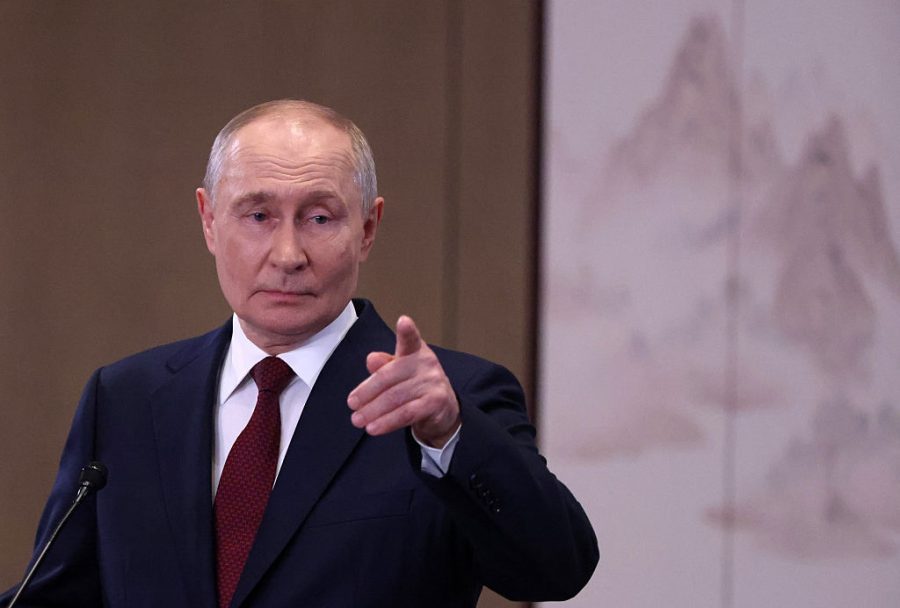
For most of a year Washington’s theory of peace in Ukraine has rested on the comfortable assumption that Vladimir Putin is, at heart, a businessman waiting for the right offer. Steve Witkoff and Jared Kushner have spent months dangling post-war ventures before Moscow in the hope that lucrative normality would soften the Kremlin’s territorial demands. Now, the Financial Times reports, the idea has been shelved and the talks have moved on to territory and security – where Moscow wanted them all along.
Europe, meanwhile, is reaching for a familiar stick. The EU’s proposed 22nd sanctions package is bigger than the 21st without being much different in substance, instead expanding most of its already existing restrictions. The only conspicuous novelties are tighter visa rules for Russians, athletes above all, and, separately, the exclusion of everyone living in Russia from Erasmus+, the EU’s flagship student exchange and scholarship programme.
European politicians cite security needs amid Russia’s increased grey-zone attacks for these new sanctions, but given that most of the attackers have been hired locally in Europe and that historically spies and saboteurs find ways to get through the visa restrictions, the measures look more punitive.
The state of the Russian economy alone will not force Putin to the table
However, it is hard to imagine something better calculated to please the Kremlin than a further tightening of the visa regime for the Russians. Tourists will spending their roubles at home, athletes will not defect as they did in the Cold War, and the government has to worry less about a brain drain or a capital flight.
The Russians most likely to want a semester in Leuven are precisely those who still regard Europe as something other than an enemy camp. Slamming the door on them confirms what state television says every evening: that the West’s quarrel is with Russians. As a propaganda tool, none of it costs the Russian treasury a kopeck.

What would cost it something is a full European ban on maritime services for Russian oil and serious enforcement against the traders and banks that keep the barrels moving, or draconian measures against the re-export of technologies, machines and spare parts to Russia via third countries. But this all still awaits a political consensus that shows no sign of appearing.
Washington has been shyer still to wield this stick, treating sanctions less as a weapon than as small change in a negotiation. The US eased pressure on Russian oil when the Iran war sent prices soaring and, this autumn, after an amiable phone call between Trump and Putin, exempted Russian diesel from sanctions altogether. Each waiver teaches the Kremlin that American penalties are transactional.
The deeper error, shared on both sides of the Atlantic, is the belief that the Russian economy is, or soon will be, in the kind of trouble that obliges Putin to choose between his war and his treasury.
It is certainly in trouble, as the budget for 2027, waved through the Duma on Tuesday with 37 brave abstentions and not a single vote against, makes plain. This year’s federal deficit is expected at 3.2 per cent of GDP, twice the figure written into the budget law, after closing at 2.6 per cent last year against a plan of 0.5. Next year’s target of 2.2 per cent assumes a consolidation the finance ministry has failed to deliver in every year since the invasion. Defence spending, more than a quarter above last year’s plan, will absorb over a third of the budget, and with the security services and police the share reaches 44 per cent.
The bill will be paid, as Russian bills generally are, by ordinary Russians. Having raised VAT to 22 per cent this year, the government is adding a progressive tax on dividends and deposit interest, VAT on goods bought from foreign online retailers and a windfall tax on miners and metallurgists. The rest will be borrowed at home, since no one abroad is lending, pushing state debt beyond the 20 per cent of GDP the finance ministry once treated as a prudent ceiling. While the share is not big compared to Britain’s and other developed countries, the real yield of about 10 per cent makes Russian debt painfully expensive.
Elsewhere the economy is barely moving. Growth this year will be about 1 per cent and civilian manufacturing sits some 5 per cent below its late-2024 peak while the defence plants work extra shifts. Oil revenue is falling as the premium from the Iran war unwinds and Ukrainian attacks on refineries force the Kremlin to import fuel and help oil companies.
State payments to soldiers keep climbing and cannot be trimmed without hurting recruitment. Meanwhile, bad loans are surfacing on bank balance sheets, real incomes are slowing;and prohibitively high rates, technological sanctions and deteriorating property rights prevent business from investing in productivity. Russia is facing years of low growth, high borrowing rates and underinvestment.
This is not economic collapse but rot, which eats into the future without producing the crisis Western capitals keep waiting for. A Russian proverb holds that while the fat one grows thin, the thin one dies, and Moscow reads its war of attrition in exactly those terms: Ukraine’s financing gap, shortage of men and battered energy system, together with Europe’s strained budgets and political fatigue, look to it more acute than its own troubles, and it believes time is on its side.
Moscow can pay for the war for at least another year. Taxes can be raised again, inflation tolerated and state banks leaned upon, with the cost passed to households and savers. With repression and control of the information space at their present levels, the Kremlin also sees little danger of a backlash.
The state of the Russian economy alone, then, will not force Putin to the table, at least not yet; he has made it plain that he is prepared to make ordinary Russians pay for his geopolitical ambitions. For economic pressure to matter, sanctions would have to change strategically, aimed squarely at oil revenue and financial plumbing, and be enforced with a ferocity neither Brussels nor Washington has yet shown. There is, alas, little appetite for that, which leaves the West with new visa rules for figure skaters and Putin with every reason to wait.





Comments