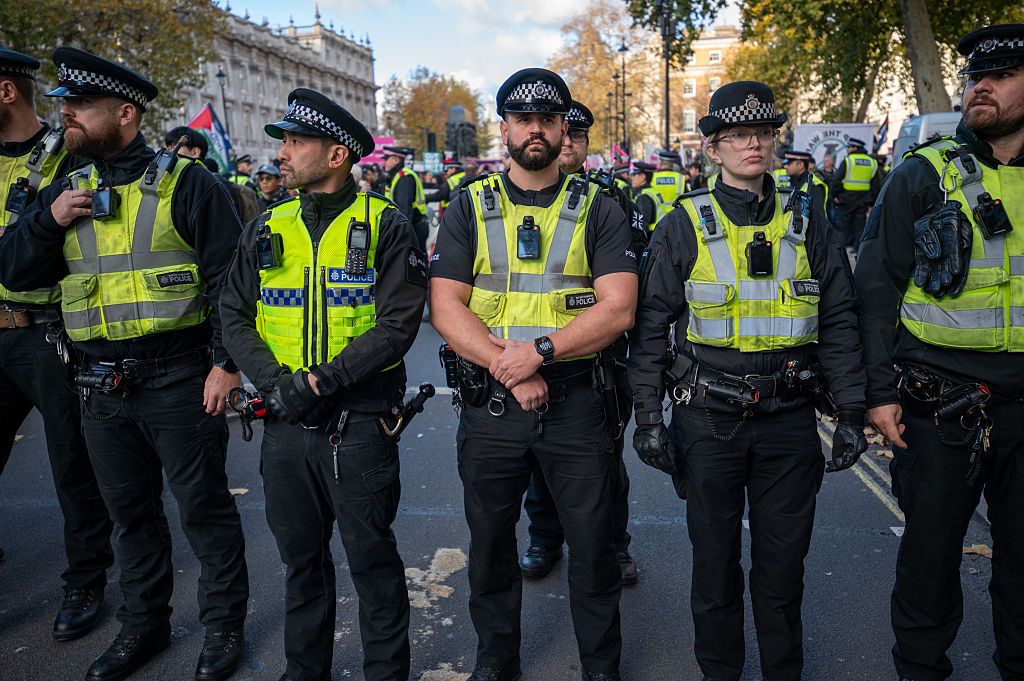
‘The Met is building a healthier and stronger culture.’ That was the Metropolitan Police’s response in March 2023 to an excoriating report by Baroness (Dame Louise) Casey which had been commissioned after the rape, kidnap and murder of Sarah Everard by a serving Met officer. Casey’s report accused Britain’s biggest force of institutional racism, sexism and homophobia and laid bare shocking failings of management, accountability and transparency.
Three-and-a-half years on, the Met’s pledge to turn things around has been forensically examined by another public sector troubleshooter, Dr Gillian Fairfield, a former NHS chief executive. Fairfield’s 389-page review makes for deeply uncomfortable reading. Although Scotland Yard reacted with ‘considerable energy’ to Casey’s findings and has made some progress, says the report, it concludes that the foundations have not been fixed, the organisation remains over-centralised and too defensive, with further scandals ‘highly likely’ to emerge. Systemic problems, particularly around racism, remain.
Casey’s report was so damning it led to calls for the Met to be stripped of some of its responsibilities and broken up. Fairfield’s review will undoubtedly renew that debate, although the question of whether the force is too unwieldy to be managed effectively has wider relevance. It goes to the issue that appears to be paralysing police reform: how many forces do we need and what size should they be?
In January, Shabana Mahmood unveiled a Home Office white paper which contained a proposal to ‘significantly reduce’ the number of forces in England and Wales from the current total, 43. She claimed that the 1960s version of independently run constabularies, each with its own leadership structure, wasted money on procurement and technology, duplicated support functions and delivered a patchy service. ‘That model has been straining for decades, and today it is simply not fit for purpose,’ said the Home Secretary. ‘Some forces are not equipped to handle complex investigations or respond to major incidents.’

Mahmood asked the former Met commissioner, Lord (Sir Bernard) Hogan-Howe, to recommend what the exact number and configuration of forces should be, aware that he had come to the view more than a decade ago that policing would function better with fewer than a dozen forces, not 43. Hogan-Howe’s report, which followed months of analysis and consultations, has not yet been published, despite a promise from Mahmood that it would be completed in the summer so that the government could ‘crack on’ with the reforms. The reason for the delay is twofold.
First, the Home Office is working through the implications of restructuring that under such a radical scenario would see the creation of vast police forces, some with towns 250 miles apart, each formed by merging up to six constabularies. In south-west England, for example, a mega-force would rise from the ashes of the constabularies of Gloucestershire, Wiltshire, Dorset, Avon and Somerset and Devon and Cornwall – from Penzance in the south to Tewkesbury in the north. Similar regional forces would be established in other parts of England, while there would be one force, instead of four, in Wales.
Reorganisation on this scale would be an immense logistical exercise with no guarantee of success. It would be politically risky: the Conservatives and Reform UK are opposed to mergers and opinion surveys suggest the public are sceptical, at best. And it would require between £1 billion and £2 billion in set-up costs.
The second cause of the delay is that the Home Secretary does not have the green light to act from No. 10, because a sweeping programme of police force mergers is directly at odds with Andy Burnham’s ‘re-wiring the state’ mission. The Prime Minister wants to establish at least 30 strategic authorities across England within two years. Regional police forces would be aligned to their boundaries unless there was a ‘strong financial, strategic or operational’ case for them to be bigger, according to the devolution paper he launched in July. Going from 43 forces to around 12 would therefore run counter to Burnham’s agenda, while cutting them down to 30 would hardly be the ‘significant’ reduction the Home Office envisaged.
While discussions rage behind the scenes in Whitehall, they have spilled out into the open among police leaders. A group of the country’s most senior officers, including the heads of the Met and Greater Manchester Police (GMP), have urged ministers to press ahead with mergers, while the majority of police and crime commissioners (PCCs, whose roles are set to be scrapped under the reform programme) have called on the Prime Minister to halt them. ‘There is no evidence, academic or otherwise, that shows that larger forces perform better,’ they said, in a letter to Burnham this month.
The PCCs now have ammunition. The Fairfield review is a powerful reminder of just how challenging it is to run a gigantic force like the Met, whose 46,000 officers and staff are responsible for the safety of more than nine million Londoners and millions more commuters, visitors and tourists. It demonstrates how hard it is – even with experienced leaders, such as Sir Mark Rowley, the present commissioner – to change culture and practices in an organisation with multiple departments. Is it a coincidence that three of the forces placed in ‘special measures’ by His Majesty’s Inspectorate of Constabulary and Fire & Rescue Services (HMICFRS), the policing inspectorate, in the past six years were the three largest? The Met, GMP and West Midlands Police are now off the policing naughty step but it shows how serious problems can arise in huge, complex institutions.
There is of course a persuasive argument that bigger would suit some forces better. The PCCs of Norfolk and Suffolk, for instance, have formally requested a merger, to save money and improve the way they deal with cross-border crime. The two constabularies already pool most of their resources and share IT, and with a single mayor for Norfolk and Suffolk due to be elected in May 2028, there is logic to the idea of an East Anglian amalgamation: one force, one mayor.
An East Midlands force, combining Derbyshire and Nottinghamshire, is not out of the question either, given there’s already one mayor for the two regions, while some smaller constabularies, such as Cleveland, would benefit from joining up with their neighbours, for financial security and operational resilience.
Fairfield says ministers should ‘consider whether there are lessons’ from her review that may ‘inform’ the Home Office’s merger plans. The key lesson, it seems to me, is that manufacturing giant forces would pose a giant risk to policing. Let smaller-scale mergers happen organically, where there’s strong local support, a clear law enforcement purpose and a sound business case. But compelling constabularies to join together so they end up the size of the Met? On the evidence assembled by Fairfield, I don’t think that’s a good idea.





Comments