China is the master of political theater, and the country’s technology capital is the perfect stage for President Xi Jinping to strut and pose. World leaders arriving in Shenzhen today for the APEC summit reportedly will be treated to drone displays, shuttled between venues by driverless electric vehicles and ushered to their seats by humanoid robots. Alongside the copious banquets, they will be served up a diet of platitudes about “building a community with a shared future for mankind” – Communist party speak of a China-centric world.
Enter stage left, a wounded and unpredictable Donald Trump. When he and Xi last met, at the White House in September, the President presided over a summit of almost cringeworthy obsequiousness. Since then, Trump has been defeated in mid-term elections and Jensen Huang, the man who has been at his side during the last two encounters with Xi, is now embroiled in scandal – including accusations that a woman with whom the former Nvidia boss had an affair was a Chinese agent.
Enter stage left, a wounded and unpredictable Donald Trump
On the eve of Trump’s arrival in Shenzhen, the US Commerce Department tightened export restrictions on advanced chips used in artificial intelligence (AI), attempting to close a loophole that has enabled Beijing to access data centers powered by AI chips located in third countries, mostly in southeast Asia. The Commerce Department is also coming under pressure to sanction companies in that region that have allegedly acted as fronts for smuggling advanced chips, including the company Megaspeed, for whom Alice Huang (Jenson Huang’s lover) worked.
The smuggling has been an open secret. This has raised questions about why restrictions were not imposed sooner and the precise role of Alice Huang in the broader smuggling network. Treasury Secretary Scott Bessent reportedly pushed through the new restrictions, having been highly critical of the inaction of Commerce Secretary Howard Lutnick. Lutnick was close to Jensen Huang, who lobbied hard against restrictions on chip exports.
Both Bessent and Lutnick are traveling with Trump, with the atmosphere between them tense to say the least. “They have two different views,” Trump said. “One wants to be friendly with China, and one wants to have a blow-up with China.” The president said he is not considering replacing Lutnick.
The Nvidia scandal threatens to ignite wider tensions with China. Beijing’s Foreign Ministry described the spy claims as a “smear against China,” and yesterday Beijing warned that it would retaliate if the curbs on remote access to chips went ahead, the Ministry of Commerce expressing its “strong dissatisfaction and firm opposition” and threatening “firm countermeasures.” A fragile trade truce is due to expire in January, and an extension will be a key part of bilateral talks between Trump and Xi, scheduled for lunchtime tomorrow.
Under the trade deal, Trump lifted sanctions in exchange for China lifting restrictions on the export of rare earths. But US officials have complained that Beijing, which has a near monopoly over the supply chains of these critical minerals that are vital for high-tech manufacturing, has continued to apply restrictions.
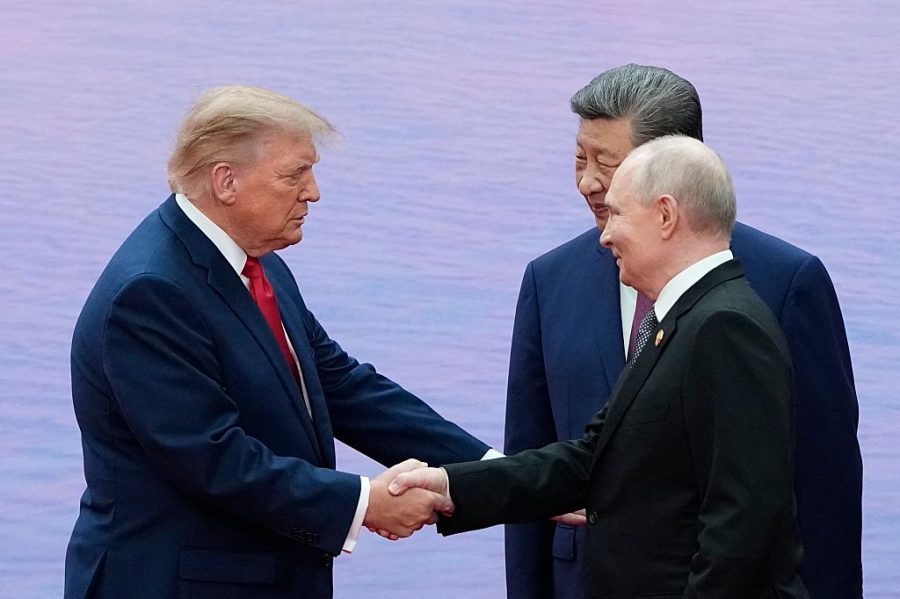
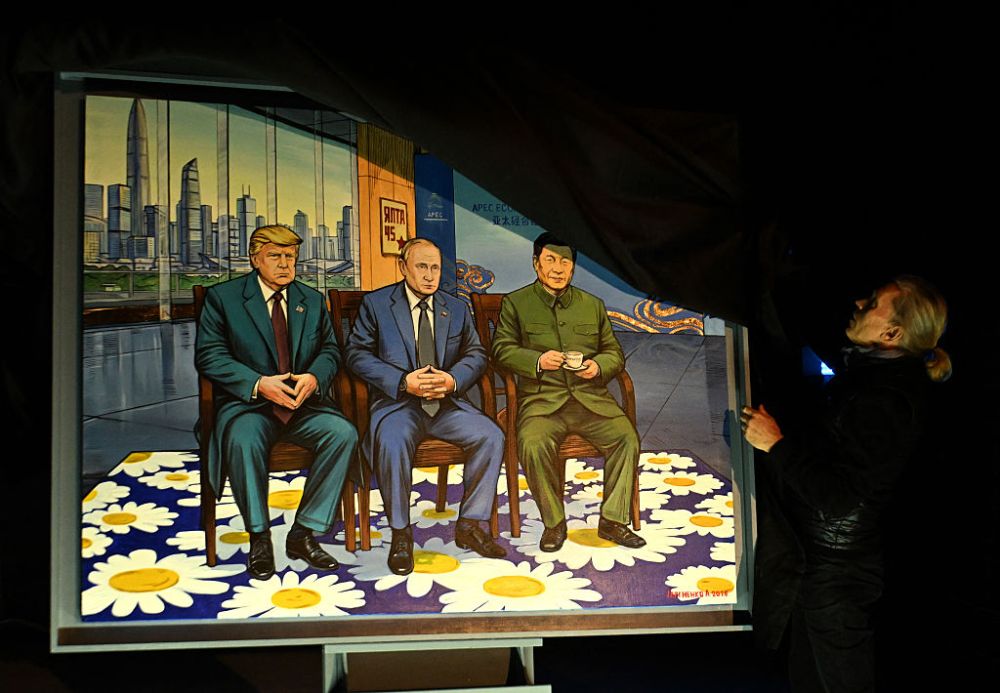
The Trump-Xi bilateral will be followed by a trilateral meeting including Vladimir Putin, which some have dubbed “Yalta 2,” after the 1945 Yalta summit. This brought together the leaders of the US, UK and Soviet Union and divided post-war Europe into spheres of influence, shaping the future of smaller nations without their participation. It’s unlikely to live up to that troubling analogy, which has been encouraged by Russian lawmakers and media, which have described the three-way meeting as a diplomatic victory in itself. But the symbolism of the first such face-to-face meeting is still important – and unsettling.
In the run-up to the trilateral, Beijing has reportedly been pushing for a very tightly scripted affair, with each reading from prepared and approved statements and with very little room for discussion – essentially a glorified photo-op. China has since said that “world peace” and “strategic stability” will be the focus. Yet Ukraine, where Russian aggression is being underwritten by Chinese economic and political support and the supply of dual-use technology, will reportedly not be on the agenda. Trump says he wants to talk about nuclear weapons, but this is unlikely too since Beijing, which is rapidly expanding its nuclear arsenal, has consistently rejected any discussion of nuclear arms control.
US officials will be anxious that Trump does not sign up to any statement referring to their respective “core interests.” Bland as this sounds, it would be seen as an endorsement of Russia’s designs on Ukraine and beyond and China’s dubious claims on Taiwan, which Beijing is always anxious to force onto the agenda in some way, shape or form.
Shenzhen, which sits next to Hong Kong in southern China, is where China’s economic reforms began, a laboratory for paramount leader Deng Xiaoping’s “reform and opening” policy. It was China’s first “special economic zone,” established by Deng in 1980, and offering a degree of economic freedom to investors. Back then it was a sleepy backwater, now it is the country’s leading tech hub. The initial reforms were supervised by Xi Jinping’s father, Xi Zhongxun, and as Xi Jinping has tightened control over China, so he has re-written the narrative, seeking to give greater credit to his father (and himself) – even while rolling back many market and investment-friendly reforms.
Putin was one of the first leaders to arrive in Shenzhen ahead of APEC – and one of the first to meet Xi. The Chinese leader described their relations as “stable as a mountain, unshaken by storms,” according to Xinhua, China’s state news agency. He went on to say that Sino-Russian relations “provided greater stability and certainty to a world fraught with turmoil and upheaval.”
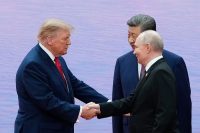
Trump arrived in Shenzhen late this afternoon local time to be greeted on the tarmac by Xi. It is thought to be the first time the Chinese leader has greeted a foreign leader in this way, and mirrored Trump’s actions in Washington. The two men hugged at the foot of the aircraft steps, in what appeared to be a carefully choreographed diplomatic gesture. Then his heavily armored limousine, dubbed “the beast” (3.7 miles per gallon on a good day), swept him into downtown Shenzhen, home of renewables, drones, humanoid robots – and, for 48 hours, to Trump, his battling entourage and a diplomatic obstacle course of unusual complexity.



Comments