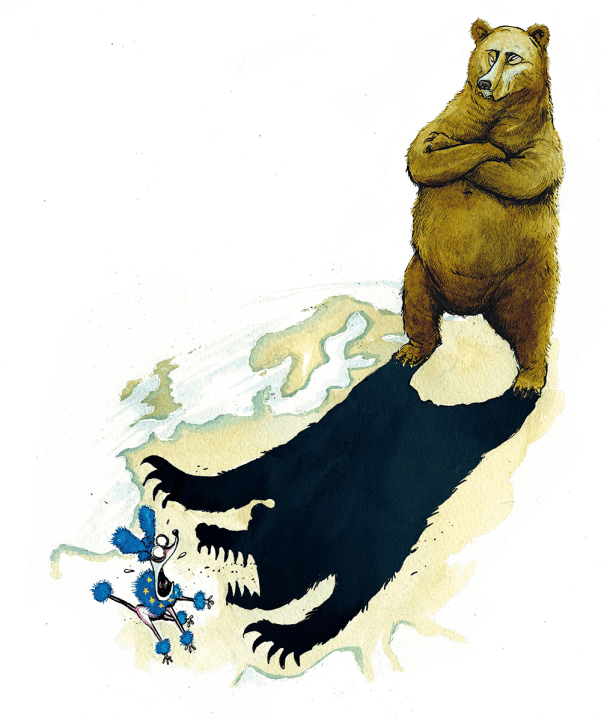
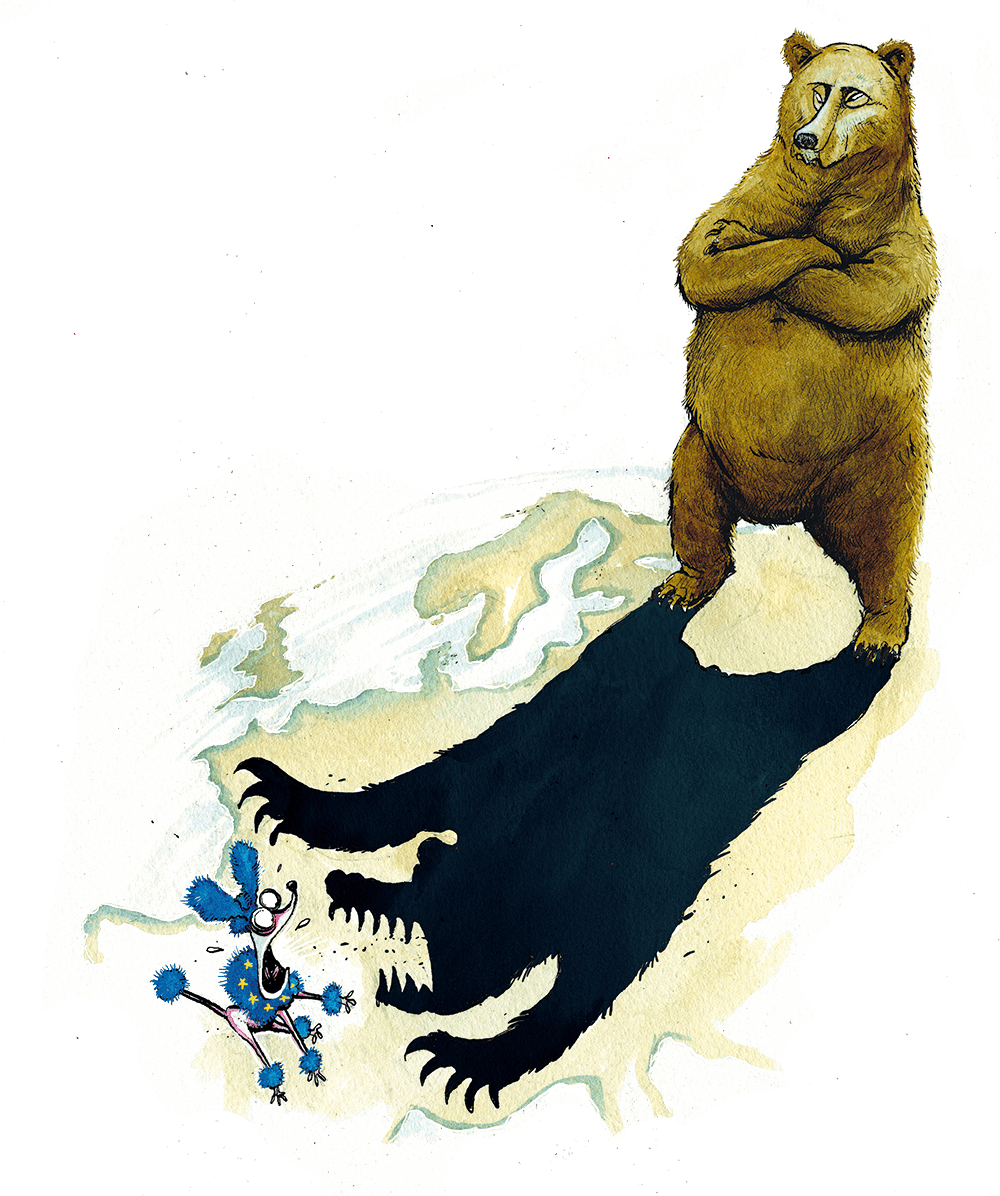
For decades, Britain has, like the rest of Europe, clung to a deluded belief in soft power. Within minutes of being appointed prime minister in May 2010, David Cameron was outside No. 10 declaring that Britain was to become ‘more compassionate abroad’. This was where the new government was heading: soft power was on the up and hard power degraded. The 2010 manifesto pledged to meet the UN target of spending 0.7 per cent of national income on overseas aid by 2013. The government produced a strategic defence and security review that would see defence spending fall by 22 per cent in real terms. Gaps in key capabilities would be tolerated on the assumption that there would be no European war within the next ten years.
Defence capabilities were treated only as potential responses to aggression rather than deterrents to stop it from occurring. As George Kennan, the architect of Cold War containment, noted in his diary in 1949: ‘We are ultimately dependent on the intentions, rather than the capabilities, of the adversary, the influence of which is primarily a political and psychological, not a military, problem.’
Regardless, Britain’s nuclear deterrent was hollowed out and the number of warheads cut by 25 per cent ‘in line with our commitment vigorously to pursue multilateral global disarmament’. Crucially, climate change was treated as a greater security threat than Russia, which was deemed a partner in the great fight against global warming. Britain had checked out of geopolitics.
The worldview informing the review was already hopelessly out of date. In August 2008, Vladimir Putin launched a war against Georgia and seized a fifth of its territory. France’s Nicolas Sarkozy rushed to Moscow on behalf of the EU with a team that, according to one French newspaper, lacked detailed maps of the area, to agree buffer zones and lines of separation that left Russia holding the territory it had seized.
This was the pattern set for the next decade and a half: appeasement to aggressive powers while supposedly saving the world from climate change. Three months after Russia attacked Georgia, parliament passed the Climate Change Act, imposing a commitment on Britain to cut its greenhouse gas emissions by 80 per cent by 2050.
The impact assessment, signed by the then energy secretary Ed Miliband, put the Act’s cost at between £324 billion and £404 billion (excluding transitional costs) and highlighted the intractable free-rider problem of climate policy. If the UK acted, but global emissions continued to rise, the £404 billion to £964 billion of supposed climate benefits would be distributed globally. The legislation, then, was about virtue-signalling. It was, in the words of the assessment, about ‘demonstrating the UK’s leadership’.
The test of leadership is followship. In the 11 years from the Climate Change Act becoming law to the target being raised to 100 per cent (net zero) in 2019, Britain cut its annual carbon dioxide emissions by 180 million tons – a reduction of nearly a third – while the rest of the world increased its emissions by 5,176 million tons. Eleven years of Britain’s emission cuts were being wiped out every 140 days. The Act’s objective of cutting global emissions through ‘leadership’ is comprehensively refuted by the data.
Neither did emissions cuts make Britain and Europe more secure, although they did further debilitate their already weak economies. The greater harm, however, came from the mindset that elevated soft over hard power. The response to Putin’s seizure of Crimea and the start of Russia’s proxy war in 2014 parallels the appeasement of the interwar years, when France, like Ukraine, the victim of aggression, was blamed for being the source of tension. The May 2015 Riga EU Eastern European Partnership declaration noted the ‘illegal annexation’ of Crimea; it failed to identify Russia as the aggressor but stressed the EU’s role in facilitating talks between Russia and Ukraine to underpin ‘the uninterrupted gas flow to Europe’.
Germany and France brokered the Minsk agreements that would have left Ukraine incapable of having an independent foreign policy. An EU paper circulated in January 2016 illustrated the depth of the EU’s delusions: ‘A well-functioning, democratic, and prosperous Ukraine with a vibrant civil society based on the rule of law is indeed the best retort to Russian aggression.’
The pattern was set: appeasement to aggressive powers while supposedly saving the world from climate change
Philip Hammond, then foreign secretary, chimed in to urge Kyiv to fulfil its side of the Minsk agreements to ‘make sure they can look the Russians firmly in the eye’. The one thing that would enable Ukraine to look Russia in the eye – hard power – was not on the table.
In late 2021, as Europe stood on the abyss of war, its diplomats were still obsessing about climate change. At a meeting of the Organisation for Security and Co-operation in Europe (OSCE), the US ambassador, Michael Carpenter, was astonished to find his European colleagues still going on about climate change when ‘all I wanted to talk about was the risk of a full-blown war’.
That December, the OSCE asserted that climate change could ‘negatively affect prosperity, stability and security in the OSCE area’. The conclusion was praised by Britain’s ambassador, Neil Bush, who also spoke of the need to ‘mainstream gender across all dimensions of the OSCE’s work’. The Canadians, however, complained about OSCE’s weak language regarding ‘the disproportionate impact of climate change on women’. Twelve weeks later, Russia launched its full-scale invasion of Ukraine.
In his last interview weeks before his death in June, Sir Alex Younger, who led MI6 for six years, pushed back on the suggestion that Nato’s woes were Donald Trump’s fault. ‘We’ve been huge beneficiaries of an incredibly generous security guarantee from the United States,’ he told the Economist. ‘My strong view is that we’ve actually been infantilised by it.’
He saw Trump’s disruption of the alliance as an occasion to ‘amend our relationship with hard power’ that he thought long overdue. His view was contested by Simon McDonald, who was permanent secretary at the Foreign Office when Younger was leading MI6. In May 2023, after more than a year of Putin’s full-scale war, McDonald told the New Statesman that intrastate conflict mattered less for Britain’s foreign policy than ‘planetary issues’ such as climate change.
Whoever is right, it is a binary choice. The resources consumed in what has proved to be a futile fight against climate change are not available for investing in economic growth and reviving British hard power. It would be a choice to turn Britain into a European version of Costa Rica without the wildlife.
Choices are hard. Making them is part of growing up, for cakeism is also an aspect of infantilisation.
Rupert Darwall’s The Age of Error and the West’s Undoing is out now.




Comments